
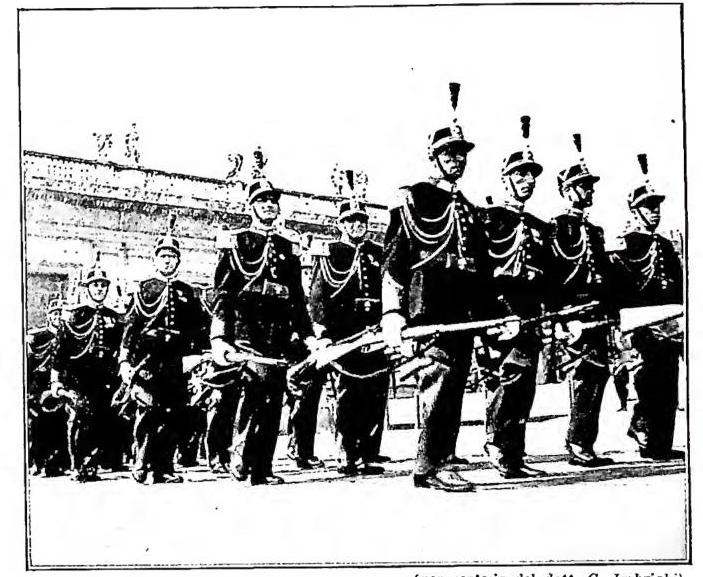
PALATINE GUARD OF HONOR. - It is one of the corps of the pontifical armed forces, an expression of the tribute of fidelity of the Roman people to the supreme pontiff. The institution of the G. p. d'o. was made by Pius IX with a dispatch of the Secretary of State, Card. Antonelli, of 14 Dec. 1850, which came into force on 1 Jan. 1851. With this dispatch the first constitutive regulation of the G. p. d'o. was officially issued, resulting from the fusion of the Urban Militia of the Roman people and the Chosen Civic Guard, which were suppressed. The G. p. d'o. was reformed by the same Pius IX with another dispatch of 7 Sept. 1859 and with a disciplinary regulation of 28 Dec. 1859, issued by the Secretariat of State. Another dispatch of the Secretariat of State remitted, under date of 17 Oct. 1829, to the commander of the G. p. d'o. the organic reform and the modifications of the regulations in force, which, approved by Leo XIII, were to come into force on 1 Jan. 1893. The regulation currently in force, which came into force on 1 Jan. 1935, was approved by Pius XI on 31 Dec. 1934 and remitted to the corps with a dispatch of Card. Pacelli, Secretary of State.
The G. p. d'o. is composed of officers, appointed by the sovereign (one reaches the rank of officer by passing through all the lower ranks), distinguished into three categories: on active service, in attendance (who perform only occasional service assigned by the Command), and in retirement; there is then the troop, which in turn comprises: an adjutant non-commissioned officer (who has the duty of standard-bearer), non-commissioned officers (marshals and sergeants), corporals, effective guards (of company and of depot) and cadet guards. The G. p. d'o., now divided into two battalions (although the regulation still provides for only one), has a total strength of about 500 men, including the colonel commanding and the officers, among whom are the chaplain with the rank of major or lieutenant colonel and the vice-chaplain with the rank of captain. All the members of the corps must be born or resident in Rome. The general staff of the G. p. d'o. is part of the pontifical family (v.).
The appointment of the commander (who may also be chosen from outside the corps) and the promotion of officers are made with the sovereign's consent. The appointments of the guards are made by the cardinal Secretary of State and after they have taken the prescribed oath.
The G. p. d'o. depends directly on the cardinal Secretary of State, is destined for the service of the supreme pontiff and takes its place in the antechamber, after the noble guard, with a picket of 6 guards under the command of a sergeant or a corporal. The officer on duty occupies instead another hall, together with the officer of the Swiss Guard. The G. p. d'o. performs service at pontifical functions and in the pontifical chapel with a detachment proportionate to the place it is to occupy. For such services it is at the disposal of the master of the chamber.
During the period of sede vacante it is at the disposal of the cardinal camerlengo and of the marshal of the Conclave (art. 2 of the regulation in force).
The G. p. d'o. has its own white and yellow flag, fringed and adorned in gold, which is the only survivor of the regimental flags given by Pius IX in 1859 to the pontifical army; at its center is placed the coat of arms of the reigning pontiff. It is the only armed corps of the pontifical state that has a musical band.
Bibliography14 works
Guglielmo Felici