Also known as:
German: Abtei Engelberg, Kloster Engelberg;
Abbey of Engelberg, Engelberg Abbey
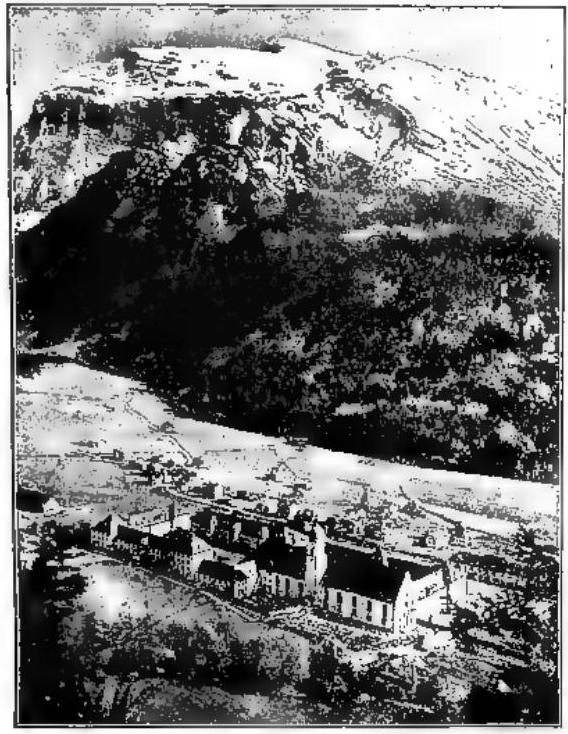
ENGELBERG - View of the Abbey. Buildings of the 18th and 20th centuries.
ENGELBERG. - Benedictineabbey founded in 1120 in the upper valley of the Aa of the same name, at the foot of the Titlis in the canton of Obwalden (Switzerland) by Baron Conrad of Sellenbüren: its first abbot was Adelmo. Pope Callistus II and Emperor Henry V took the abbey under their protection (1124); the Bishop of Constance established an independent parish in the valley.
The abbey rose to great renown under the rule of abbots Frowin (1174-78) and Berthold (1178-97); it became a center of culture with a library rich in illuminated manuscripts. Abbot Henry I (1197-1223) procured for the monastery, probably from Alsace, a reliquary cross which, together with the ancient staurotheke, enclosed a particle of the Holy Cross. E. was destroyed by fire in 1199 and in 1306; it was devastated by the plague in 1548, 1574, 1583. With Abbot G. B. Sigrist (1603-10) E. entered the Helvetic Benedictine Congregation in 1602. After a new fire, Abbot E. Crivelli had the church and monastery rebuilt by the architect G. Rueff (1730-34). The French occupied the abbey in 1798. The monastery contributed to the founding of Rickenbach (1857) and of Melchtal (1869), and to the missions in the United States of Conception, Mo. (1773), later an abbey in 1881, and of Mount Angel (1882, later an abbey in 1904). The buildings of E. were enlarged between 1925-29. Since 1932 the monks of E. have also been in Cameroon and direct the major seminary at Yaoundé.
The monastery library is rich in 600 manuscripts, among them the "Bible," an illuminated manuscript by Hugh of Tennenbach, and in more than 50,000 volumes; it also contains valuable works of art. The founder Conrad and the abbots Adelmo, Frowin and Berthold enjoy a local cult as blessed, and the bodies of the first two are preserved.
Bibliography16 worksCottineau, I, coll. 1048-49; B. Gottwald, Catalogus codicum manuscript., Engelberg 1801; A. Vogel, Urkunden des Stiftes E., in Geschichtsfre
BIBL.: Cottineau, I, coll. 1048-49; B. Gottwald, Catalogus codicum manuscript., Engelberg 1801; A. Vogel, Urkunden des Stiftes E., in Geschichtsfreund, 40 (1894), pp. 233-62; 51 (1896), pp. 1-162; 52 (1897), pp. 187-239; 53 (1898), pp. 101-242; 55 (1900), pp. 134-257; 57 (1902), pp. 140-273; R. Durrer, Kunstdenkmäler des Kantons Österreichs, 1890-1928, p. 117-128; id., Der Mäter und Schreiberschule K's. in Aus. Schw. Altertumsb. morm. uctic. 3 (1901), pp. 42-55; 122-76; J. Huse, Geschichte der Klosterschule in K., Beilage Jahrb., 1902-1903; Angelomontana, Blätter aus der Geschichte v. E. Jubileumg. f. Abt Landger II, Engelberg 1914; J. Nimule, Les Réadéctions d'E., in Zschr. f. Schw. Gesch., 10 (1916), pp. 23-41; R. Schilling, Die Engelberger Bildhandschriften aus Abt Francis Zelt in ihrer Beziehung zu burgundischer und schwäbischer Buehndorf, in Anzeiger f. abs. Altertumsb. 5 (1913), pp. 117-28; Schiess-G. Heer, Die blitzigen Urkunden des Klosters E., in Rev. hist. cert. 1909, 35 (1941), pp. 30-97; 234-69; F. Günerbock-G. Heer, K's Gründung und erste Blüte, Zurico 1948.
Kunzle, Paolo. “Engelberg.” In Enciclopedia Cattolica, vol. V, coll. 360–361. Città del Vaticano: Ente per l’Enciclopedia Cattolica e per il Libro Cattolico, 1950. https://azioneromana.com/article/engelberg.
MLA
Kunzle, Paolo. “Engelberg.” Enciclopedia Cattolica, vol. V, Ente per l’Enciclopedia Cattolica e per il Libro Cattolico, 1950, coll. 360–361. Azione Romana, https://azioneromana.com/article/engelberg.
BibTeX
@incollection{ec5_engelberg,
  author    = {Kunzle, Paolo},
  title     = {Engelberg},
  booktitle = {Enciclopedia Cattolica},
  volume    = {V},
  pages     = {360--361},
  note      = {Cited by column},
  publisher = {Ente per l’Enciclopedia Cattolica e per il Libro Cattolico},
  address   = {Città del Vaticano},
  year      = {1950},
  url       = {https://azioneromana.com/article/engelberg}
}
One of some 20,000 entries brought back from the twelve printed volumes (1948–54). Spotted something? Help us improve it.
Click or scroll to zoom · drag to pan · Esc to close