
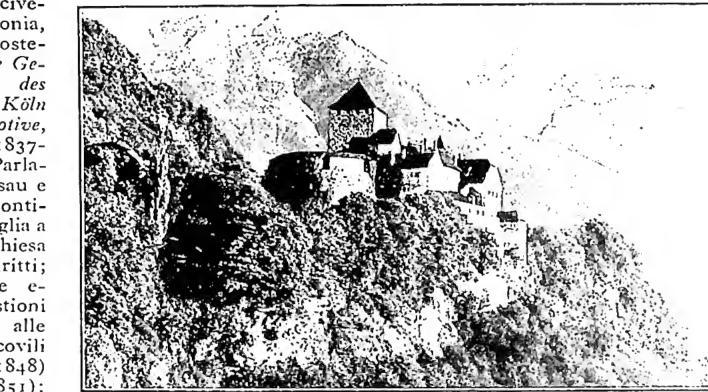
LIECHTENSTEIN. – A small State (159 sq. km.) enclosed between the frontier of Austria (Vorarlberg) and that of Switzerland (S. Gallo and Grigioni). Capital: Vaduz (2,000 inhabitants). The territory of the present-day principality of L. has been the site of human settlements since the Stone Age; it was brought under Roman rule in 15 B.C. and became an important transit area along the Roman road from Coira to Bregent. Subject to the rule of the Ostrogoths in 493 and of the Franks in 537, while between the 7th and 8th centuries the Alamanni passed through the territory, its various feudal dependencies came to an end in 1396, when the entire lowland and mountainous territory, finally united under Count Enrico of Vaduz, came to depend directly upon the emperor.
When the Holy Roman Empire came to an end in 1806, L. acquired full sovereignty and, as such, from 1806 to 1814 became part of the Confederation of the Rhine, then passing from 1815 to 1866 into the German Confederation. When this political organization also ceased to exist at Sadowa, L. continued to remain entirely independent, retaining until 1919 the customs union with Austria, in force since 1852. Having remained neutral during both the First and Second World Wars, L. has formed part of the Swiss customs territory since 1923, and Switzerland has assumed its diplomatic representation since 1924. On the basis of the Constitution of 5 October 1921, L. is a hereditary constitutional monarchy in the male line of descent of the princes of L.; legislative power is repres-
The inhabitants, approximately 14,000, are 98% Catholic, and the territory of the Principality forms part of the Diocese of Chur.