
SMITH, ADAM. — Philosopher and economist, born at Kirkaldy (Scotland) on 5 June 1723, died at Edinburgh on 17 July 1790. At the age of fourteen he entered the University of Glasgow, where he was a pupil of Hutcheson in the course on moral philosophy; he subsequently developed his philosophical and economic thought from his teacher’s general principles, intending, in accordance with his family’s wishes, to pursue an Anglican ecclesiastical career. He nevertheless abandoned theology in order to attend courses in the natural sciences and philosophy, graduating in 1746.
He gave public lectures at the University of Edinburgh, where he met Hume, with whom he remained friends; in 1751 he was appointed professor of logic at the University of Glasgow, and the following year professor of moral philosophy, a chair he held until 1763. His course, following the lines of that of Hutcheson, who had preceded him, was divided into four parts: natural theology, ethics, civil and political law, and political economy. Of these, only the second and fourth, developed and enlarged, were published by S.: the one in 1759 (Theory of moral sentiments, London 1759), the other in 1776 (An inquiry into the nature and causes of wealth of nations, there 1776). At the end of 1763 he left teaching to accompany the Duke of Buccleugh on a journey through Europe; he stayed with him for a long time in France, where he met the most eminent men of the period. In discussions with Turgot and Quesnay, founders of the French physiocratic school, S. deepened and broadened his economic knowledge, so much so that he was subsequently accused of having
taken the most important part of his doctrine from the physiocrats; but in the notes of his lectures on political economy preceding the journey, all the fundamental principles of the «Wealth of Nations» are already set forth (Lectures on justice, police, revenue and arms, delivered in the University of Glasgow by A. S., reported by a student in 1763 and edited with introduction and notes by E. Cannon, Oxford 1896). On his return to England
in 1766 he withdrew for several years to Kirkaldy, where he worked out his treatise on political economy, which, published in 1776, met with rapid success. In 1778, in recognition of his merits, S. was appointed commissioner of customs and excise in Scotland, an office he held until his death. After his death, several of his short philosophical and economic monographs, of lesser importance, were published (A. S., Essays, Dublin 1795).
In the Theory of Moral Sentiments, S. does not depart from the empiricism and moralism of Hutcheson and Hume: man is a moral being guided by the feeling of sympathy, which nature employs to direct the destiny of humanity toward the happiness willed by Providence. The balance between selfish and altruistic impulses, brought about by sympathy, leads to harmony between personal good and the good of society. The analysis of the feeling of sympathy constitutes the essential part of the work, but the initial error of attempting to deduce a moral law from the immediacy of feeling gives S.’s reasoning a character of fragility and inadequacy.
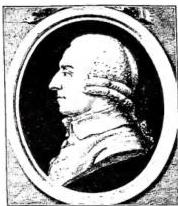
(from A. S., Recherches sur la nature... I. Paris 1883)
SMITH, ADAM — Portrait, engraving by B. L. Prevost.