Machine translation of the 1948–1954 Italian original. The original text is authoritative.
ELIOGABALO (Imp. M. Aurelius Antoninus), ROMAN EMPEROR. — Born at Emesa in 204, died in Rome on 11 March 222. The son of Vario Marcello and Giulia Soemia, his name was Vario Avito, but he is more commonly known by the name of E., after the god of whom he was priest at Emesa during the exile of the Severan family to which he belonged. Through the intrigues of his grandmother Giulia Mesa, who passed him off as the son of Caracalla, he was proclaimed emperor in the spring of 218 following a revolt of soldiers. A depraved young man, in whom all the vices and extravagances of the East were combined, he attempted to replace the gods of Olympus with the cult of his god Elagabalus, together with its orgiastic and sanguinary rites.
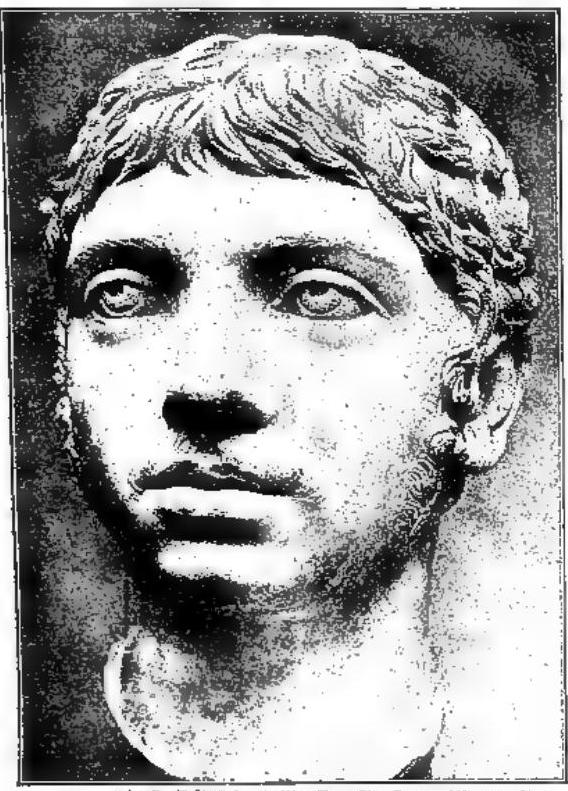
Ida B. Dabruch, Antike Portella, Bonn 1917, vol. II, II ELIOGABALO – Portrait (3rd century) – Rome, Museo delle Terme.Having come to Rome toward the end of 219, he brought there the sacred black stone of Emesa, for which he built a temple on the Palatine, gathering in it all the venerated symbols of the ancient world: the fire of Vesta, the statue of Cybele, the shields of Mars, and the Palladium. It was his intention to establish a religious syncretism entirely to the advantage of his solar god. He subjected the Romans to his shameful insanities, offering sacrifices to the sacred stone of Emesa in the presence of senators and equestrians, painted and dressed as a woman and surrounded by eunuchs and bacchants. He nevertheless left the Christians in peace, both because, being their religion of Eastern origin, it found favor in his eyes, and because he thought of making them an element of his bizarre religious reform. His biographer Lampridius indeed attests that E. intended to gather in his temple Jews, Samaritans, and Christians as well, so that his priesthood might possess the religious secrets of the entire world (Helio, 3). His untimely death prevented him from carrying out this strange project, which would nevertheless certainly have encountered vigorous resistance from the Christians. Having indeed become hateful to everyone, especially after he had attempted to get rid of his cousin Alexander Severus, whom he had already adopted, the praetorians, supported by the Senate and the people, killed him together with his mother and threw the corpse into the Tiber.
BIBL.: E. Callegari, Il salotto di una imperatrice romana, Rome 1902; G. Duviquet, Hiliogabale, Paris 1903; G. Pasciucce, Elagabale, Felice 1902; P. Allard, Storia critica delle persecuzioni, 3rd ed., Italian translation, Florence 1935, pp. 167–70.
Agostino Amore
Cite this article
“ELIOGABALO (IMP. M. AURELIUS ANTONINUS), IMPERATORE ROMANO.” Enciclopedia Cattolica, vol. V (1950), p. 169. Azione Romana digital edition, https://azioneromana.com/article/eliogabalo-imp-m-aurelius-antoninus-imperatore-romano.