Machine translation of the 1948–1954 Italian original. The original text is authoritative.
GIANO (Ianus). — Ancient Roman god. Although his name does not appear in the oldest Roman calendar, it has been demonstrated that the festival of 9 January, designated by the term Agon(ium), was celebrated in his honor. This is the first festival of the solar year, just as Ianuarius (January) is its first month. This position of beginning, on the basis of which one could say: « penes Iovem summa, penes Ianum prima », is also confirmed by other facts: all sacrifices and prayers had to begin with an invocation to G. (and end with another to Vesta).
The first day of every month is also sacred to G.: together with Giunone, goddess of the Kalendae, as the day of the new moon, he receives a sacrifice each month; in this connection he is also called Ianus Iunonius. G. is therefore a « principium deorum », the first of the gods, « god of the gods » and « good creator » (duonus cerus), as the ancient hymn of the Salii invoked him. In Roman myth this character of his is expressed in his position as the « first king » of Latium. The rex sacrorum, too, who may be regarded as his particular priest—for it is he who offers the god a ram on the day of the Agonium—is first in the hierarchical order of Roman priests. On the earliest Roman coins (4th century B.C.), the unit, the as, bears the effigy of the god: a two-faced effigy that is characteristic of him at all times. This singular type of representation, which finds parallels among the solar gods of other peoples, together with other elements (festival, victim, etc.), sheds light on the solar nature of the god, also intuited by ancient exegetes and perhaps confirmed by the etymology of the name: today, in fact, there is a tendency to abandon the supposed derivation from the concrete term ianus, ianua (arch, door) and, without, for that matter, taking up again the implausible theory of a
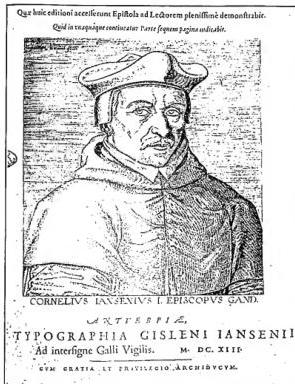
(fol. Eur. Cott.) GIANSENIO, CORNELIO — Portrait of G. C., bishop of Ghent, known as G. the elder. Frontispiece of the Commentariorum in suam concordiam... Antwerp 1613.(D)ianus: the name of the god has been explained by the Sanskrit yūna (to walk); it would refer to the course of the sun. The position of “beginning” (for which G. is also “matutinus”) and other features, such as the connection with water, emphasized above all—but not exclusively (cf. the dedication of one of his temples on the occasion of a naval victory; the spring near the Ianus Geminus; the prow associated with his image on the republican us)—by the myth, nevertheless advise against a simplistic equation between G. and the sun. The ancient places of worship of G. are: the regia itself, where the rex sacrorum sacrifices the ram on the day of the Agonium; the tigillum sororium, on the Oppian Hill, where the worship of Ianus Curiatius is associated with that of Iuno Sororia (the foundation legend is that of Horatius, victor over the Curiatii, who expiates his killing of his sister by passing beneath the tigillum; the festival is held on 1 October); the monument, rather than temple, called the Ianus Geminus: according to tradition, this was founded by Numa Pompilius and was to remain open as long as Rome was at war, and closed in time of peace (the god’s double epithet Patulcius Clusius was connected with this practice); the temple near the Theater of Marcellus, founded on the occasion of the victory at Mylae (the temple’s festival coincided with the Portunalia of the ancient calendar, 17 August); one may add the Ianus Quadrifrons, built under Domitian: the four-faced image was supposedly imported from Falerii. The cult of G. is almost exclusively public. The limited private participation and the lack of Greek models account for the mythological poverty of the figure, which nevertheless appears either as the first peaceful king of Latium, or as an all-seeing god involved in amorous relations with water deities, such as Iuturna and Venilia, or with others, such as Carna. More than to mythology, the figure of G. lent itself to cosmogonic speculations, in which it represented the origin, the beginning of the world, Chaos (v.) of the Greeks. The name of the Janiculum (Ianiculum), his mythical dwelling, derives from the name of G. Perhaps here too G. had an ancient place of worship that has been forgotten.
BIBL.: G. Wissowa, Religion und Kultus der Römer, 2nd ed., Monaco 1912, p. 103 ff.; Otto, Ianus, in Pauly-Wissowa,
Suppl., III, col. 1175 ff.; O. Huth, Ianus, Bonn 1932; F. Atheim, Altitalische und altrömische Gottesvorstellung, in Klio, 30 (1937), p. 48 ff.; P. Grimal, Le dieu Janus et les origines de Rome, in Lettres d'humanité, 4 (1945), p. 15 ff.
Cite this article
“GIANO (IANUS).” Enciclopedia Cattolica, vol. VI (1951), p. 232. Azione Romana digital edition, https://azioneromana.com/article/giano-ianus.