
**ACHEMENIDS** (Old Persian *hakhamanîşîja*, Greek *’Aχαιμενίδαι*). — Persian dynasty (founder Achaemenes) of the Pasargadae tribe which in the 7th century BC moved from its first capital Pasargadae to Susiana, founding there the Elamite kingdom of Anshan, and then, under Cyrus, the great Persian empire (549–330 BC), which included Media, Assyria, Babylonia, Lydia (Asia Minor), Syria and Palestine and (after Cambyses) Egypt. After the Babylonian exile ended, Israel, reduced to the Jews, lived under their dominion (“Persian period”), amid internal and external events little known to us (books of Ezra and Nehemiah, Esther, Haggai, Zechariah, Malachi). The Persian period is characterized by the religious restoration among the Jews returning from exile. Following the transformations in the national life of Israel came the development of a cultural and doctrinal organization which constituted “Judaism.”
The success of the Achaemenids, who formed the political power of Iran and were the first to realize a universal monarchy by absorbing previous monarchies, is due above all to the genius and magnanimity of Cyrus, who spared the life of Astyages and Croesus, spared the conquered cities of Ecbatana and Babylon, and allowed the many exiles to return home; and then to the organizing genius of Darius I. Under the Achaemenids, the Persians attained a high culture and derived from Babylonian cuneiform an alphabetic script, still partially syllabic, composed of 41 signs.
The religion of the Achaemenid kings was ancient Mazdaism: they worshipped Ahura Mazda, symbolized in fire; they do not appear to have adopted Zoroastrianism, the religion of the Magi, which was still confined to Bactria. J. Hertel asserts the identity of the dynasty of the Kayanids (Kayāni), mentioned in the Avesta, with the Achaemenids; Hystaspes (*’Ištāšāntyā*), father of Darius I, is identified with King Vištāspa, praised in the Avesta as protector and patron of Zarathustra. But G. Messina demonstrates that Zarathustra must be placed much earlier, in the 11th century BC, and that Darius I was not properly a Zoroastrian. Eclectic, the “Great Kings” did not trouble themselves to make proselytes. The Achaemenids felt themselves religiously akin to the monotheistic Jews, who also shunned representations of the deity. The desire to win the love of their subjects, however, led Cyrus to a practical polytheism, by which he attributed his ascent to the throne indifferently to Marduk and to Yahweh (cf. Ezra 1:2).
The internal organization was wisely carried out by Darius I. The empire, strongly centralized, was divided into 23, then under Darius I into 31 satrapies, whose satrap (*khāthrapha*), a powerful viceroy subject to the “King of Kings,” was to regulate the ordinary civil and military administration and execute the fixed tax payment. Under him, but answerable only to the King, were a chief of the army (*karanos*) and an official in charge of bureaucratic affairs. Periodic inspections reported to the Great King the situation of the satrapy. But under weak kings like Xerxes I and Artaxerxes II, offices became concentrated in few hands, and inspections became empty formalities.
Grandiose constructions of roads (Darius I built the “Royal Road” between Sardis and Susa, about 2400 km long), rapid postal services, daring exploratory journeys, increasingly linked the most distant provinces. Thus the syncretistic movement developed; “from the east to the west of the empire, cults were mixed and gods were united” (A. Causse).
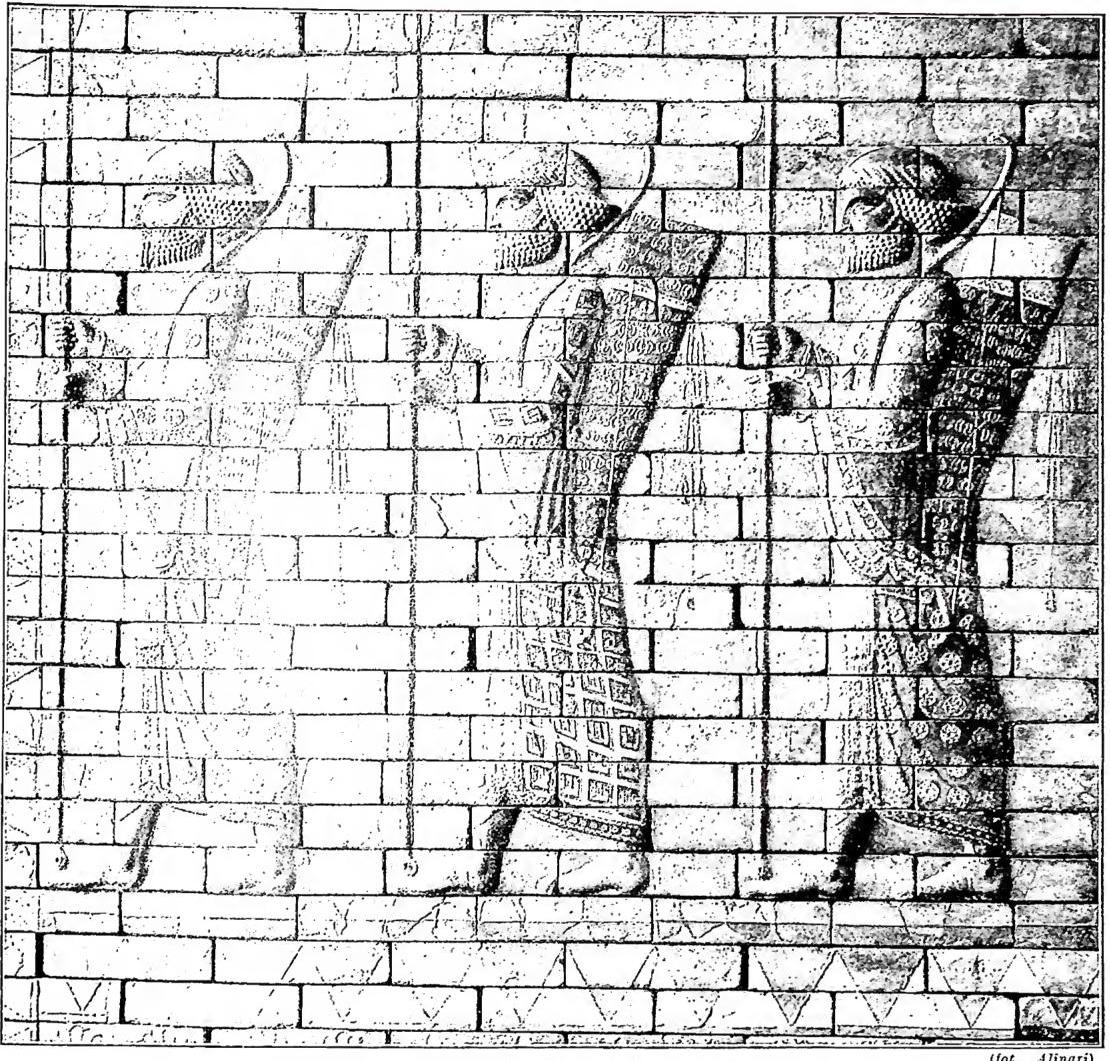
But continual rebellions of the various peoples led to the collapse of the dynasty and the empire. Darius I fought 19 battles in 7 years; under Darius II (404) Egypt revolted, until 341. The revolts were fomented by the atrocities of unworthy successors of Cyrus. In Egypt, Cambyses went so far as to kill the Apis bull, and then Artaxerxes Ochus repeated his devastations; Xerxes I destroyed the great city of Babylon. Cruel suppressions of pretenders to the throne (Smerdis killed by his brother Cambyses, the Sogdians killed by Artaxerxes III) favored conspiracies that killed Xerxes I, Xerxes II after only a month on the throne, Sogdianus after six months; then the eunuch Bagas poisoned Artaxerxes III and Arses. The internal decay of the Achaemenid kingdom allowed Alexander the Great to defeat the Persians at the Granicus (334), at Issus (333), and at Gaugamela (330), where the fugitive Darius III was killed.
At Susa (q.v.) the palaces of the Achaemenids and their citadel (Neh. 1:1; Esth. 1:2) have been explored by M. Dieulafoy and J. de Morgan since 1884. At Persepolis E. Herzfeld discovered in 1933 the archives of the Achaemenid kings with over 30,000 tablets, 500 of them in Aramaic.
**Chronological list of Achaemenid kings.** — The genealogy from Achaemenes onward is known from the “Cyrus Cylinder” and the Behistun Inscription. After Teispes, son of Achaemenes, a double line begins (Herodotus 1.209):
1) Cyrus (q.v.) [II], great-grandson of Teispes, king of Anshan from 558 and of Persia from 549; 2) Cambyses, 530–522, conqueror of Egypt, opposed the Jewish restoration; 3) Gaumata the Magian, the “false Smerdis,” attempted to elevate Zoroastrianism to the throne; 4) Darius I (q.v.) son of Hystaspes (grandson of Ariaramnes, younger son of Teispes) of the second Achaemenid line, (522–486), favorable to the Jews; 5) Xerxes I (q.V. AS-SUERO) not well disposed toward the Jews (486–465); 6) Artaxerxes I (q.v.) Longimanus (465–424); 7) Xerxes II (424: 1 month); 8) Sogdianus (424: 6 months); 9) Darius II Nothus (424–405 [404]), under whom the revolt of Egypt occurred; 10) Artaxerxes II Mnemon (405 [404]–358); 11) Artaxerxes III Ochus (358–337), who reconquered Egypt; 12) Arses (337–335); 13) Darius III Codomannus (335–330). — See PERSIA.
**