
ATRIUM (a-trium, αἰθρίον). — In the Christian architecture of the early centuries it consists of an uncovered space, directly placed before the façade of the church and surrounded by porticoes that delimit its quadrangular area. The porticoes of the atrium occupy the entire front of the church and are not externally visible, being enclosed by a continuous wall, interrupted only by the doorways.
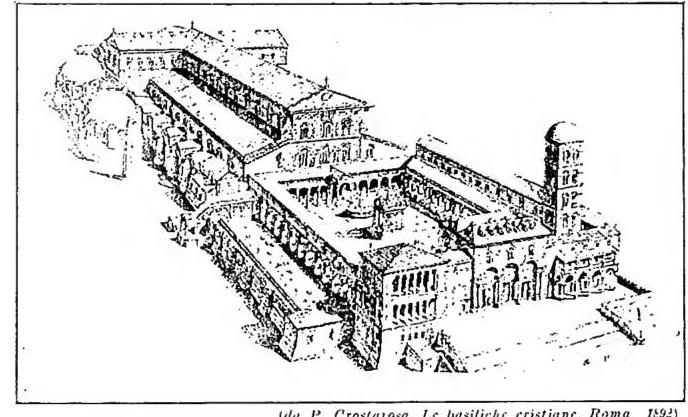
It retained, however, its specific function. Even during the Renaissance (churches of the Santissima Annunziata and of Santa Maria Maddalena dei Pazzi in Florence, of San Gregorio al Celio in Rome) the atrium is sometimes placed before churches, with ever-increasing variety of form.