
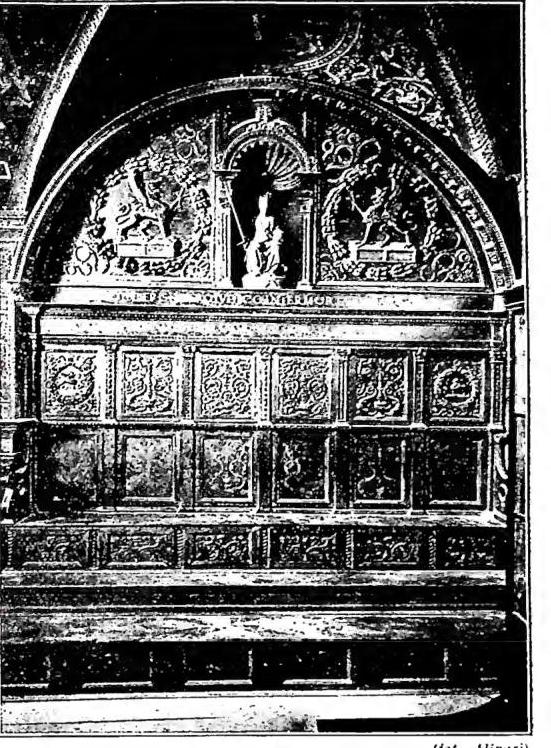
BENCH (Ger. med. *panch*, med. Lat. *banchum*, Fr. *banch*). - A movable piece of furniture used since antiquity, consisting of a board supported by two or four legs, with side supports and sometimes a backrest; it may be freestanding or placed against a wall. In its primitive form, it appears to have been recessed into the thickness of a wall or constructed of masonry (e.g., in the Roman catacombs).
In the 15th–16th centuries, it often evolved into a chest-bench (v.).
Some miniatures document the very simple form of benches from the early Middle Ages, otherwise unknown; one of the oldest surviving originals (12th–13th c.), from the church of Alpirsbach and preserved in the Stuttgart museum, is still of the simplest form.
In private homes, benches were placed near beds or hearths and adorned with cushions or special cloths (*bancali*, *pancali*). Walls to which benches were sometimes affixed were decorated with textiles or embroidery, especially when benches ran along entire walls of halls, sacristies, or presbyteries; many inventories mention these *dossalia* (*vela*), of which some originals remain. In northern European houses, and especially during the Gothic period, benches were fixed to walls when, as often happened, the walls themselves were made of wood.
During the Renaissance, especially in Italy, the backs of benches were richly decorated with reliefs or inlays (e.g., the Sala del Cambio in Perugia, etc.). From the 18th century onward, benches almost disappeared from the most refined interiors and became common in working-class homes. They are regularly found, sometimes in fine forms, in churches, especially in northern countries; in such cases, the bench proper is often combined with a prie-dieu.