
BECCAFUMI, Domenico. - Painter, born around 1486 in Val di Biena (Siena), died in Siena in May 1551. He showed openness to the influences of the masters of his time from his earliest works, which were tied to the styles of Fra' Bartolomeo and Mariotto Albertinelli: for example, the fresco for the chapel of the Manto in the hospital of Siena, from 1512. In those immediately following (the Trinity of 1514 and the Stigmata of St. Catherine of 1515, both in the Pinacoteca of Siena), Peruginesque influences are evident; in the St. Paul, also from 1515, Beccafumi more clearly defined his personality as a mannerist. Two years later, he began, with Sodoma and with Gerolamo del Pacchia, the decoration of the chapel of St. Bernardino in Siena, completing in 1518 the two frescoes depicting the Marriage and the Transit of the Virgin, notable for the linearity of their composition. He then painted the panel of the Nativity, in the church of S. Martino, also in Siena, in which the contributions of Raphael's art predominate, works which Beccafumi had come to know during his stay in Rome between 1510 and 1512. Having become the official painter of the Republic of Siena, he frescoed a ceiling in the house of Marcello Agostini (later Bindi-Sergardi); this work, for its dazzling richness of color, its unusual architectural backgrounds, and its studied perspectival effects, is deservedly considered among his best.
The Marriage of St. Catherine with the Madonna and Eight Saints (Siena, Galleria Chigi-Saracini) is from 1528; two saints bear the imprint of Fra' Bartolomeo's art, while in the Madonna the influence of Raphael is recognized. In 1529, Beccafumi was commissioned to decorate the hall of the Concistoro in the Palazzo Pubblico of Siena, a work completed after six years; this piece, aside from its marked pictorial value, holds great documentary importance, as through its various scenes episodes of the city's history are allegorically recalled.
In 1537, he executed the famous painting of St. Michael for the church of the Carmine, under the influence of Michelangelo, though transformed through his Sienese contemplative spirit.
Between 1538 and 1539, he painted for the Opera del Duomo of Pisa the Golden Calf and the Punishment of Dathan and Abiram and the Four Evangelists; a year later, he began the frescoes for the tribune of the Duomo of Siena (completed in 1544), which bear witness to the achievement of his full artistic maturity. In 1541, he traveled to Genoa, where he collaborated with Perin del Vaga in the decoration of the Palazzo Doria.
Returning to Siena, he painted (1543) the Nativity of the Madonna for the convent of S. Paolo, notable for the geometric layering of the figures and for the dazzling richness of its colors.
Beccafumi was one of the first Tuscan mannerists. The bizarre and extravagant composition, the strong contrasts of light and shadow, and the continual mutability of color, highly sensitive to light and formal elements, constitute the fundamental attributes of his artistic physiognomy.
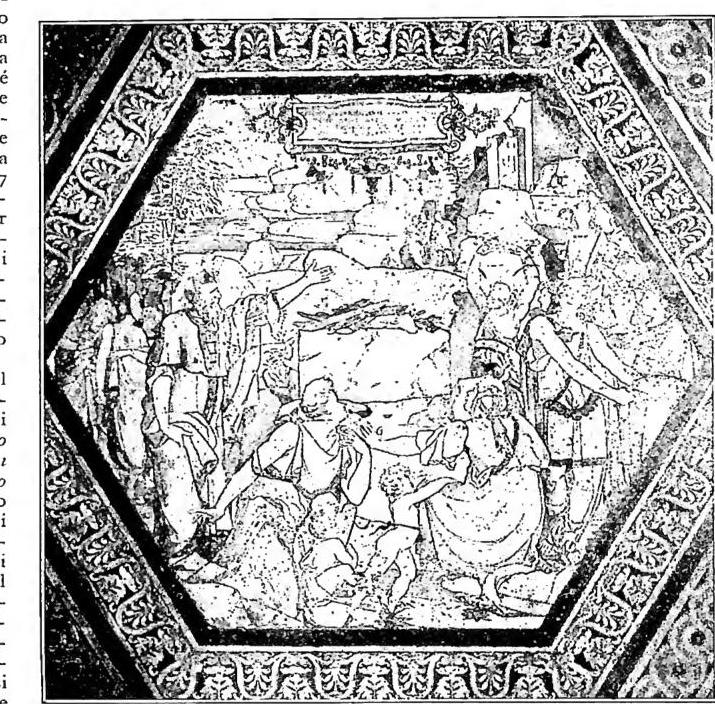
He also participated in the completion of the engravings on the floor of the Duomo of Siena, beginning the work in 1517 and continuing it throughout the rest of his life.
A versatile artist, he also produced banners, temporary architectural works, decorations, etc.; his last work was the bronze angels for the Duomo of Siena. - See Plate LXXI.