
CALVARY. – The place where Jesus “suffered outside the gates (of Jerusalem)” (*Hebr.* 13:2), called “the place of the skull” (*ἐκφαλινόν τόπος*) and in Greek Γολγοθά (*Jn.* 19:17). *Golgotha* is an Aramaic name formed from the Hebrew *gulgoleth* with the dropping of the second *l* so that the two syllables would not end in the same way (G. Dalman). The name seems to derive from the shape of this “hillock” (CSEL, XXXIX, p. 22). But already Origen, “to whom this tradition came,” explains the term “by the fact that there the skull of Adam was buried” (*In Mt. Comm.*, 126a series; PG 13, 1777; ed. E. Klostermann, X, p. 265); St. Epiphanius, St. Jerome (PG 41, 844; PL 22, 485), and others agree.
“Wicked men filled the place with much earth piled up and built there a dark cavern of the demon which they call Venus” (Eusebius, *Vita Constantini*, 26: PG 20, 1085; ed. Heikel, I, p. 89). “From the time of Hadrian, a statue of Venus was worshipped on the rock of the Cross” (Jerome, *Ep.*, 58, 3: PL 22, 581); St. Ambrose therefore calls the place “Venereus” (*In Ps.*, 47, 5: PL 14, 1203). When Constantine covered the entire area with a splendid building (*Martyrium Anastasis*), constructed according to the plan of a pagan temple (37 × 137 m.), the Holy Cross remained outdoors: “Ipse locus subdivanus est” (Etheria, 37, 4: CSEL, XXXIX, p. 89). The Christians placed there a very large silver cross (Arculf and Bede: CSEL, XXXIX, pp. 233 and 304). Even in the time of Willibald, the crosses “are not inside the church, but stand outside the church under a canopy” (T. Tobler–A. Molinier, *Itineraria Hierosolymitana et descriptiones Terrae Sanctae*, I, Geneva 1880, p. 263). It was, it seems, Constantine Monomachus (c. 1042), who, in rebuilding the church of the Holy Sepulchre destroyed by the Muslims in 1009, brought this holy place under the same roof as the church of the Holy Sepulchre.
From Ps. 73 (74):12 (“God has wrought salvation in the midst of the earth”) the conclusion was drawn that Calvary is the center of the earth. Thus St. Cyril of Jerusalem, *Cat.*, 13, 28; cf. Didymus, *De Trin.*, I: PG 33, 805, and 39, 324. This error still persists in the “navel of the earth” shown in the choir of the Greeks.
The fissure in the rock that occurred at the death of Jesus (*Mt.* 27:51) is attested by St. Cyril of Jerusalem: “Golgotha even today bears witness how the stones for Christ were split” (*Catech.*, XIII, 39: PG 33, 819). An even earlier testimony is found in the account of St. Lucian the Martyr (d. 312), preserved by Rufinus (*Hist. Eccles.*, IX, 6; Eusebius, *Hist. Eccles.*, IX, 7; ed. E. Schwartz: GCS, IX, II, p. 815). In later centuries pilgrims also speak of this “cleft formed at the death of Jesus” (Theoderic, c. 1172: D. Baldi, *Enchiridion Locorum Sanctorum*, Jerusalem 1935, p. 853).
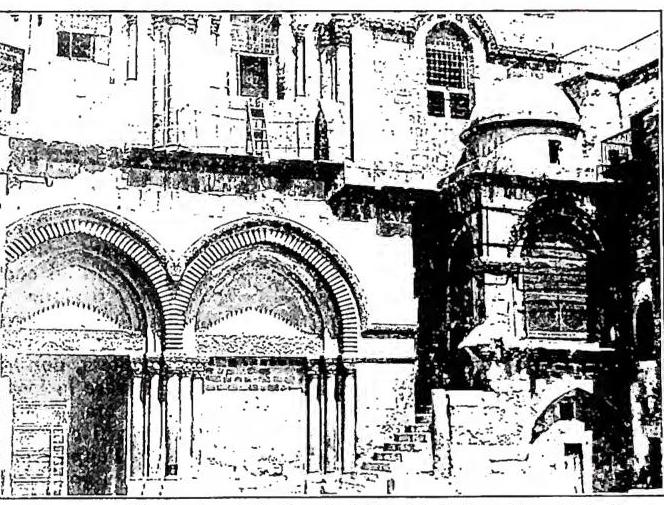
The authenticity of the hillock of Calvary is confirmed by the testimony of the Emperor Hadrian, who wished to profane that place, then venerated by Christian tradition. To those who objected that Calvary was outside the walls, the ruins of that gate which Tsar Alexander II purchased in 1857 bear witness: they show that the walls of Jerusalem were then to the east of Calvary (Vincent, p. 57).
When the rock of Calvary was incorporated into the church in which it was enclosed, it was hewn with the pick into the shape of a cube about 5 m. on each side. Today it occupies the southern side of the basilica of the Holy Sepulchre, to the right of the single entrance. Two chapels adorn the surface of the Calvary sanctuary; their space (11.45 × 9.25 m.) exceeds that of the rock. The southern chapel (leaning against the wall of the basilica, to which was later added the chapel of the Franks outside the wall of the basilica) belongs to the Catholics and contains the Xth, XIth, and XIIIth stations of the Way of the Cross. The main chapel, to the left (north) of the former, was occupied by the Greek schismatics, who possess the place of the Holy Cross, there erected together with images of the Blessed Virgin Mary and St. John. Between the place of the Cross and the Latin altar (XIth station) is included the altar of Our Lady of Sorrows.
Beneath the chapels of Calvary there is a crypt which is the chapel of Adam, said to have contained the skull of Adam, bathed in the blood of Christ which descended through the fissure in the rock; there is also venerated the sacrifice of the patriarch Abraham. Two staircases lead the pilgrim, and first the procession of the Latins which daily traverses these holy places, to the place of the Holy Cross.