
SAINT CECILIA. — Roman martyr, venerated on 22 November. Her *passio* is found in acts composed in the 5th–6th centuries, which contain numerous elements that together constitute a genuine crux for hagiographers. In them she appears as a young girl of noble family, betrothed to the noble Valerian. On the wedding day, while music resounded, she sang in her heart the hymn of purity (from this detail she has been given the title of patroness of musicians). On the first night of marriage Cecilia tells her spouse that an angel watches over her virginity. The spouse wishes to see the angel, and she urges him to receive baptism and sends him for this purpose to the third milestone on the Appian Way, to Bishop Urban. After a celestial apparition, Valerian is baptized. Clad in white he returns to Cecilia, who is accompanied by the angel holding two crowns: one of roses is given to Cecilia, the other of lilies to Valerian. At this point the story of SS. Tiburtius, Valerian and Maximus (a group venerated on 14 April) is interwoven, since the martyr Tiburtius appears as the brother of Valerian. Later the prefect of Rome, Turcius Almachius, first sacrifices the men, then has the woman arrested. She is condemned to be suffocated in the *calidarium* of an overheated bath in her own house. Since this means of martyrdom does not cause death, she is beheaded in the same place. Pope Urban is said to have carried her body away for burial among those of his episcopal colleagues, and her house of martyrdom was consecrated as a basilica in her name.
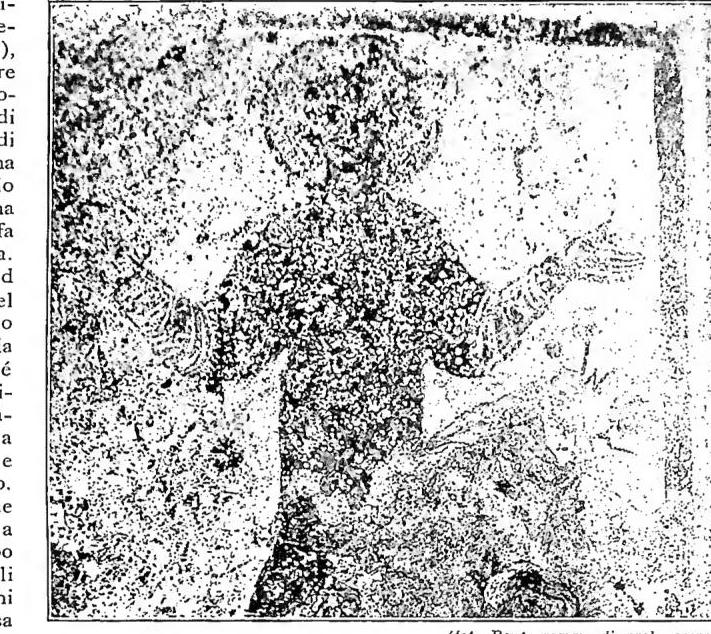
Saint Cecilia — St. C. in an attitude of prayer.
Fresco (9th century) in the crypt called of St. Cecilia.
Rome, cemetery of St. Callistus.
Cf. BHL, 1495; B. Mombritius, *Sanctuarium*, ed. Solesmense, pp. 332–41; *Martyrologium Romanum*, p. 539; H. Delehaye, *Études sur le légendier romain*, Brussels 1936, pp. 73–96, 194–220; see also the same author’s commentary on the *Martyrologium Hieronymianum*, pp. 612–13.
As positive facts may be noted: Tiburtius, Valerian and Maximus are martyrs of the cemetery of Praetextatus. A certain Urban was also venerated in Praetextatus (Itinerarium Salisburgense; *Liber Pontificalis*). Yet an inscription with ΟΥΑΛΕΡΙΑΝΟϹ and the mention in the list of Pope Sixtus III point to a namesake in the cemetery of Callistus. This must be a different bishop, and moreover the palaeography of the inscription does not allow us to date it to a very early period. These connections of Cecilia with figures in the cemetery of Praetextatus may have led some scholars to believe that she too was venerated there. In reality she belongs to the cemetery of Callistus, and the *inter collegas suos episcopos* of the *Passio* alludes to the adjacency of the papal crypt. Indeed the crypt of St. Cecilia lies in absolute proximity to that of the Popes.
The spacious crypt has inscriptions from the end of the 3rd century (e.g., an inscription of Septimius Fronton Pretestatus Licinianus) and paintings from the 5th century and later. Among the earliest are those of the lucernarium (image of the saint—now almost faded—and three figures: Polycamus, Sebastian and Quirinus; the first is an unknown saint and the last may be the bishop of Siscia in Pannonia, whose relics were transferred to the catacombs in the 5th century). Another figure of St. Cecilia, on a wall, belongs to the 9th century. It seems that from this crypt Pope Paschal I removed the martyr’s body (April 821) to place it beneath the altar of the basilica to be mentioned. Yet the author of the *Liber Pontificalis* (II, p. 36) is confused and speaks of the cemetery of Praetextatus. It is strange that a martyr so celebrated is not mentioned in the most ancient Roman calendar (4th century) nor is there a word about her in the writings of Damasus, Ambrose, Jerome, Augustine or Prudentius.
Yet it is certain that an image of St. Cecilia appears in the 6th century in the mosaics of Ravenna (Archiepiscopal Chapel; S. Apollinare Nuovo), and the *Liber Pontificalis* in the life of Pope Vigilius (535–55) speaks of the envoy sent from Constantinople, Artemius, who went to arrest the Pope: *in ecclesia sanctae Caeciliae hal. dec. erat enim dies natalis eius*. At the time of Gregory the Great (590–604) a certain John collected the oil that burned before the tomb of the saint in the cemetery on the Appian Way. Moreover, among the signatories of the Roman synod of 499 is already the title of St. Cecilia.
The *Martyrologium Hieronymianum* mentions St. Cecilia in notes open to discussion. That of 22 November betrays the use of the late *Passio*. The problem therefore is this: there is no doubt that the cult of St. Cecilia was already widely established in the 6th century and can be traced back to the 5th. But up to the first decades of the 5th century there is no trace of II. The legend has a patrician character. The basilica in Trastevere, moreover, was erected over an important Roman house, a veritable palace, with very ancient parts and a small lararium. The remains of private baths may have furnished the inspiration for the legend about the manner of her death.
There is one fact that must be taken into account. The cemetery of Callistus lies in an area belonging to the ancient family of the Caecilii. It has therefore been proposed that a Christian Cecilia may have obtained a privileged sepulchre in the 3rd century in a crypt near that of the popes. On the other hand, it is thought that in Trastevere there must have existed a house of the Valerii in which there was a tradition of kinship with the Caecilii.
The memory of this distinguished Christian of the Appian Way, probably a woman of holy life (but not a martyr), may have promoted the erection of an important basilica, fostered veneration at the tomb on the Appian Way, and stimulated the legendary accounts, perhaps even encouraged by some family tradition. In the basilica of Trastevere, at the time of Clement VIII (in 1599), the body said to have been placed there by Paschal I was found intact, it is said, with the head turned toward the ground, whereas it is known that Paschal I had placed the head in a casket and later it was found among the relics of the basilica of the Four Crowned Martyrs.
The basilica of St. Cecilia has not yet been thoroughly investigated in its most ancient parts and can only be identified from the reconstruction by Paschal I. It is well known that this pope made the important apse mosaic. Later it received various adornments. For the late Middle Ages one should mention the ciborium carved by Arnolfo (1283) and the frescoes on the wall.
The entrance (Last Judgment) painted by Cavallini. The spread of the cult of St. Cecilia in medieval Rome was great, as attested by the various churches erected in her honor.
Iconography. — She is depicted in rich vestments, crowned with roses and jewels, holding the palm of martyrdom; from the Renaissance onward she is also shown with a small organ or a viola, although the saint has nothing to do with music (cf. A. De Santi, s. Cecilia e la musica, in Civ. Catt., 1921, IV, pp. 318-33).
Among the oldest images is one to be noted in the mosaics of S. Apollinare Nuovo in Ravenna (570) in a procession of virgins, and that in S. Maria Antiqua in Rome (8th century). In a 13th-century fresco in Rome, in the church dedicated to her, the Saint is depicted as appearing to Pope Paschal I. Famous is Raphael’s St. Cecilia from the Pinacoteca of Bologna, with musical attributes; the Saint has also been depicted playing an instrument (Rubens) or accompanied by angelic musicians (Anthony van Dyck). One of the most renowned representations of the Saint is the one sculpted by S. Maderno in his Roman church, inspired by the enthusiasm following the rediscovery of her tomb by Cardinal Sfondrato under Clement VIII (1599). — See Plate LXXII. Fabia Borroni