
CLAUDIUS (T
i. Claudius Caesar Augustus Germanicus), ROMAN EMPEROR
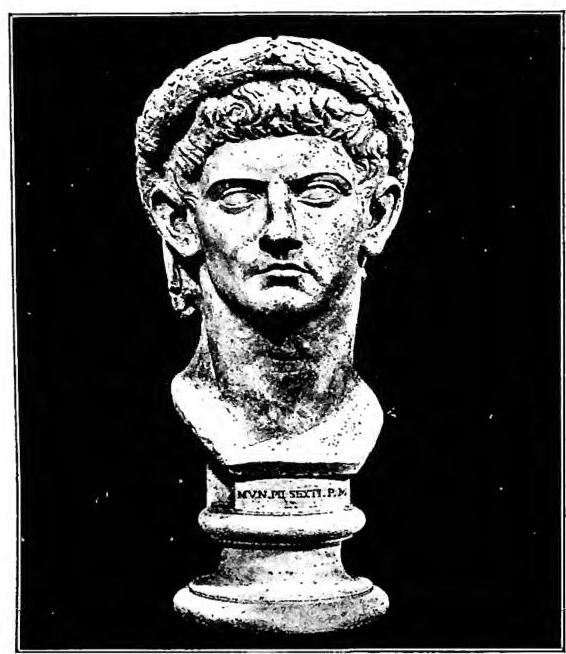
Fourth emperor (41-54 AD), son of Drusus and Antonia, uncle of Caligula, who succeeded him on the throne at the age of fifty. Although he lacked great aptitude for governing, being by nature weak and timid, he nevertheless rendered good service to the empire through successful military enterprises and wise administration. He revoked some of his predecessor’s senseless decrees, granted an amnesty, and recalled exiles, including his niece Agrippina, whom he later married. He completed the port of Ostia, built in Rome the great aqueduct that bears his name, and promoted regular grain shipments to supply the city. Yet during his reign, persistent drought afflicted the empire’s provinces, and a severe famine, noted by Suetonius (Claud. 5, 18) and Cassius Dio (LX, 11) as well as in Acts 11:28, struck particularly hard in Palestine between 44 and 48 AD. On that occasion, St Paul organized collections in the churches of Syria and Asia to aid the poor Christians of Jerusalem (cf. Acts 11:29; Gal. 2:10; 1 Cor. 16:1).Among Claudius’s military achievements are the victorious campaign in Britain, in which the future emperor Vespasian distinguished himself, and the annexation of Mauretania. He suppressed the Druidic cult in Gaul. Yet he showed weakness in allowing himself to be dominated by the women who successively held sway over him—Messalina and Agrippina—and by powerful freedmen such as Callistus, Narcissus, and Pallas, brother of the procurator of Judea, Antonius Felix, and administrator of imperial finances.
Claudius’s policy toward the Jews is noteworthy for its impact on early Christianity. When bloody clashes erupted in Alexandria between pagans and Jews at Caligula’s death in 41 AD, a consequence of that emperor’s misguided policy, Claudius quickly restored order and tranquility with his famous Letter to the Alexandrians, promulgated on 10 November 41 and preserved in a Greek papyrus discovered in 1924 (British Museum Papyrus 1912). By this decree he restored to the Jews their full rights and ancient privileges, including the free exercise of their religion, while abolishing the imperial cult that Caligula had imposed even on the Jews because of his “great folly and madness” (Josephus, Ant. Iud. XIX, 5, 2). In this way the main cause of the disturbances was removed, and a regime of mutual tolerance was established between pagans and Jews. The ordinance, extended to the whole empire, closed with a warning to the Jews not to admit or attract into that city coreligionists from the rest of the province or from Syria, “for in that case,” the emperor added, “I would be forced to entertain graver suspicions; otherwise I shall punish them absolutely as fomenters of a plague that spreads throughout the world.” Some scholars (e.g., H. Janne) have seen in this last phrase a veiled allusion to the nascent Christian religion, which was already spreading rapidly throughout the empire. If so, it would be the earliest secular document attesting the existence and growth of the new faith. Yet this ingenious conjecture is unsupported by the text or by subsequent events and is generally rejected. Rather, the expression should be seen as evidence of Jewish cosmopolitanism and the solidarity uniting the dispersed communities.
Among other acts favoring the Jews, Claudius confirmed to King Agrippa, in gratitude for his valuable support during Claudius’s accession, possession of the territories Caligula had granted in 41 AD (the tetrarchies of Philip and Lysanias with Galilee) and added those under Roman procurators (Judea, Samaria, and Idumea), thereby restoring the administrative unity of Palestine under the Herodian dynasty.
Later, between 49 and 50 AD, the Jews of Rome were struck by a decree of expulsion; among the exiles were Priscilla (v.), who met St Paul in Corinth (Acts 18:2). Suetonius gives the reason for the measure in his well-known passage: “He expelled the Jews from Rome because they were constantly rioting at the instigation of Chrestus” (Claud. 25). The allusion to the Christian religion cannot be doubted. The Chrestus, whom the pagan historian depicts as fomenting Jewish unrest, is Christ or the Messiah; the dissensions within the Jewish community arose precisely from the messianic question: some Jews in Rome regarded Jesus of Nazareth as the Christ or Messiah and were the Christians (sometimes called chrestians in antiquity, from Chrestos for Christos), while others did not believe, and the clash between the two groups gave rise to heated debates and disturbances. Nevertheless, the edict of expulsion must have been applied leniently or restricted to forbidding public assemblies. Indeed, a few years later, under Nero, the Jewish colony in Rome was still large and perhaps more influential than before. It is reasonable to think that this edict had important consequences for the Christian community, helping to sever the last ties binding it to the synagogue. Thereafter the church developed in full autonomy, with a clear predominance of Gentile Christians; thus, after 50 AD, the synagogue and the Christian community in Rome were completely separate (cf. Acts 28:17 ff.).
Claudius died on 13 October 54 AD, poisoned by his wife Agrippina. He was succeeded by Nero (v.), her son.