
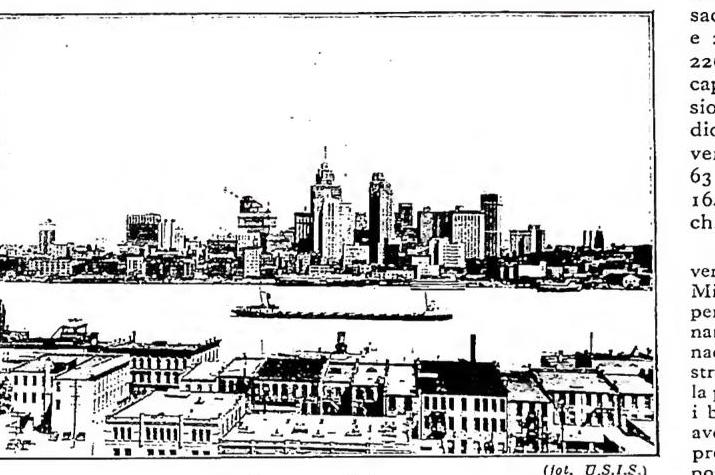
The archdiocese of Detroit is in the State of Michigan in the United States of America. Its territory, covering approximately 13,800 sq. km., includes the counties of Lapeer, Lenawee, Macomb, Monroe, Oakland, St. Clair, Washtenaw, and Wayne, in the south-east of Michigan. Its suffragan sees are the dioceses of the same state, namely: Grand Rapids, Marquette, Lansing, and Saginaw. In 1948, out of a population of over 3,113,503 inhabitants, the archdiocese counted approximately 900,000 Catholics, served by 563 diocesan priests and 281 regular clergy, with 226 parishes, 60 chapels, 16 missions, 2 diocesan seminaries, one university, 5 colleges, 63 high schools, and 164 parochial schools.
Christianity was introduced into Michigan as early as 1642 by Jesuit missionaries from Canada. In 1671, the first chapel for whites was built at St. Ignatius; in 1688, when France officially took possession of the region, Fort St. Joseph was built at Detroit, where in 1700 Lamothe-Cadillac led a number of French-Canadian families. On 26 July 1701, the Franciscan Constantine de l’Halle blessed the church of St. Anne, which is the mother church of the region and whose parish registers, unlike those of other ancient parishes in the United States, remain intact to this day. It was served first by Franciscans, then by Sulpicians, remaining under English rule and under the jurisdiction of the Bishop of Québec until 1796. In that year, due to political changes, Detroit came under the jurisdiction of the Bishop of Baltimore, who entrusted the care of souls to French Sulpicians, given the nationality of the faithful. At that time, the parish of Detroit encompassed all of Michigan and most of Wisconsin, so that under the American regime the first parish priest, G. Richard, became the organizer of the Church in these regions and co-founder of the University of Michigan.
Indeed, he was the first and only priest elected as a deputy to Congress (for Michigan in 1823). Meanwhile, Detroit had passed in 1822 from the Diocese of Bardstown (Louisville) to the new Diocese of Cincinnati, until on 8 March 1833 it was created a suffragan diocese of Baltimore for the entire territory of Michigan. The first bishop was Msgr. Frederick Rese. Subsequently, the dioceses of Milwaukee (1844), Sault Ste. Marie and Marquette (1857), Grand Rapids (1882), Lansing (1937), Marquette (1937), and Saginaw (1938) were formed from Detroit. On 22 May 1937, Detroit was elevated to a metropolitan see.
The archdiocese currently has a large number of Polish parishes and some Italian ones.