
UNEMPLOYMENT
The unemployed worker often feels a victim of injustice. The enterprise in which he may occasionally find work no longer interests him except for the occasional earnings; thus, the profound separation between worker and enterprise is accentuated, a separation which today, for other reasons as well, characterizes the difficult relations between employers and workers.
The problem of unemployment has long troubled sociologists and economists, and has given rise to the concerns of politicians. Especially in the last decade, in the face of the consequences of war and the solutions—however debatable—adopted in countries with controlled economies, programs known by the current designation of “full employment” have been formulated in England and the United States of America.
Such programs usually refer to countries in which unemployment does not stem so much from a lack of capital goods and natural resources as from defects in the functioning of the economic mechanism. They are based on State action aimed at maintaining productive investments at the level required to achieve total employment. This result can be achieved, depending on circumstances, by encouraging private enterprises, through monetary policy, or by public investment.
The solution is more difficult for countries where unemployment is chronic and essentially depends on a lack of savings and the poverty of the environment.
Emergency solutions—such as obligatory labor levies, prohibitions on the use of machinery, limitations on working hours, and the like—even when they appear at times as inevitable, do not permanently absorb unemployed workers and may aggravate the problem in the future. There is no definitive solution except through an increase in labor efficiency and in income, as well as in the portion of income saved for productive investment. When this is not possible, the transfer of surplus labor to areas where it is lacking becomes inevitable.
Whatever solution is chosen, the State has among its duties that of facilitating II. Through reclamation works and the development of any natural resources not adequately utilized—perhaps because they are temporarily unprofitable for private initiative—the State must create new opportunities for employment; or, failing this, it must provide assistance to the unemployed, even if this action implies a redistribution of income. Such assistance is now normally carried out through the development of compulsory insurance schemes.
It should be noted that public intervention is extremely delicate, for if excessive, it may cause a decline in the total income of the community. The natural way for the State to obtain the necessary means for this purpose is through taxation, though it must be borne in mind that this should not be so heavy as to discourage saving and its productive investment. In exceptional cases, and when private interests conflict with the use of natural factors most conducive to a permanent increase in employment, limitations may be imposed on the right to property: this is the case with agrarian reforms aimed at a better utilization of land assets.
The liberalistic solution, which waits for unemployment to be absorbed through the natural movements of the market, is utopian under present conditions of economic and social organization, for it presupposes a perfect mobility of production factors, a mobility which exists only partially, and it disregards the serious hardships to which large sections of the population are subjected.
The worsening of the unemployment problem could become so severe as to impose, on the political and economic plane, more radical solutions, such as the centralization of the means of production in the hands of the State, unless the State itself takes on the task of addressing the social consequences of unemployment. When the phenomenon of unemployment reaches exceptional proportions and becomes permanent in a given country, it cannot find a stable solution except through international agreements aimed at facilitating the movement of workers from one country to another and the inflow of capital to develop labor forces that could be employed in new locations.
This solution is of particular concern to Italy, where unemployment is largely structural: in a naturally poor environment, already sparsely populated, the growth of the population has been more rapid than that of the savings necessary to employ the labor force as it becomes available; this is estimated at 200,000 workers per year.
Before 1914, this increase was partly absorbed by emigration; subsequently, as the pace of emigration slowed and despite considerable expansion in production, the number of unemployed remained high, reaching an average of 700,000 in the period 1936–39.
At the end of 1947, the unemployed numbered 1,778,820. This figure is an overestimate if referred to the number of workers totally unemployed; nonetheless, it is indicative of a grave situation, especially since many workers have only partial and occasional employment, while in many sectors the number of workers exceeds the limits of an economic combination with other productive factors.
Italian unemployment, in particular, calls for the considerations applicable to structural unemployment, the need for State intervention, and international agreements aimed at developing colonization in territories not yet adequately exploited and at assisting emigration.
DISEASE, DEATH OF
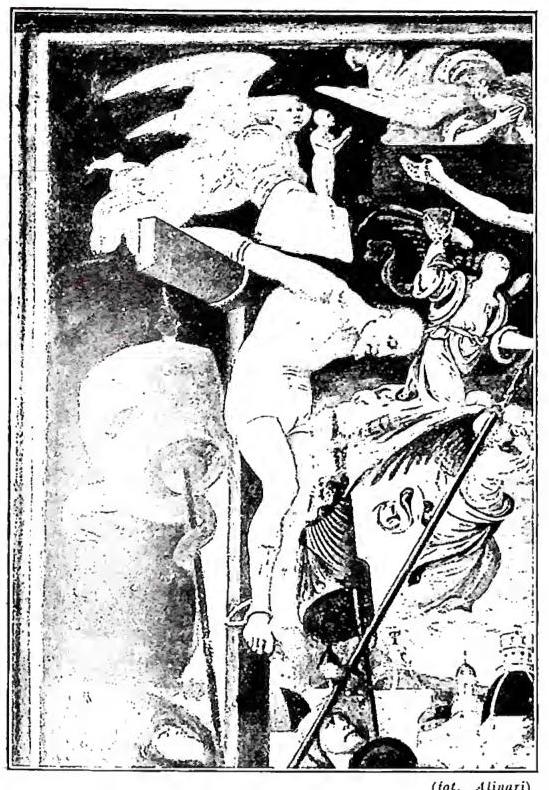
Death from disease. Detail from *The Crucifixion* by G. Ferrari (1523) – Varallo Sessa, Church of the Madonna delle Grazie.
Obstacles of various kinds that, over the last fifty years, have increasingly hindered the movement of people, goods, services, and capital between countries.
Moreover, the very rigidity of the capitalist system in its modern form—far removed from the ideal of a market economy—makes adequate solutions difficult without the intervention of the State or the States concerned; this fact complicates the economic and social problem with difficult political issues.
The effects of unemployment are extremely serious, both from the economic and social standpoint and from the political one, as well as for the individual who suffers II.
In particular: 1) It constitutes a waste of labor and thus affects the income of communities. 2) It weighs as a constant threat upon the worker and often confirms his inferiority in relation to other economic actors. 3) It is the basis of pauperism in modern society, since it systematically affects certain groups, for whom the precariousness of work and income prevents social and economic advancement, keeping them on the margins of productive life. 4) It is an element of social instability, as it exacerbates distrust in the economic system that sustains it and pushes toward subversive solutions of the system itself. 5) It burdens the community with increasingly heavy welfare costs. 6) It disrupts family stability by forcing women and children to work, either to supplement or sometimes entirely replace the lost earnings of the unemployed head of household. 7) It is one of the most dangerous forces of demoralization and moral decay at work in modern society. While it offends the dignity of the worker, abandoned to the consequences of not only material poverty, it distances him from any constructive interest in the institutions of society, toward which the unemployed