
ERASMUS of ROTTERDAM (Desiderius Erasmus Roterdamus). - Humanist, b. Rotterdam 27 Oct. 1469, d. Basel 12 July 1536. The natural son of a burgher, Roger Gerrit (or Gerrits), who later became a priest, and of a certain Margherita, daughter of a physician, Erasmus was deprived in early childhood of both parents and passed a sad and loveless youth under the guidance of three guardians, who were chiefly concerned to steer the young man toward a religious career so that they might freely dispose of the patrimony which, in Erasmus’s name and that of his brother, they were to administer. Erasmus actually entered, about 1488, a monastery of Augustinian Canons at Emmaus (Steyn, near Gouda).
At first he was not displeased with this, as letters of the time attest. Later, having tasted the freedom of the wandering humanist, he felt a repugnance for the monastic life and, finding it difficult to free himself from the bonds of his Order, Erasmus gave a retrospective and darkly colored picture of that life, and an ever-growing aversion to monks and religious in general took root in him. He was ordained priest in 1492, and the following year passed into the service of the Bishop of Cambrai, Henry of Bergen, who sent him to Paris to study. He remained there for some time, devoting himself to humanistic studies, at first with a predominantly formal bent. In 1499 Erasmus set out for England: this was the beginning of that long and unbroken series of journeys which was to constitute one of the most characteristic features of his restless and feverish life. Among lesser peregrinations he passed from England (1499–1500) to France, the Netherlands, Louvain (1502–1504), back to England (1505–1506), to Italy (1506–1509), to England for a third time (1509–14), to Basel (1514–15), to the Netherlands and Belgium, back to Basel (1521–29), to Freiburg (1529–1535), and finally, briefly, to Basel again. Fame, praise, and honors accompanied, in an ever-increasing crescendo, the peregrinations of this man of difficult character, irascible, ambitious of glory to an extreme, yet intolerant of the notoriety that it brought him. In England he formed perhaps his most sincere and cordial friendships: with John Colet, who had a singular influence in directing him toward a humanistic, ethical-philological theology; with Thomas More, whom Erasmus loved as a sweet and happy scholar; and with John Fisher, Bishop of Rochester (when Erasmus was in the Netherlands, L. as X, with a brief of 26 Jan. 1517, released him from his religious vows and permitted him to live as a secular priest).
From a careful study of Lorenzo Valla, his first ideal master, Erasmus turned with passionate zeal to antiquity, both pagan and Christian, aiming at an ever more harmonious reconciliation between an ideal of pure, straightforward, sincere evangelical morality and the composed and majestic wisdom of classical antiquity. The most living example of this balance is his Latin style, flexible, harmonious, skilled in psychological refinements, yet elevated and colored by a moral pulse and pervaded by a singular exhortative force. It is not without reason that he loved St. Jerome as the favorite of his authors and masters. The most famous sayings of ancient wisdom were long and patiently collected by Erasmus: hence the collections of proverbs, Adagiorum collectanea, which appeared in 1500 in the number of eight hundred and then, in subsequent editions, more than tripled. These were followed by the Parabolae (1514) and, in the last years of his life, the Apophthegmata. The study of Greek, begun systematically in 1500 after his return from England, gave solid foundation to his philological-critical revision of theology, which he conceived as a return to the Scriptures, understood in their original purity and freed from the “ignorant” and “barbaric” interpretation—so he called it—of the scholastics.
The method and purpose of this theology Erasmus set forth, among other works, in the celebrated little book Enchiridion militis Christiani (1501–1504), so called because it was originally written for a soldier. It is foreign to the asceticism preached by the Imitation of Christ, and his ideal may rather be described as intellectualistic; it proposed the practice of a practical Christianity which, far from any asceticism or mystical particularism, from any supererogatory practices such as vows, fasts, pilgrimages, etc., should concentrate on the exercise of those Christian virtues which were to crown that measured humanism proper to the man devoted to culture, that is, to learning and to piety.
For Erasmus, theology essentially meant a polemic on the method of theological studies, a search for moral improvement, a radical critique of what he considered sheer degenerations of spiritual and religious life. When, after endless hesitations, he finally took up his pen against Luther, he did not cease even then to manifest his distrust of “assertions,” aspiring rather to place himself “willingly among the sceptics, provided this were permitted by the inviolable authority of Scripture and the decrees of the Church” (De libero arbitrio, ed. Leiden, IX, 1215 D–1217 B).
The polemical and sarcastic side of these ideas Erasmus vulgarized in a celebrated work, perhaps the most vivid of all his writings, together with some of the Colloquies: the Moriae Encomium or Praise of Folly. Erasmus composed it on his return from Italy (1509) after years of fruitful labor. A satire full of freshness and vivid representational force, it now amiably mocks human vanity, now ridicules superstition and formalistic religiosity, now lashes the presumption of theologians and the “barbarisms” of the scholastics, now, growing grave and severe, directs its barbs against the morals of religious and seculars alike, the avarice of rulers, the unworthiness of bishops, cardinals, and popes. In short, no one is spared. A corrosive and penetrating satire which, though it had had precedents in its genre and would have imitators, in no one else ever attained such equal brilliance and clarity; a satire which, however, beyond the author’s intentions, resolved itself into a critique of institutions rather than of men. The Praise of Folly, moreover, appeared at a time when an age largely habituated to every kind of anti-ecclesiastical and anti-theological satire found the text exceedingly biting, so as to provoke severe censure and profound dismay. And Erasmus himself expressed his amazement as something incredible that such malevolent intentions should be attributed to what he considered nothing more than an occasional, cheerful, and playful writing.
In 1522 he published his Colloquia familiaria, dialogues full of wit and caution, in which he took aim at the vices of the society of his time, again striking with particular satirical vein at the morals of ecclesiastics and especially of religious, the crass ignorance of so large a part of Christendom, etc.
The critical-philological work dominated, in an ever-increasing crescendo, the life of Erasmus: his world was the world of learned humanists, of discoverers and editors of classical treasures, who were unanimous in proclaiming him a luminary and master of that same world.
Here vast excitement among scholars was aroused by his edition of the original Greek text of the New Testament, printed by Froben in Basel in 1516, slightly improved in the subsequent edition of 1520, and thereafter reprinted down to the critical editions of our own age. Thus he formed a “textus receptus” that was not to be received, as it was said; for E. published it on the basis of manuscripts of little value, preferring the variants that departed most from the Latin Vulgate. E. accompanied it with his own Latin version, in which, while professing to remain faithful to the Greek, he gave it a classical flavor that pleased the learned circles of the time but was far removed from the simplicity of the Vulgate. In 1518 he added to the text his Adnotationes, of humanistic character, in the manner of those by Lorenzo Valla. The Paraphrases of the books of the New Testament (except the Apocalypse) were published by Parisian printers in 1517–24. He also published the Eutharistus, commentarius ecc. in 11 volumes, containing various passages between 1515 and 1536. He accompanied these biblical works with the assiduous editing of patristic texts. In this way he continued work already begun, but he intended to give it a greater critical perfection. First among all was the edition of St. Jerome, issued in 9 volumes in 1516–20; he also became the editor of St. Jerome (1520), St. Hilary, and the Commentaries of Arnobius on the Sabians (1522). In 1525 he published some treatises of the Josephites in translation; in 1527 St. Ambrose; in 1528 St. Irenaeus; in 1529 a treatise by Lactantius. In these years his edition of St. Augustine also appeared; in 1532 E. still had the strength to publish St. Basil.
In this atmosphere of intense scholarly activity, aspiring to a renewal of culture and of the life of the Church through the efforts of learned and enlightened men, the Protestant Reformation overtook him. From many quarters E. was looked to as an arbiter, indeed as a living symbol of that Christianity united in the name of spiritual and moral values that was not to be divided. But events soon made him seem outmoded, and only the petty aspects of his character and his human weaknesses then came to the fore. His work had undoubtedly contributed to creating the atmosphere favorable to the rise and flourishing of the Protestant movement. At first, indeed, he viewed the insurrection with sympathy, although the excessive passion and clamor of Luther and his followers disturbed him (he had intervened in favor of Luther with Leo X). Yet certain traits revealed him as profoundly indecisive and exposed him to suspicion from both sides. He was urged to emerge from the shadows: Leo X and Adrian VI invited him to take up his pen in defense of the Church against the reformers; Ulrich von Hutten, who saw in him a champion against Rome, pressed him to side with the Protestant Reformation. E. promised, evaded, and sought to avoid taking a stand. Already on 25 March 1519 Luther had written to him urging him to join the movement. E. desired an inward and spiritual religion without excessive rigid observances, a broader intellectual freedom within Catholicism, a piety free from superstitions. When he finally opened his eyes and realized that the Lutheran movement was turning into a revolution that rejected the priesthood and the primacy [of the Pope], he changed his stance toward Luther in 1521 and passed over to opposition: in August 1523 he deplored the ruin of culture and reproached Luther for a freedom that, when perversely used, doubled servitude. Hutten, who had once acclaimed E., presented himself before Basel, worn out and broken by an illness considered among the excesses of his youth. But E. rejected him. From Zurich, whither Hutten had dragged himself, he hurled against E. his Expostulatio cum Erasmo (1523), a bitter invective in which the great humanist was branded as greedy, cowardly, selfish, and envious of Luther. E.’s irritated and sarcastic reply, Spongia adversus aspergines Hutteni, reached his adversary only in the grave. The following year (1524) E. entered the fray, directly attacking Luther with the celebrated De libero arbitrio, to which Luther responded with his harsh and scornful De servo arbitrio. E. replied in 1525 with a Hyperaspistes, underscoring Lutheran errors. A response from Luther followed, and then a “defense” by E., to which Luther no longer replied in print. But this polemic between great figures was, in terms of history, a thing of the past: the protected revolt was passing from the hands of the reformers into those of the princes, and from a religious movement it was becoming a political phenomenon. Moreover, E.’s defense of human autonomy and the freedom of the will was undertaken more with an eye to humanistic dignity and the cause of the bonae litterae than with regard to the fundamental theological-moral problem that it implied.
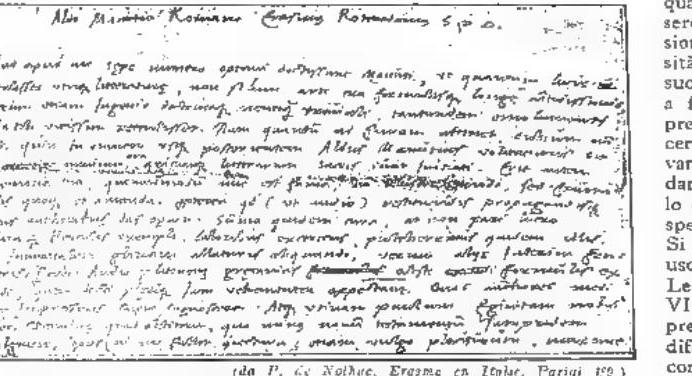
E. in fact did not clearly perceive what the events he had witnessed meant, essentially as a spectator. He was disturbed by the passions and hatreds unleashed, which threatened a dark barbarism, and he was vexed by those sudden events that impinged upon his sheltered scholarly life, such as, for example, the establishment of the Reformation in Basel (1529), which forced him to move to Freiburg. There, in 1533, he published the work De sarcienda Ecclesiae concordia, in which, while condemning the radicalism of the innovators on the one hand and the excessive zeal of theologians who saw heresy in everything on the other, he argued that the schism was still curable with a little good will—though he was mistaken. His chief concern, apart from certain literary controversies, was the work on the classics and the Fathers of the Church that he pursued with tireless energy. Precisely for this reason, in 1535 he decided to move once more to Basel, to the printer Froben. There, ever absorbed in his work, an attack of gout carried him off.
Events were maturing in those years that would overturn the “Erasmian” ideals. If there was a moment when all Europe seemed “Erasmian,” so that even in 1527 Charles V hailed E. as the “star of Christendom” and placed him above popes, emperors, and princes, the years that followed marked the end of the ideal unity of Europe to which E., in his own way, had believed. The champions of the Counter-Reformation judged him very severely; in 1557 the Inquisition condemned his works to the flames, and in 1559 and 1590 Paul IV and Sixtus V simply prohibited their reading. The fame of E., though not entirely extinguished, revived in the Enlightenment and in early Romanticism; even among Catholics judgments of him were nuanced, and among others Tiraboschi vindicated, though with some reservations, his substantial orthodoxy. — See pl. XXXVI.