
BROTHERS OF THE CHRISTIAN SCHOOLS
(Vol. Fotosedere)
BROTHERS OF THE CHRISTIAN SCHOOLS. – For a long time the members of religious associations dedicated to teaching were designated by the name “f.” [brothers]. The Netherlands knew the “F. of the Common Life,” founded by Gerard Groote in 1380. In France in 1681 the teachers gathered around Adrian Nyel in Rouen called themselves “f.” while maintaining full and complete freedom of action, without any canonical bond. The title they chose seemed to them most fitting to their modest function and their charitable initiatives. When “F. Nicolas Barré, of the Minims, frequenting them in Normandy, conceived the idea of a more stable society bound by vows later recognized by the Church, he called some of his disciples “F. of the Child Jesus.”
St. John Baptist de la Salle opened in Reims, with the assistance of Adrian Nyel, his first popular schools. This work was the result of a great movement of ideas, a current of initiatives that had arisen in various countries for Christian instruction to be imparted preferably to the children of workers and the poor, by men consecrated to the glory of God and the salvation of their neighbor, united in a common life and with rigorous pedagogical preparation.
The Institute of the F. of the Christian Schools began to exist with its own identity between 1679 and 1684. By the latter date it already had its essential characteristics in the remote house of Neuve: it had already spread into Champagne and its borders. Soon the F. organized a novitiate, an almshouse, and a “teachers’ seminary” for rural parishes. They applied the principles to which de la Salle attached the greatest importance: a very lively and complete catechetical instruction, the simultaneous method, and the substitution of the mother tongue for Latin in the first reading lessons.
In 1688 the center of the new institution was transferred to Paris in the parish of St. Sulpice, and with this began a new expansion, under the reign of Louis XIV, from Calais to Marseilles.
Struggles, persecutions, and sufferings of every kind came from all sides. Meanwhile the holy founder was securing the future of his spiritual family. In 1717 he promoted the election of Brother Barthélemy as the first Superior General and, together with his collaborators, drew up the definitive rule. Two years later, at his death, there were about 200 F. and some twenty houses. From 1707 Gabriel Drolin was in Rome, sent by de la Salle, where in 1705 he had been able to open a small school and, in 1709, obtain the official approval of the Supreme Pontiff.
The year 1724 marks the development of the Institute. It obtained from Louis XV letters patent and from Pope Benedict XIII, on 25 January 1725, the bull In apostolica dignitatis solio, which enrolled it among the institutes approved by the Holy See. The F. were now bound by the three vows of religious life, with the addition of that of gratuitously teaching the poor. Their numbers increased despite the attacks first of the Jansenists and then of the “philosophers.” From 1750 they were in Brittany, Anjou, Orléans, Franche-Comté, Lorraine, and the Dauphiné. They were called to Estavayer in Switzerland and had a house in Rome. Their motherhouse was still in Normandy, in the property of Saint-Yon, which preserved the relics of St. John Baptist de la Salle. Particular circumstances would later oblige the superiors to choose another residence. From 1780 to the Revolution, Melun was the seat of government of Brother Agathon, heir, administrator, and pedagogue of broad vision. Under his generalship the F. continued their work not only in elementary classes but also in teaching drawing, commercial accounting, and maritime hydrography. An intellectual elite prepared in the higher “scholasticates” to instruct the young people of the boarding schools, institutions created on the model of Saint-Yon to satisfy the desires of a social class little inclined toward classical culture but desirous instead of acquiring a scientific background and knowledge of modern languages.
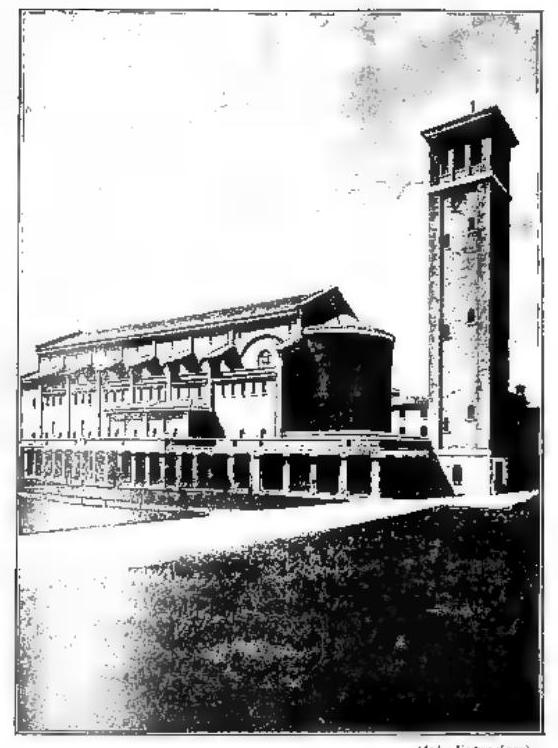
The events of 1789 brought ruin to a beautiful work. After the closing of numerous schools and the dispersal of teachers who refused to accept the Civil Constitution of the Clergy, by decree of 18 August 1792 the Institute was suppressed on French territory. Among the sons of de la Salle there were martyrs: Blessed Salomon in the prisons of the Carmelites in Paris, Brother Monitore on the scaffold in Rennes, others on the horrific prison hulks of Rochefort. Brother Agathon, imprisoned during the Terror, died obscurely in Tours in 1798. Meanwhile a group had taken refuge under the protection of the Pope. On 7 August 1795, with the brief Inter graves, Pius VI designated Brother Frumentius as vicar general of the Institute. Thus religious life continued. With the signing of the Concordat of 1801 the survivors immediately resumed their work. By decree of 3 December 1803 Bonaparte reestablished the Institute. Brother Frumentius responded in 1804 to the appeal of Cardinal Fesch, archbishop of Lyon. Thanks to his protection the Institute was reconstituted, and by decree of 7 March 1808 it was legally recognized. Its principal members, gathered in Chapter on 8 September, elected Brother Gérbaud as Superior General. The fall of Napoleon, far from hindering it, accelerated its progress. From 1816 the Institute was in the Belgian provinces of the Netherlands; it accepted from the king of France the teaching assignment on the Isle of Bourbon and in French Guiana; it spread into the States of the Church, at Bolsena and Spoleto; in 1830 it was in Turin. The generalship of Brother Philippe marked the era of worldwide expansion. At the beginning of his government the F. were already in Canada. From 1840 to 1870 they were in Asia, Africa, North America, and South America. Continental Europe welcomed these educators. Meanwhile the Third Republic expelled them from the free schools and from numerous post-school organizations in France: patronages, study circles, religious unions, and unions. The year 1900 brought them, in the social field, the praise and homage decreed by the jury of the Exposition, and in the spiritual field the canonization of St. John Baptist de la Salle. This was followed by a very harsh trial: the sectarian government on 7 July 1904 suppressed the Institute in France. Other persecutions followed in Mexico and Hungary.
According to the latest official statistics, the Institute has a de facto existence in France. The religious habit is now worn by the F. not only in the novitiates and formation houses but also in the schools, boarding schools, and large technical institutes such as those of Beauvais and Lyon. In Italy the two provinces of the Institute count 688 F. and 305 aspirants. In Belgium and Holland 1,411 Lasallian educators instruct 36,840 young people in 117 colleges, the most famous of which are the art schools known under the name of St. Luke. The Anglo-Irish province numbered 699 F. in 57 houses with 16,000 students. In Central Europe—Germany, Austria, Czechoslovakia, Romania, and Poland—there are only 600 members of the Institute, threatened today no less than yesterday. The Spanish Revolution sacrificed 159 disciples of the first de la Salle, but 1,459 have resumed their magnificent activity: 700 novices are preparing for the work, and 26,723 young people attend their schools, most of them free. In Portugal the first house was opened in 1932. Still to be noted in Europe are the Swiss College of Neuchâtel and the three Florentine schools in the principality of Monaco.
The Canada has two French-speaking provinces and one English-speaking province; in all, 1,346 Brothers, 500 young men in novitiates, and 32,000 pupils; 1,592 Brothers and 500 novices make up the two districts of the United States, where 43,000 young people attend their primary, commercial, agricultural, industrial, secondary, and higher schools. In Mexico a surprising prosperity has succeeded the anxieties and sorrows of the past. The Republics of Cuba, Nicaragua, Panama, and Santo Domingo have important houses of the Institute with 405 religious and 18,000 students in 33 colleges. South America—Argentina, Bolivia, Brazil, Chile, Colombia, Ecuador, Peru, and Venezuela—has 1,436 Brothers with 43,000 pupils. In Australia the Irish Christian Brothers, established in 1905, have 18 schools.
This worldwide expansion largely animates a missionary apostolate carried out in Muslim and pagan lands such as the Near and Middle East, Africa, China, the Indies, and Japan. It is a peaceful army of 14,500 educators distributed, for the salvation of souls, in 67 countries, whose moral and social influence extends to more than 400,000 young people, to whom may be added over 200,000 former pupils who remain part of post-school works. For the pedagogical principles followed by the Brothers of the Christian Schools, V. GIOVANNI BATTISTA DE LA SALLE, saint.