
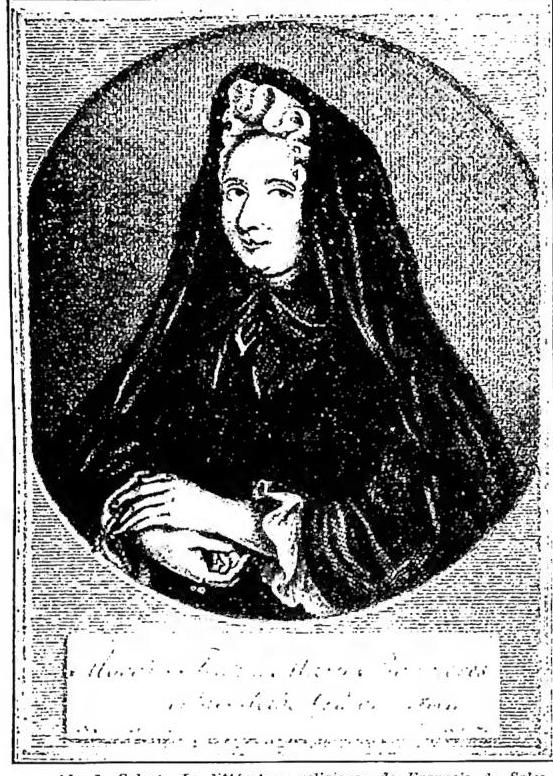
GUYON, Jeanne-Marie. — Quietist Frenchwoman, born at Montargis on 13 April 1648, died at Blois on 9 June 1717. After becoming a widow in 1679, she devoted herself to a life of charity.
---
AARLEM, DIOCESE OF. — City and diocese in Holland, suffragan of Utrecht. The first mention of the city of Haarlem dates to the second half of the 10th century; it was the residence of the Counts of Holland at the end of the 11th century. The diocese was founded in the year 1559 by Pope Paul IV with the bull *Super universas* and originally comprised only the province of North Holland and a small part of the province of South Holland. About 20 years later, the Protestant “Reformation” occurred. The territory was then administered by archpriests under the jurisdiction of the Apostolic Vicar of the Batavian Mission. The hierarchy was re-established in the year 1853; the first bishop was J. F. van Vree (1853–61).
The reconstituted diocese is larger than the ancient one, for in addition to the two provinces of North and South Holland (excluding the deanery of Hilversum), it also includes the island of Zeeland, with a total area of 6,600 km² and 4,100,000 inhabitants, of whom 1,286,412 are Catholic. These are distributed among 313 parishes, served by 832 diocesan priests and 276 religious; there are two seminaries, the major one in Warmond, founded in 1799, and the minor one in Hegeveld, established in 1817. There are also 37 male and 280 female religious communities (1949). Since 1835, three synods have been held in the diocese, the last in 1949.
The ancient cathedral of the 14th century, with a tall bell tower from the 15th century, was dedicated to St. Bavo; it is now occupied by Protestants. Notable within are the high central nave with ribbed oak vaulting and remnants of frescoes; the choir stalls and pulpit are also of oak.
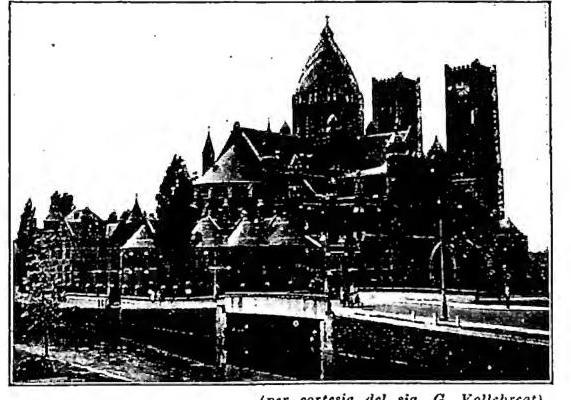
The new Catholic cathedral, also dedicated to the patron St. Bavo, was begun in 1883 and completed in 1930. Other notable sites include: the 14th-century chapel of the convent and hospital of the Knights of St. John; the 13th-century church of the former Béguinage. The Frans Hals Museum, housed since 1913 in the former almshouse (1608), is particularly noteworthy; it contains the principal works of Frans Hals and other Dutch painters. The Episcopal Museum was reorganized in 1932.
At Egmond, near the tomb of St. Adalbert, a church was erected by Count Theodoric II, and a Benedictine abbey was founded in 1950. In 1139 the abbey was so flourishing under Abbot Walter that Pope Innocent II enriched it with privileges; a church was then built and consecrated in 1143 by Bishop Artberto, and monastic buildings were enlarged. Reformed in the 15th century, the abbey joined the Bursfeld Congregation; it was later united in 1561 to the episcopal see of Haarlem. In 1573, however, the monks were expelled and the abbey destroyed. At the beginning of the 15th century, French Benedictine monks of the Congregation settled at Oosterhout in the Diocese of Breda, founding a monastery that became so prosperous that some of them later returned to Egmond, establishing a new monastery that the Holy See recognized as a priory in 1947.
Pope Pius XII, by an apostolic letter of 14 February 1950, elevated the Priory of Egmond to the status of an *abbatia nullius*, united to the French Benedictine Congregation (AAS, 42 [1950], pp. 550–51).