
HILDREBRANDT, JOHANN LUCAS von. – Architect, b. Genoa 14 Nov. 1668, d. Vienna 16 Nov. 1745. His father, a German, served as a soldier in the pay of the Genoese; his mother was Italian. H. spent his youth in Genoa, where he learned his craft and executed his first documented work, a design for a convent adjoining the church of S. Maria di Carignano.
In 1696 the architect was in Vienna, where he received the title of court engineer, and in Austria and the Catholic German lands he pursued the rest of his career. In 1730, on the death of J. B. Fischer von Erlach, he was appointed superintendent of imperial buildings. Among his principal works are the Viennese palaces of Schwarzenberg, Schönburg, Schönborn (afterwards the Ministry of Finance), the castle of Mirabell in Salzburg, and the palaces of Hetzendorf, Daun-Kinsky, and the two castles of the Belvedere—together with that of Pommersfelden, not far from Bamberg in Germany, and the castle of Würzburg, these may be reckoned among his finest achievements.
Trained in the military milieu of his father, he acquired a solid technical grounding that underpinned his free Baroque architectural imagination, which was receptive to the charm exerted by Juvarra and by the Piedmontese and Lombard masters who variously interpreted forms derived, albeit distantly, from Borromini. This training, nourished by a notable taste for picturesque architecture, left its mark throughout the architect’s career. He is to be numbered, with Fischer von Erlach, among the greatest architects active during the Baroque age not only in Austria but more generally in the German lands.
Emilio Lavagnino
HILDESHEIM, DIOCESE OF. – The city of H., situated at the north-western edge of the Harz mountains and at the beginning of the North German plain, has 24,000 Catholics out of a total population of 70,000. The first missionary foundation dates from about 775, during Charlemagne’s wars against the Saxons. It was erected into a diocese, under the patronage of the Assumption of Mary, by Louis the Pious on 19 July 815 for the Ostfalian part of Saxony. The original oratory of Louis the Pious (legend of the thousand-year-old rose) was incorporated by Bishop Altfried (851–74) as the eastern apse of the cathedral he built. Under Altfried the first monastic foundations were established: Gandersheim (852) and Lamspringe (872). Under Bishop Othwin (962) the relics of St Epiphanius of Pavia were translated. The golden age of the diocese extended until the mid-thirteenth century.
Outstanding monuments: to the time of Bishop Bernward (993–1022) belong the construction of St Michael’s with its Benedictine abbey, the finest church of early Romanesque style, with notable preserved works in goldsmithing, illumination and bronze-casting (Bernward’s doors, Christ’s column, Bernward’s cross, etc.). Under Bishop Godehard (1022–38) more than thirty new churches were built, including St Maurice and St Andrew in H. Under Bishop Hezilo (1054–79) the cathedral of Altfried, destroyed by fire, was rebuilt: a three-aisled Romanesque basilica (destroyed 22 March 1945) with cloister. In the twelfth century numerous monastic foundations were made by Benedictines, Cistercians (Amelunxborn, the first Cistercian monastery in Lower Saxony) and Augustinian Canons. Bishop Bernward promoted the
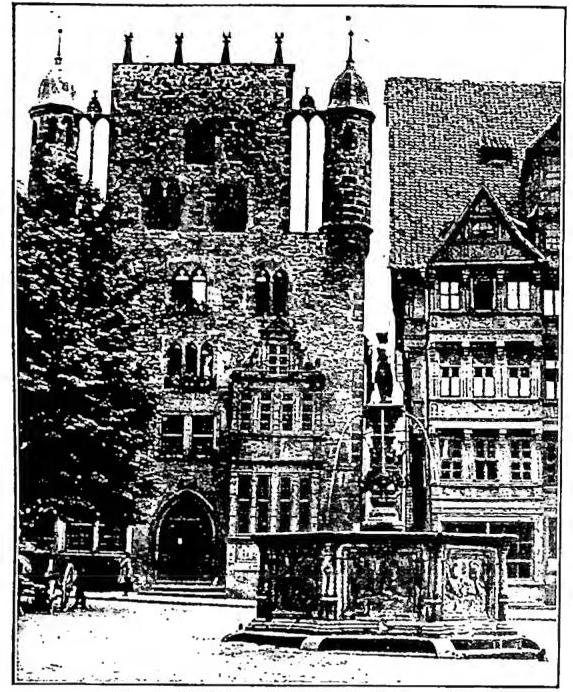
Hildesheim, diocese of – Knights Templar house (14th c.)