
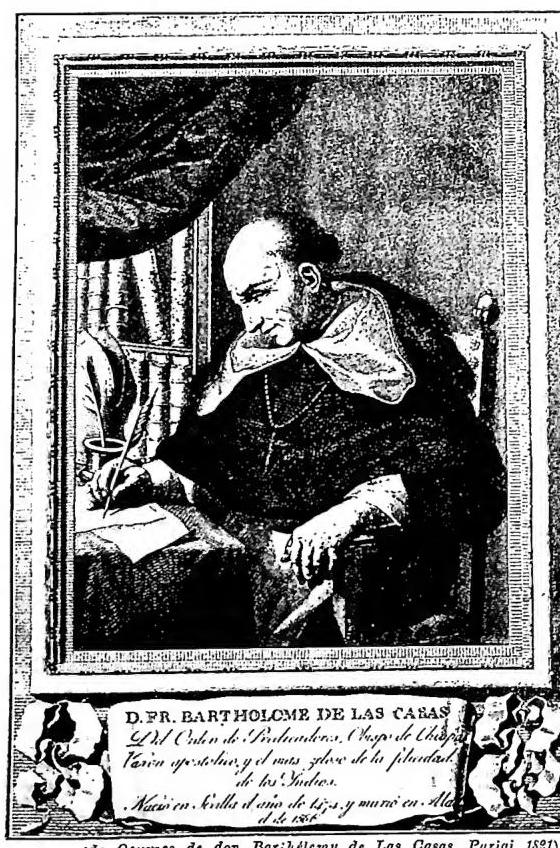
Even while studying law at the University of Salamanca, he began to take an interest in the new lands that the discovery of America had opened up to Europeans. It is worth noting that his father had accompanied Columbus on his second voyage (1493). Therefore, at the age of 28 (1502), he himself set sail for Hispaniola to take possession of his father’s rich estate and to make his fortune. At first, then, he was an exploiter of the Indians, like all the other conquistadors; he himself would recall this with bitterness in the *Historia de las Indias*. But over the course of about ten years, through contact with some Dominicans, he not only abandoned the estate but became a tenacious protector of the oppressed indigenous peoples, devoting the remaining fifty years of his long life to their cause and, for this purpose, crossing the ocean no fewer than a dozen times.
He fought first and foremost against the *encomienda*, that is, against the inhuman exploitation of the Indians under the specious pretext of evangelizing them; naturally, he encountered strong opposition from the conquistadors, whose colonial system was thus overturned. His fundamental vision, which was in truth somewhat one-sided—as will be explained more fully in his writings—can be briefly summarized as follows. Providence had reserved for Spain the discovery of the new lands for the evangelization of those peoples, of an angelic simplicity and goodness, who lacked only the light of the Gospel. Instead, the Spaniards, in defiance of every human and divine law, had set aside evangelization and given themselves first to plunder and oppression, heedless of the shedding of indigenous blood. In 1516, L. C. was appointed general protector of all the Indians and succeeded in having laws reformed in their favor. But upon his return to America, he was unable to implement these measures, so he devised a new system of colonization, entrusting the exploitation of part of the territory to peaceful Spanish colonists (1520). The experiment proved a dismal failure, and from that point onward he decided to devote himself entirely and exclusively to evangelization through preaching. To this end, he relied on the Dominican Order, which had guided and always supported him in this direction, and he became a friar (1523); he had been a secular priest since 1510.
In 1539, he wrote the *Brevísima relación de la destrucción de las Indias*, which was not published until 1552 in Seville and was later translated into various languages. His fervent and impassioned defense of the Indians met with further success in 1542, when he obtained from Charles V new laws in favor of those he protected; moreover, to enhance L. C.’s prestige, the Emperor proposed him for the episcopal see of Chiapa(s), now in Mexico. The Pope consented (19 Dec. 1543): the consecration took place in Seville on 30 March 1544. Yet even these new measures did not overcome the hostility of his adversaries, who in fact accused him of treason and heresy, forcing him to return to Spain to clear his name (1547). It was then that he faced his great opponent, J. Ginés de Sepúlveda, who argued for the natural slavery of the conquered, and he defeated him in a famous juridical-theological debate on the subject. In 1551, L. C. missed the opportunity to return to his Indians, and—already nearly eighty years old—he resolved to remain in his homeland, though he continued to defend them with his pen.
Besides the aforementioned *Brevísima relación*, L. C. left numerous writings, some still unpublished. Particular mention should be made of the *Historia de las Indias*, incomplete (published in *Colección de documentos inéditos para la historia de España*, vols. 62–66, Madrid 1875), which, despite its flaws, remains a rich and valuable source on the early Spanish colonization as well as on the life of Christopher Columbus, whom L. C. had known personally. To complement this history, one may cite the *Apologética historia sumaria*... (published in *Nueva biblioteca de Autores españoles*, XIII, Madrid 1909), on the geography, customs, and character of the population. The zeal of L. C. for an undoubtedly good cause, his irascibility, and the fiery eloquence with which he confronted the obstinacy and methods of the colonists led him to exaggerate; as a historian he is questionable, but as an apostle he is a figure of the first rank.