
Papal Mantle
A sacred vestment, very ample with a train, also called a pluvial or *cappa pontificalis*. It is similar to the pluvial, but longer, extending from the neck down beyond the feet; it has no sleeves, is open at the front, and is fastened at the chest by two small silver-gilt hooks, which are then covered by the *formale*. In ancient times, a hood was attached to it at the back; now, in its place hangs a semicircular piece of cloth, sewn only at the top.
The papal mantle (*m. p.*) is made of silk in white, rose, red (a color that in papal vestments replaces black and purple), or green, according to the liturgical season, adorned with magnificent gold embroidery on the extreme edges (called *pedana*), across the entire back, and especially on the wide front panels that also surround the neck. The former hood area is further decorated with gold fringe and tassels.
The *m. p.* is placed on the pope’s shoulders in the Sacristy by two Auditors of the Roman Rota; the first Cardinal Deacon fastens it at the chest with the hooks and then places the *formale* over them. Then, the first two Cardinal Deacons, who assist at the throne, take the extreme edges and hold them during all the pope’s actions at the throne, arranging the mantle so that it covers his august person. When the pope is at the kneeler, these duties are taken over by the first two Masters of Ceremonies, who arrange the *timbrici* of the *m. p.* over it; the train of the *m. p.* falls onto the *falda*, which, together with the latter, is supported by two Auditors of the Roman Rota (cf. the constitution *Ad incrementum decoris* of 15 August 1934: *AAS*, 26 [1934], p. 511, no. LXXVII).
The newly elected pope first wears the *m. p.* to receive the second and third adorations of the cardinals. He then wears it during pontifical functions in the chapels he attends, during the ceremonies of possession, the opening and closing of the Holy Door, public and semi-public consistories, and finally to intone the hour of Terce if he solemnly celebrates Mass, and to give the solemn blessing.
---
Diocese of Mantova
Diocese and provincial capital city in Lombardy.
It covers an area of 2,024 km², with a population of 375,000, of whom 374,586 are Catholic; it comprises 153 parishes served by 312 diocesan priests and 16 religious, has 1 seminary, 2 male religious communities, and 86 female ones (*Annuario Pont.*, 1951, p. 263).
### I. History
Mantova is surrounded on three sides by the Mincio River. Its name derives from the Etruscan underworld deity *Mantus*, revealing its ancient origins; a legend attributes its founding to Manto, daughter of Tiresias (Dante, *Inferno*, XX, 52-99). It was conquered by the Gauls and later by the Romans; the veterans of Julius Caesar received portions of its land. It was devastated by Alaric in 401, occupied and fortified by the exarchs of Constantinople, taken by the Lombards, and later passed to the Canossa family. In 1091 it surrendered to Henry IV; in 1126 five consuls were appointed; it was favorable to the Empire, especially during the time of Bishop Garsedonio, but participated in the Lombard League and fought in 1167 at Alessandria and Legnano. Later, various families such as the Casaloldi, Riva, Poltrone, Arlotti, and Bonacolsi contended for the city; their rule ended in August 1328 when, in a violent riot in Piazza Sordello, they were driven out, and the Gonzaga family (marquises and later dukes of Mantova) rose to power, around whom the history of Mantova revolved for more than three centuries. Afterward, it declined, and Mantova, after various vicissitudes, passed to the Austrian Empire in 1707. It was besieged by the French in 1796; in 1799 the Austrians entered it; but with the Peace of Lunéville in 1801 it was retaken by the French, becoming the capital of the Mincio Department until 1814. It was then annexed to the Kingdom of Lombardy-Venetia in 1815. Ciro Menotti led an unsuccessful uprising, and later the Belfiore executions took place (1851), until with the Peace of Vienna on 11 October 1866 it was annexed to the Kingdom of Italy.
The origins of the Church of Mantova are obscure. A letter from the deacon Crispo of Milan to Bishop Mauro of Mantova dates to the end of the 7th or beginning of the 8th century (MGH, *Epistolae*, III, p. 698, no. 7). The first bishop of certain date is Iaiolfo, present at the Synod of Mantova in 827 (P. Paschini, *Le vicende politiche e religiose del Friuli nei secoli nono e decimo*, in *Nuovo archivio veneto*, new series, 20 [1911], pp. 240 ff.).
Egilulfo is then known from a letter of Pope John VIII in the year 881; Pietro, mentioned in a privilege of Lothair in the year 945; then Guglielmo in 962; Gombaldo in 981; Giovanni during the time of Otto III; Ilulfo, who received privileges from Henry II and Conrad II; Marciano during the time of Henry III; under Eliseo, two councils were held in Mantova, the first in 1053 by Leo IX, the second by Alexander II in 1064. During the time of Gregory VII, there was a schism caused by the supporters of Henry IV against Bishops Ubaldo and Ugo. For a long time, the bishops were also civil rulers of Mantova. In 1235 Uguccione degli Avvocati killed Bishop Guidotto, and from then on the civil authority of the bishops of Mantova declined. In 1466 Cardinal Francesco Gonzaga was bishop of Mantova; Cardinal Sigismondo Gonzaga was administrator in 1511; in 1521 his nephew Ercole was created bishop of Mantova; in 1563 Cardinal Federico Gonzaga was administrator; in 1565 Cardinal Francesco Gonzaga; later bishops of Mantova were found in 1574 Marco Fedele Gonzaga and in 1593 Francesco Gonzaga. The bishops of Mantova were suffragans of the Patriarch of Aquileia until 1453, when Nicholas V made Mantova immediately subject to the Holy See. In 1803 it became a suffragan of Ferrara, and in 1819 of Milan. From 1884 to 1893, Bishop G. Sarto (later Pius X) served in Mantova.
In 1472, through the work of A. De Micheli, the *Divine Comedy* and the *Decameron* were printed there.
Among the illustrious Mantovans, besides Virgil born in Andes (now Pietole), are remembered the troubadour Sordello of Goito, Baldassare Castiglione, St. Aloysius Gonzaga (v.), the blessed Alberto of Mantova, Alberto Gonzaga bishop of Ivrea, Antonio Gonzaga, Bartolomeo de’ Fanti, the blessed Elisabetta Picenardi; the Fathers Teofilo Folengo, Antonio Possevino, etc.
In 1642 it had a university entrusted to the Jesuits, established in Mantova since 1584. The Accademia Virgiliana was founded by decree of Maria Theresa in 1767 with its own theater (Teatro Scientifico).
### II. Archaeology
In the Cathedral since 1776, and coming from the demolished church of St. Agnes, a Christian sarcophagus from the end of the 4th century is preserved, once gilded, depicting Christ among the 12 Apostles. On the lid, in the center, the Nativity; on one side Christ on the mountain with two disciples; on the other, a wedding scene with a notary recording the act on diptychs (Wilpert, *Sarcofagi*, I, pl. 30 and p. 39; pl. 74, 5 and 6, p. 91; II, pp. 283, 338-39). A Christian inscription, discovered in 1785 in the church of St. Benedict, commemorates a “Thomas vir honestus negotiator,” who died in 540 (CIL, V, 4084).
### III. Art
There is a fair amount of archaeological documentation of ancient Mantova, an Etruscan and then Roman city.
(Alinari)
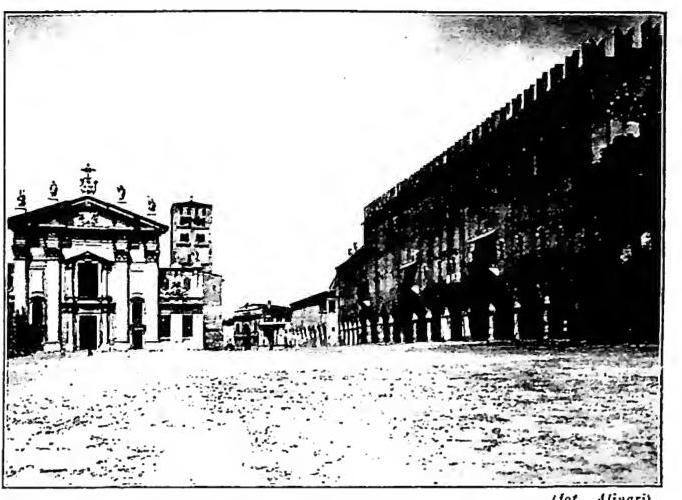
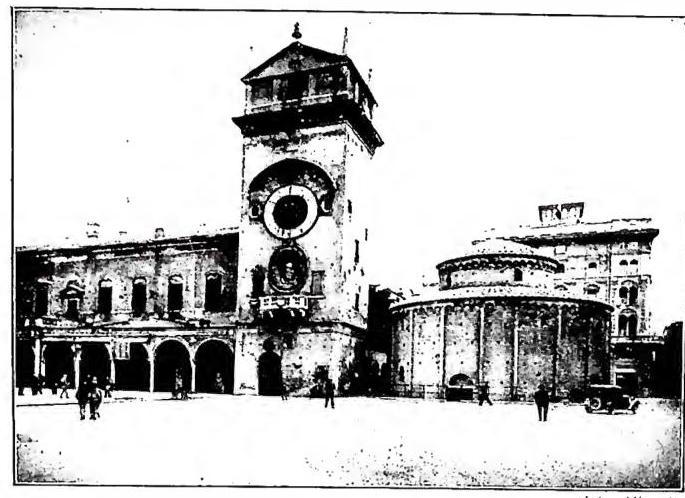
Noteworthy among these are those that recall the troubled civic life of the High Middle Ages, before Mantua flourished anew in the Romanesque age. Of that period are the notable monuments: the Rotonda of S. Lorenzo, built around the year 1000 on the ruins of Roman buildings; the bell tower of the church of S. Gervasio and that of the Duomo, as well as various civil buildings entirely or partly from that age, such as the oldest parts of the Palazzo della Ragione, the Arenarium, and the Palazzo del Broletto, on whose corner tower—where an inscription recalls its construction in 1227—there is also a rough monument to Virgil... *Mantuanus poetarum clarissimus*, a testament to the great honor in which the singer of Aeneas was held in his homeland even during the Middle Ages.
The church of Gradaro, with its grand ogival portal signed by Jacobus et Grata-sola Ognabens, a work from the end of the 13th century; that of S. Francesco; the oldest parts of the Duomo; the bell tower of S. Andrea from 1414; the ancient Palazzo dei Bonacolsi; that of the Captain of the People; and the castle of S. Giorgio, built by the architect Bartolino da Novara, are instead constructions in the Gothic style. But it was during the 15th and then the 16th centuries, under the rule of the Gonzaga, that Mantua was transformed and became, through the work of the great artists summoned to that court, one of the most splendid cities of Lombardy. Indeed, during the principate of Marquis Ludovico (1444–76), Leon Battista Alberti, Luca Fancelli, and Andrea Mantegna arrived in Mantua, while in the time of Marchioness Isabella d'Este (1454–1539), wife of Francesco II, the Gonzaga palace—a complex of buildings from various periods and one of the most splendid in Italy—accumulated priceless works of ancient and modern art. With Federico II, Giulio Romano was invited to Mantua in 1524, at the suggestion of Baldassare Castiglione. The most notable monuments of that age are, along with the famous frescoes of Andrea Mantegna (*q.v.*) in the Palazzo Ducale, S. Andrea, the chapel of the Incoronata near the Duomo, S. Sebastiano, and the Palazzo del Te.
S. Andrea, which also houses Mantegna’s tomb, was conceived by Alberti but executed in its general layout by Fancelli and, toward the end of the 16th century, in the construction of the two arms of the transept by A. M. Viviani; it was then completed with a unified character, according to the original designs, between 1732 and 1782 by Paolo Pozzo and Filippo Juvarra, who designed its dome. S. Sebastiano, like the chapel of the Incoronation near the Duomo, are also Albertian works. The Palazzo del Te, instead, is an architecture by Giulio Romano, whose activity in the field of environmental decoration left a strong mark on local taste, which persisted throughout the 16th century, as is evident in the Palazzo di Giustizia designed by Bertani at the end of the century.
Among the works of the Baroque period, particular mention should be made of the church of S. Maurizio, with its tall, distinctive façade; that of S. Barnaba, which houses in the *sala Roma* the major work of Giuseppe Bazzani, the brilliant Mantuan painter of the 18th century; and that of S. Filippo. In the field of civil architecture, the Palazzo del marchese Sardi by the architect Francesco Geffels, that of the archbishop, another of the marchese Cavriani from the second half of the 18th century, and finally the Casa Mantovani on Via Giovanni Chiassi stand out. During the 18th century, in addition to Bazzani, the Veronese Giorgio Anselmi left significant paintings in Mantua, while the Neoclassical taste soon took hold in the city through the work of Paolo Pozzo, who in 1779 transformed some rooms of the Ducal Palace, and then through that of Luigi Canonica, to whom the Teatro Sociale (1822) is owed. Of the 20th century, the most notable work is, within the ensemble of Piazza Virgiliana, which dates back to 1797, the monument to the great poet, conceived by Luca Beltrami but with sculptures by E. Quadrelli and G. Menozzi.