
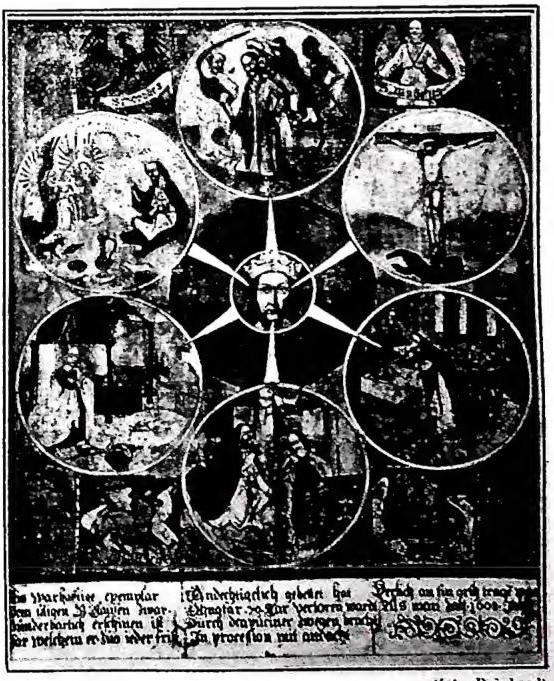
NICHOLAS OF FLUE (of the Rock), St. — Patron of Switzerland, b. at Flüeli (parish of Sachseln, Unterwalden) in 1417, probably on 21 March, d. at Ranft on 21 March 1487. He married Dorothea Wiss of Schweind, by whom he had ten children. He held public office in the commune and canton: judge and councillor (1459), deputy to the Federal Diet (1462); he refused, however, the office of head of state. He took part as a soldier and officer in military expeditions (Old Zurich War) and during the war of Thurgau against Sigismund, Duke of the Tyrol, excommunicated by Pius II, he is said traditionally to have saved from destruction the nunnery of Katharinenthal (1460).
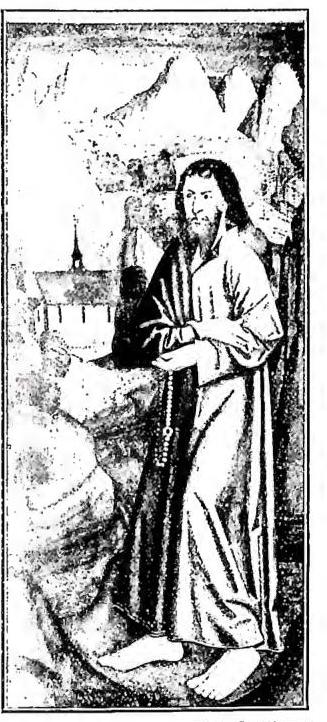
Instructed in mysticism by his friend the priest Heimo am Grund, on 16 Oct. 1467, with his wife’s consent, he left his family to live as a hermit and settled in the gorge of Ranft (Sachseln), where he lived in meditation and the severest penances. His visions and his miraculous fast of about twenty years are famous, during which the Eucharist was his only nourishment. His withdrawal from the world did not, as he hoped, mark the end of his activity, but rather the beginning of his historical and political work. The fame of his holiness and his fast spread rapidly beyond the borders of the Confederation into Germany and Italy; visitors of every rank flocked to him from all sides, and contemporary chronicles represent him as the saint of peace. His influence in federal affairs is evident already in the conclusion of the Perpetual Peace with Austria in 1473; but his most important pacifying work was accomplished from 1478 onwards. The Confederation, in the grip of a severe crisis aggravated by the consequences of the war, though victorious, against Charles the Bold, Duke of Burgundy (1474-77), saw the rise of division between city-cantons and rural cantons over the admission of Fribourg and Soleure to the Confederation and the division of the spoils of war. Nicholas worked to settle matters and accomplished the miracle of reconciling the embittered spirits at the Diet session of 22 Dec. 1481 at Stans. The danger of civil war vanished, Fribourg and Soleure were admitted to the Confederation, and on the same day the Stans Pact was concluded, which, despite the religious schism, constituted until 1798 the public law of the Confederation. From that time until today Nicholas has been regarded, by both Catholics and Swiss Protestants, as the peacemaker and father of his country. Up to his death and ever since, his name has been for all a symbol of peace, concord, and federal loyalty; above all in moments of crisis, Catholics and Protestants invoked his name and were inspired by the political principles inculcated by the holy hermit who, an enemy of war, had recommended neutrality and warned the Confederates against policies of conquest, foreign alliances, mercenary service, royal pensions, and interference in other states.
His cult was approved by Innocent X (1 Feb. 1649); Clement IX (23 Feb. 1669) granted the Office and Mass in his honour (cf. Decreta Servorum Dei 1592-1654, pp. 814-815; ibid. 1655-75, pp. 655-57, in Arch. S. Congr. dei Riti); he was canonized by Pius XII on 15 May 1947. Feast 21 March; for Switzerland, 25 Sept.