
POMPEI (Gr. Πομνίγια). — Situated on the great coastal road from Naples toward southern Italy, it was founded by Oscan peoples of Campania near the lower valley of the Sarno. At first it was under the hegemony of the Greeks, who dominated the region from Cumae to Punta della Campanella and prevailed in political influence over the area.
Toward the end of the fifth century, the Samnites subjugated it and gave it their Italic imprint. During the Hannibalic War, P. remained neutral between Rome and Carthage; but in the Social War it took part with the Italians against Rome and was subjugated by Sulla and reduced to a Roman colony, with the title of Colonia Cornelia Veneria Pompeianorum, without, however, losing its old regional spirit. In A.D. 63 it was severely damaged by an earthquake (Tacitus, Annals, XV–XXII), and in 79 it was destroyed by the eruption of Vesuvius described by Pliny the Younger (Epist., VI, 16, 20), who recounts the death of his uncle Pliny the Elder. The city was buried beneath a mass of ash and lapilli four to five metres high. Its economic and maritime function was inherited by Stabia and, in modern times, by Torre Annunziata. The archaeological excavations, begun in 1748 under King Carlo di Borbone, received a great impetus in the first half of the nineteenth century and were systematically organized from 1860 onward under the direction of Giuseppe Fiorelli and his successors. To the last of these, Amedeo Maiuri, are owed the present renewal of the ancient city’s character and the most recent and complete description of II.
P. E I CRISTIANI. - La questione del cristianesimo a P. è stata spesso agitata, non nel senso che vi fossero dei cristiani in essa al tempo della sua catastrofe, ma se di essi siano giunte a noi tracce monumentali. Infatti non si potrebbe dubitare ragionevolmente che già nel 79 P. ospitasse un certo numero di cristiani. S. Paolo approdò nei primi mesi del 60 a Pozzuoli e vi trovò una comunità di cristiani, con i quali si trattenne circa una settimana (Act. 28, 14). Ciò vuol dire che la nuova fede si diffuse prestissimo nelle cittadine del golfo partenopeo, e quindi anche a P.
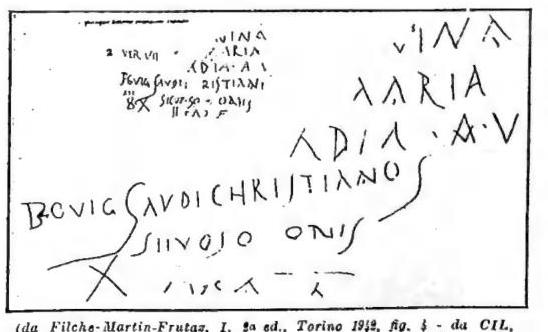
Ma lo scavo della città sommersa dal Vesuvio ha reso qualche testimonianza tangibile dell'esistenza di questi cristiani? Molti indizi sono stati raccolti in questo senso, ma così tenui che difficilmente resistono ad una critica un po' rigorosa. Maggior valore sembra avere una scritta a carbone vista « sulla parete di una grande stanza posta nella via che costeggia le terme stabiane » e purtroppo da tempo svanita, nella quale, anche se non si ammette la lettura del De Rossi audi christianos saevos olores, è tuttavia difficile negare che ci fosse il nome dei cristiani.
Recentemente la questione fu rinfrescata dal ritro-
ROTAS
OPERA
TENET
AREPO
SATOR
finora ritenuta opera di cristiani. Naturalmente si cominciò a mettere in dubbio anche la cristianità di questo gioco di parole e la questione dei cristiani a P. restò sostanzialmente allo stesso punto.