
SAMARIA (Hebr. Šomērôn; Ass. Samarina; Gr. Σαμαρέεια). — A city founded in 880 B.C. by Omri (cf. Amri), sixth king of Israel, at the center of his kingdom, on the summit of a hill (443 m. above sea level), purchased for two talents of silver from a certain Somer (1 Kings 16:24); the present-day Arab village of Sebastijieh, 10 km northwest of Nābulus, occupies its ancient site.
The choice of site was excellent (Is. 28:1), at the crossroads of the main communication routes, with the possibility of fortifying its flanks effectively.
Archaeological excavations, partially undertaken in 1908–10 and 1931–35, have revealed the historical vicissitudes of the city under Omri (880–721 B.C.), Sargon (721–331 B.C.), Alexander the Great (331–323 B.C.), and Herod the Great (30 B.C.).
Omri, having leveled the western side of the summit, then unoccupied (though archaeological finds show it had been used by a Canaanite settlement in the 3rd millennium B.C.), built the royal palace, which was later enlarged and embellished by Ahab and then by Jeroboam II. Under Ahab, the citadel with the palace and temple was enclosed by a double parallel wall, broken by rooms, and to the southwest a watchtower was erected, from which the name Šomērôn (“watchtower”) may have derived. In the southern part of the great western courtyard of the palace, in the ruins of a large building, 75 ostraca were found, written in archaic Hebrew with black ink using a reed, marking the distribution of oil or wine to the royal stores. They mention 22 names of villages in the territory of Manasseh and the names of royal stewards, and the element Ba’al appears frequently, confirming biblical data regarding the religious conditions of the Kingdom of Israel after Omri (1 Kings 16:31–33; 2 Kings 10:18). In the northwest corner of the citadel, a large basin (10 x 5 m.), partly cut into the rock but entirely cemented, may represent
In 30 B.C., the emperor Augustus ceded it to Herod the Great, who completely transformed it and in 27 B.C. named it Sebaste, after his patron Augustus, repopulating it with Roman colonists and merchants.
A vast circuit of walls, reinforced with towers, was built along the flanks of the hill, extending northward to the valley floor, where the stadium was located, and northeast to the site of the present village of Sebastijieh. A monumental gate, flanked by two circular towers, led into a colonnaded street about 1,700 m long. Above the ruins of the royal palace of Ahab and Omri and perhaps the temple of Baal, a grand staircase led to a vast terrace on which stood the Augusteum, an apsidal building with porticoes, an altar, and a statue of Augustus. Further north was the temple dedicated to the goddess Kore, whose statue was found in a cistern; in the temple two stones were discovered bearing relief symbols of two oval helmets entwined with laurel and surmounted by a star, the symbol of the Dioscuri, venerated in Samaria’s pantheon. Today, the ruins of the stadium, theater, forum, basilica, mausolea, and aqueducts are still recognizable. Herod rebuilt the city, and later the Roman governors stationed five cohorts of Sebasteans there; under Claudius (42–54 A.D.), a cavalry unit was also stationed.
In Samaria, Christianity was introduced by the deacon Philip, who encountered Simon Magus there (Acts 8:9–14). During the disturbances of 64, soldiers maltreated the Jews severely, who in 66 took terrible vengeance by burning the city.
After 70 A.D., Vespasian withdrew the troops. In 196 A.D., Septimius Severus imported new inhabitants and granted it colonial rights under the title Colonia Lucia Septimia Sebaste, restoring the walls, public buildings, theater, and forum; but the city was gradually losing its importance as nearby Neapolis (cf. Na-
“the pool of Samaria” (1 Kings 22:38), where the chariot of Ahab was washed after the fatal battle of Ramoth-Gilead. In 1932, among the ruins of the citadel, a rich collection of ivories, about 200 pieces, was discovered, some inlaid with lapis lazuli or other colored substances and covered with gold leaf, all delicately decorated with mixed motifs of Egyptian or Oriental origin, dating to the 9th century (1 Kings 22:39). Amos (3:15) deplored its excessive luxury.
Beyond architecture, Phoenician influence deeply affected the religious sentiments of the population. Ahab (cf. Ahab), having married Jezebel (cf. Jezebel), daughter of Ethbaal, king of Sidon, ended by making the worship of Baal Melqart, venerated in Sidon, public in the capital. Near the palace he erected a temple served by Phoenician priests, maintained by the public treasury, where he placed a massebah in honor of Baal and an asherah for his consort Astarte (cf. Astarte), who was widely honored among the people, as indicated by amulets bearing the figure of the goddess. Against the encroaching polytheism, the prophets Elijah (cf. Elijah) and Elisha (cf. Elisha) courageously protested. Jehu reacted violently, had the priests killed, burned the massebah of Baal, and after demolishing the temple, turned it into an unclean and impure place; perhaps for this reason no trace of it has been found (1 Kings 16:23; 2 Kings 3:2; 10:18–27). Nor has the site of the royal necropolis (1 Kings 16:28; 22:37; 2 Kings 13:9; 14:16) yet been located; however, excavations were mainly conducted in the citadel.
Strongly fortified, the city resisted the serious attacks of the Syrians of Damascus (1 Kings 20:1, 13, 21) and for three years withstood the siege of the Assyrian Shalmaneser V, until it was captured in 721 B.C. by Sargon, who deported its inhabitants to Assyria and replaced them with people of different stock, who mingled with the few Israelites remaining, forming the mixed race of the Samaritans (cf. Samaritans). From the destruction of 721 B.C. until the time of Alexander the Great, little is known: a Neo-Babylonian letter addressed to Abi-Ahi, governor of Samarina, and many potsherds attributed to the Assyrian-Babylonian and Persian periods attest to the two foreign administrations.
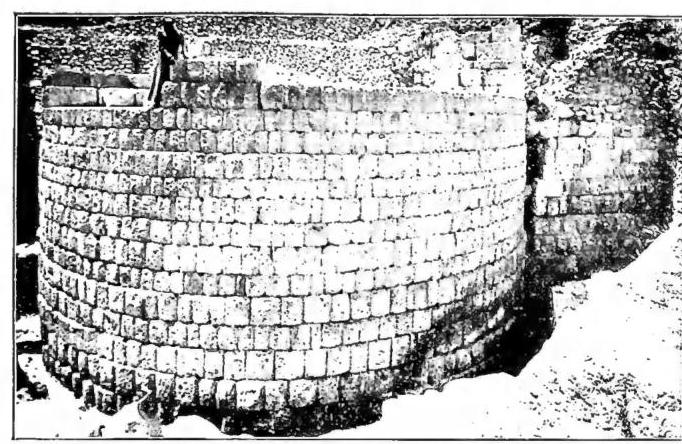
In 331 B.C., Samaria first submitted, then attempted to rebel against Alexander the Great, who dismantled it and imposed a colony of 6,000 Macedonians. Renewed by the Macedonian Perdiccas, it was again destroyed by Ptolemy I and later by Demetrius Poliorcetes, but enjoyed a period of prosperity; around 108 B.C. it was taken and destroyed, though not annihilated, by John Hyrcanus. A fine round tower with sections of wall, numerous fragments of Rhodian-type jars, coins, and inscriptions (including a Greek votive stele of Hegesander with his wife Xenachis and children, dedicated to Serapis and Isis) indicate the Hellenistic-pagan revival of the city. In 63 B.C., occupied and rebuilt by Pompey the Great, it was further fortified by the governor Gabinius in 57 B.C., so that its citizens were called “Gabiniani.”
SAMARIA — SAVARIA — SAMARITANI
was adopted to signify the Revelation of the Messiah, but Wilpert (Pitture, pp. 390–93) discerns in the depiction of Praetextatus and in that of the third cubicle of Domitilla a hint of the rite of refrigerium. With a different meaning, perhaps, and without the figure of Jesus Christ, the S. was painted in the Christian building at Dura-Europos (c. mid-3rd century), and in this Hopkins is to be preferred to Baur, who sees Oriental influences there (cf. Ph. Cl. Hopkins, The Christian chapel at Dura-Europos, in Atti del III Congresso intern. di archeol. crist., Rome 1934, p. 492, fig. 2; P. V. Baur, Les peintures de la chapelle chrétienne de Dura, in Gazette des beaux arts, 75 [1933], pp. 76–78).
There are about fifteen examples provided by the sarcophagi, almost all from the 4th century. The sculptors, in addition to the two traditional figures, give special prominence to the well. In the reliefs, Jesus Christ more decisively assumes the role of teacher, holding the scroll of the Law in his hand or a bundle of volumes near the well. The basilica architecture has also provided, both in Sant'Apollinare Nuovo in Ravenna and in the baptistery of Naples, two traditional examples in which, however, the well is replaced by a stream in the first (cf. C. Ricci, Ravenna, 8th ed., Bergamo n.d., p. 79, fig. 68).
Other scenes of the Samaritan Woman are provided by African terracottas (F. Coudray La Blanchère - P. Gauckler, Catalogue du Musée Alaoui, I, Paris 1897, p. 209, pl. 37,5), by gold and ivory objects, pyxides from Leningrad, the Voulette-Chillac, and Cluny (late 5th - early 6th century; cf. G. Rouault de Fleury, La Messe. Etudes archéologiques, V, Paris 1887, pl. 359; 366; 367,1), and by sacred goldsmith work. Finally, mention should be made of the 10th external panel of the ivory throne of Maximian in Ravenna, where new elements appear, such as the cross, the amphora, etc. (cf. C. Cecchelli, La cattedra di Massimiano ed altri avori romano-orientali, Rome 1936, pp. 176-77, pl. 31).
The exposition of the Samaritan Woman continues to be represented in medieval and modern art: e.g., in the *Exultet* of Pisa, in the mosaics of Monreale (13th century), in a bas-relief in the Louvre (14th century), in a remarkable panel by Duccio (specifically the *Maestà*, Siena), in a lunette by Giovanni Della Robbia (Florence, Bargello), in paintings by Tintoretto (Florence, Uffizi), by Lavinia Fontana (Naples, Pinacoteca), by P. Mignard (Paris, Louvre), etc.