
TEBESA. - Theveste, a city and ancient diocese located in Proconsular Africa, present-day Algeria, is today a titular see.
From the beginning of the empire of Tiberius until the Flavians, T. was the seat of the Third Augustan Legion. In 508 T. was occupied by the Vandals, as attested by an inscription (CIL, VIII, 16516; S. Gsell, *Les monuments antiques de l'Algérie*, II, Paris 1901, p. 273, no. 1). Around 535 another inscription documents that T. was rebuilt from its foundations by the Byzantine commander Solomon (CIL, VIII, 16507). At that time the city was fortified, enclosed by walls with 14 towers and three gates (Ch. Diehl, *L'Afrique byzantine*, Paris 1896, pp. 186-90).
Among the known bishops of T., the first is Lucius, present at the Council of Carthage in 256, condemned to the mines of Sigus in 257, and later buried in the area of Faustus in Carthage; a Romulus Tebestianus was bishop in 348; in 411 at the Conference of Carthage the bishop was Urbicus; of Palladius, who was bishop for 12 years, the epitaph survives (CIL, VIII, 2009); Felix was bishop in 484. In the year 883 T. was still an episcopal see.
Among the martyrs of T., the best known are: Maximilian, martyred on 12 March 295, whose relics were brought to Carthage by the matron Pompeiana and deposited near those of St Cyprian (BHL, 5813; H. Delehaye, *Les Passions des martyrs et les genres littéraires*, Brussels 1921, pp. 104-10). Crispina, wealthy, noble, a married woman, born at Tagura, was martyred at T. during the proconsulship of Anullinus on 5 December 304. St Augustine repeatedly praises her (In Psalm., 120 and 137; PL 37, 1616-17; 1775, 1777, 1783; Sermo 286, 2; PL 38, 1298; Sermo 354, 5; ibid., 39, 1565; De virgin., 44, in CSEL, 41, 5, 3, p. 290; P. Franchi de’ Cavalieri, *Osservazioni sopra gli atti di s. Crispina*, in *Nuove note agiografiche* [Studi e testi, 9], Rome 1902, pp. 21-35; 79-80). Near T. an inscription was found reading: “(memoria) Sanctae Crispinae martiris” (P. Monceaux, *Enquête sur l’épigraphie chrétienne d’Afrique*, Paris 1908, no. 337).
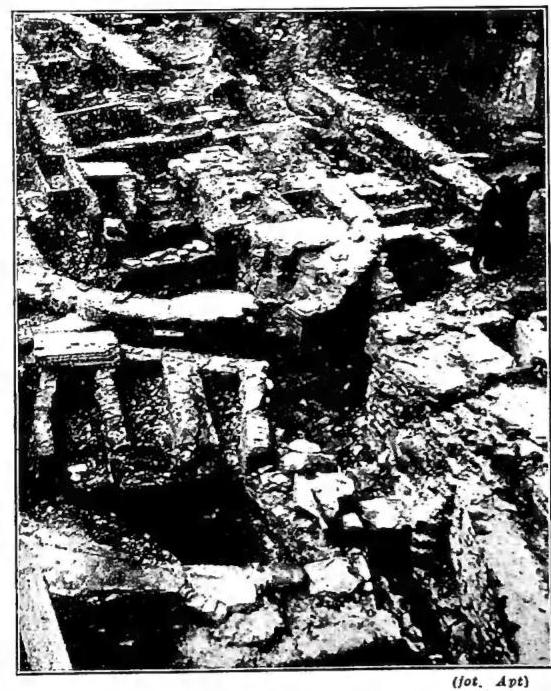
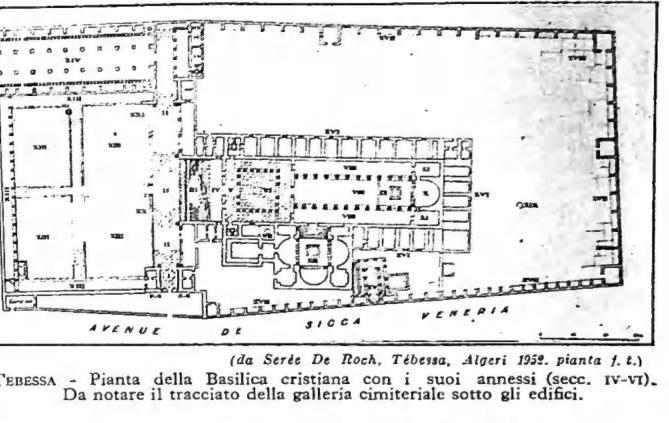
In front of the monumental entrance of the great basilica, in 1944 a staircase was discovered leading down 9 m to a gallery over 200 m long, ending in a three-apsed chapel with a skylight and many tombs; in the floor are two *formae*, one with an inscription in *opus musivum* of a Gaudentia; in the apse two raised tombs form an altar. In the walls of the gallery the loculi are closed with tiles, one by a marble slab with the inscription “SVREIA IN PACE.” The foundations of the basilica obstructed the galleries of the hypogeum. Beneath the eastern three-apsed chapel a Christian cemetery was found, in which an inscription in *opus musivum* within a wreath was read commemorating “XI K(alendas) Ian(uarias) memoria sanctorum Heracli, Donati, Zebrocis, Secundiani, Victoriani, Publiciae, Meggenis” and below “Novellus diaconus votum”; to the left of the wreath is read “Donatus lector in pace”; to the right “Victor diaconus in pace” and above “Ista memoriam si quis violaverit violabit illum Deus.”
The large building discovered in 1858 on the road between T. and Sicca Veneria was explored between 1888-92; being outside Solomon’s citadel it was enclosed by a solid trapezoidal wall flanked by towers, 180 m long by 90 m wide. A grand staircase led to a quadriporticus with columns on Corinthian bases and capitals, with a fountain in the center; through three doors one entered the basilica, divided into three naves by pillars with columns in front; above rose a second order. The end of the central nave was closed by a series of vertical slabs with small pilasters, leaving a free passage in the center of 1.20 m. At the end of the apse the base for the cathedra was found; the entire floor was of geometric *opus musivum*. To the right of the basilica is a baptistery and a staircase of 12 steps leads to a tri-absidated chamber, with floor of ornamental *opus musivum*, walls revetted in marble and vaults of glass tesserae. Four carved pillars adorned with vine tendrils, fish, etc., were found there. In front of the left apse a *musivum* was found with a male orant and an inscription of the year 508; near the staircase the marble sarcophagus was found, with three allegorical figures variously interpreted (S. Gsell, *Musée de T.*, Paris 1902; G. Wilpert, *La chiesa romana nel sarcofago di T.*, in *Rivista di archeologia cristiana*, 11 [1934], pp. 249-64; id., *Sarcofagi*, III, pp. 57-62).
An inscription was found at Tebe 2261 near those of St Cyprian (BHL, 5813; H. Delehaye, *Les Passions des martyrs et les genres littéraires*, Brussels 1921, pp. 104-10). Crispina, wealthy, noble, a married woman, born at Tagura, was martyred at T. during the proconsulship of Anullinus on 5 December 304. St Augustine repeatedly praises her
An inscription was found reading: “III idus iunias natale sancti Varaqi et comitum eius” (P. Monceaux, *Inscriptions chrétiennes du cercle de T.*, in *Recueil des notices et mémoires de la Société archéologique de Constantine*, 42 [1908], pp. 243 ff.). At the site called Old T. (*T. Kalia*), a three-apsed church was found. — See pl. CXXXVI.