
**VILGELMO** – Sculptor of the 12th century, active in Modena. He may be considered the founder of Romanesque sculpture in Upper Italy and, in particular, of the Emilian school, which recent studies have now clearly distinguished from the Lombard school.
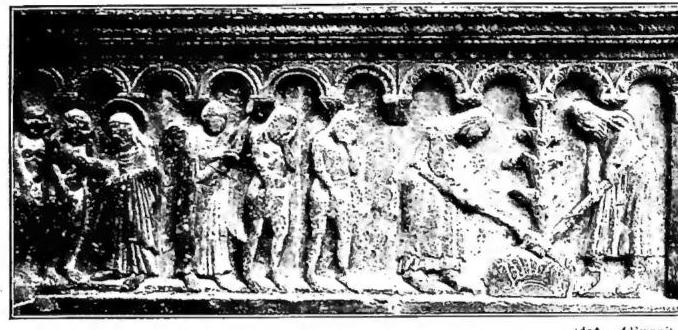
There is no documentary evidence about him, but his name appears on the stone slab commemorating the foundation of the Modena cathedral in 1099 (*inert scultores quanto sia digno di essere scultore*, but it is not a work of great importance). By comparison with the figures of the prophets Enoch and Elijah flanking the inscription, four reliefs depicting scenes from Genesis, the friezes and the figures of the Prophets on the doorposts of the main portal, and the two cherubs holding candelabra on some capitals of the loggia—i.e., the majority of the sculptures on the façade—can be attributed to him with certainty. These works must have been executed between 1100 and 1106, at the latest by 1110. The other sculptures on the exterior of the Modena cathedral, those on the portal of the Abbey of Nonantola, and even those on the old façade of the Cremona cathedral (which are sometimes attributed to him) belong to various disciples and followers, sometimes very original and with a partly different training.
Vilgelmo’s art has no precedents in Emilia or the neighboring regions, nor can it be derived—as some believe—from the Ottonian art of Lombardy, which differs profoundly from it in its courtly character and is devoid of its own language. He indeed expresses himself in a language of “vulgar” structure, which is called Romanesque in the same way as the “Romanzi” are called the dialects that, at this time, are attaining literary dignity throughout Western Europe. Some stylistic elements, such as the use of the “corded” fold, appear to be related to the sculpture of the first Aquitanian school, which had just a few years earlier produced its masterpieces with reliefs that were first (S. Saturnino in Toulouse, 1096) distinctly volumetric and then (Moissac, completed in 1100) more plastically articulated. But this is not enough to prove a direct descent, and it was certainly much more decisive for Vilgelmo’s formation to study the provincial Roman sculpture on stelae and sarcophagi of the Mutina necropolis.
---
**VILLAVISIŠKIS, Diocese of** – Town and diocese in the Republic of Lithuania.
It covers an area of 12,000 sq. km with a population of 365,000, of whom 350,000 are Catholic, and includes 101 parishes and 120 churches (Ann. Pont. 1952, p. 424). No further statistical data are available as the entire ecclesiastical hierarchy has been suppressed.
The diocese was erected by Pope Pius XI with the apostolic constitution *Lituanorum gente* of 4 April 1926, carved out of the archdiocese of Kaunas, and assigned to it the deaneries. The church, dedicated to the Visitation of the Blessed Virgin Mary, was elevated to the rank and dignity of a cathedral.
---
**VILLADA GARCÍA, Zacarías** – Jesuit, historian, born in Gatón de Campos (diocese of Palencia) on 16 March 1879, killed by Spanish Reds near Vicálvaro (Madrid) on 19 October 1936.
He entered the Society in 1894 and completed his religious and literary training. He was then admitted to the editorial staff of *Razón y Fe* (1914-25), while at the same time teaching at the *Centro de Estudios Históricos* Academy. In addition to several articles in the journal, he published works to assist and guide students: *Metodología y crítica histórica* (Barcelona 1912); *Cómo se aprende a trabajar científicamente. Lecciones de la Crónica de Alfonso III* (Madrid 1918); *Catálogo de los códices y documentos de la catedral de León* (ibid. 1919); *Cisneros según sus íntimos* (ibid. 1921); *Paleografía española precedida de una introducción sobre la paleografía latina* (ibid. 1923), etc. But his main work is the *Historia eclesiástica de España*, carried up to 1085: I, 1 and 2 (ibid. 1929); II, 1 and 2 (ibid. 1932); III, 1 (ibid. 1936). The social-communist revolution of 1931 destroyed, along with the Madrid residence, all his manuscripts, notes, and files for the continuation of the work, the fruit of a lifetime’s labor. Villada resumed his task from scratch and managed to publish the second and third volumes; but, discovered by the Red police in mid-September 1936 during the revolution, he was first left free as an academic of the Historical Center, but soon condemned and killed for counter-revolutionary activity, under the charge of having attempted to go to Toledo, then liberated by the National Army. Villada also discovered the famous Codex of Roda, which had disappeared in the mid-18th century, written on parchment and belonging to the third period of Visigothic script, important for knowledge of the origins of the Kingdom of Navarre.
---
**VILLANA DEI BOTTI, Blessed** – Dominican tertiary, born in Florence in 1332, died there on 28 February 1360.
Daughter of a wealthy patrician, she was brought to piety as a child; then, after her marriage (1350) to Rosso di Piero Benintendi, she gave herself over to worldly life. Suddenly, seeing herself in the mirror as a monster, she converted, and, having become a tertiary, devoted the rest of her life to charity and penance. Bernardo Rossellino made her tomb (1452-53) in S. Maria Novella. Her cult was confirmed by Leo XII in March 1824. Feast day: 28 February.
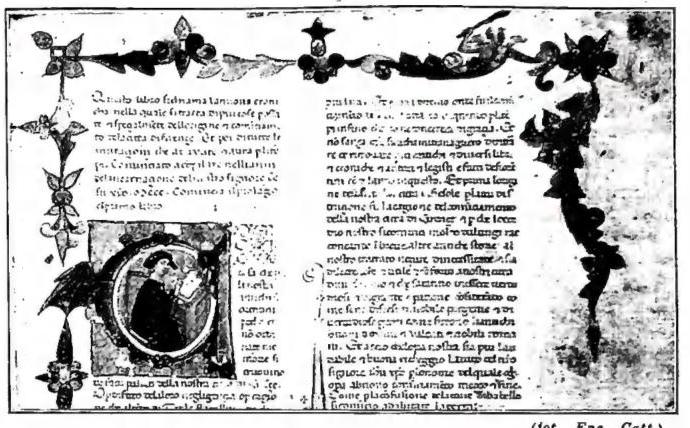
**Villani, Giovanni** – Incipit of the *Cronica* of G. V., in the initial the V. in the act of writing his work – Vatican Library, cod. Chig. L. VIII, 206, f. 167 (14th century).
---
**VILLANI, Giovanni** – He is the greatest representative of Florentine bourgeois historiography of the 14th century. He belonged to the family of the Popolo of S. Procolo and was engaged in trade. His father was a Villano di Stoldo, said to have been a member of the Signoria in 1300; his will dates from 1321 and in it his four sons—G., Filippo, Francesco, and Matteo—are mentioned.
The eldest son, GIOVANNI, the historian, must have been born in the 13th century, perhaps even before 1275–80. At the beginning of the following century GIOVANNI was already a partner in the Peruzzi Company and its representative at the Roman Curia. This explains why the Villani belonged to the Black Guelph faction: politics and commerce were intertwined. GIOVANNI tells us in his work that he was in Rome in 1300 for the Jubilee, but he does not mention his commercial activity. In the following years the affairs of the Company took him to France and Flanders; it was during this stay that he gathered extensive information on events in Flanders and the Battle of Courtrai. In 1307 he was in Bruges; in the following years he was already back in Italy, in Siena. Around 1309 GIOVANNI must have left the Peruzzi Company. After 1310 he began the phase of his political activity. In 1316 he was appointed Prior, then ambassador to Pisa to negotiate peace, and later an official at the mint. In 1321 he was again Prior; then he was appointed official for the construction of the city walls. In 1327 the Duke of Calabria proposed him for the mint. His appointments followed one after another: he was now in mature years and held great prestige in Florence. In 1329 he was involved in negotiations to reach an agreement with the German mercenaries of Cerruglio, then he was an official for the construction of the doors of S. Giovanni, and then for the building of the bell tower of the Badia. In 1331 he was in charge of the construction of the city walls; the appointment earned him an accusation of embezzlement. He was tried; he had to account for his administration. In 1341 he went to Ferrara as a hostage for the 250,000 florins agreed upon in the treaty with the Scaligeri for the purchase of Lucca: he remained there for two months. In 1342 he was in Florence as a witness to the events of the Duke of Athens. In all these years he had carried on commercial activity within the Bonaccorsi Company. The failure of the Bardi in 1345 involved him both as a merchant and as a *cessans et fugitivus*, and he had to resign himself to imprisonment in the Stinche. The *Liber carceratorum* records his release from prison under guarantee on 4 February 1345. He died of the plague in 1348 and was buried at the Annunziata in the chapel of the Crucifix. He had been married twice: from monna Sibilla he had three sons, GIOVANNI, Bernardo, and Francesco; from donna Mona di Francesco de’ Pazzi he had Arrighetta, Villano, and Matteo.
The Chronicle of GIOVANNI appears to be connected with the impressions made on his mind by the monuments of ancient Rome seen during his stay in 1300 and by his reading of ancient historians. Compagni also alludes to the monuments seen in Rome during the Jubilee. GIOVANNI could hardly have devoted himself to his work before returning from his travels; nor are the readings of the ancient historians to which he refers certainly from his youth. He set about compiling his work from chronicles that were more widely circulated (e.g., Martin of Poland) in order to produce a work that would be useful to those who might wish to write in the future. The work is divided into 12 books: the first six deal with biblical and Roman history; Book VII begins the account of the history of Florence from the descent of Charles of Anjou to 1332; Books XI and XII narrate events from 1333 to 1348.
The division of the material certainly depends on the time taken in its composition and the years in which GIOVANNI wrote. Following the custom of chroniclers, events are narrated year by year, but there is often an attempt to go beyond chronological order and to link events by a causal connection. GIOVANNI is a writer entirely of the Middle Ages. He narrates portentous events, sees in them divine Providence that rewards and punishes. The purpose of the work is indeed to instruct the Florentines to avoid vice, to live virtuously, and to govern the State wisely. He is thus a moralizing writer; even when he speaks of business affairs, he judges by the medieval criterion of good and evil, of the corruption of the new men, of the simple, sober customs of an age that he laments. But apart from this inadequacy in his judgments, he recounts, even with vividness, the economic and financial activities of the Florentines of his time, showing great competence and ability to perceive what concerns commercial life. At such moments his style, which is usually poor, even heavy, far from the vigorous passion of Dino Compagni, rises and becomes robust. Thus when he portrays the figure of some character with strong lines, he seems to reveal the habit of the merchant to see and judge with robust synthesis the people with whom he deals. Usually, however, his narrative resolves itself into the exposition of countless minute facts, of unchecked, uncritical episodes, which the merchant keeps in mind only to know the fortunes of the princes or the personages with whom he may have to deal in business, but in which he is not interested in knowing the why or the how, being content with more or less precise information about them. Usually these are reports that Florentine merchants transmitted from the great center of information, Avignon, or from other French-Flemish commercial centers, news that was fundamentally accurate but embellished and often transformed so as to make it romantic and fantastic.
A problem already discussed, but on which there are still no definitive conclusions, is that of the structure of the Chronicle and its sources. Thus the question of the relationship between GIOVANNI and Dante has been examined. Contacts between the two authors have been established: a common source has been suspected, others have thought of the possibility of interpolations or corrections by GIOVANNI himself. The relationship between GIOVANNI and the Malispini chronicle has also been discussed: here too the matter is *sub iudice*.
The work of GIOVANNI VILLANI was continued by his brother Matteo, who wrote the events from 1348 to 1363 in 10 books, but in a sustained, solemn style. Matteo’s son, Filippo, who was a man of letters, a humanist, and a reader of Dante in Florence, added another book to the work of his uncle and father, bringing the narrative up to 1364. Summaries of GIOVANNI VILLANI’s Chronicle were soon made in prose and verse, such as the *Centiloquio* of Pucci.
---
VILLANI, Maria, Venerable. – A Dominican nun, born in Naples on 18 September 1584 to Giovanni, Marquis of Polla, died there on 26 March 1670.
From her early youth she practiced mental prayer and enjoyed moments of sublime contemplation. At the age of 14, on 7 October 1598, she entered the monastery of S. Giovanni in Naples, taking the name of Sister Maria. In religious life she found an excellent spiritual guide in the Servant of God Fr. Giov. Leonardo of Lettere, and in 1637, by a special inspiration of God, she founded the monastery of S. Maria del Divino Amore, where she died. Her cause of beatification was introduced in 1746.
---
Felicce da Mareto
---
VILLA REALE, Diocese of. – A city and diocese in the province of Trás-os-Montes, in Portugal.
It has a surface area of 4,273.20 sq. km. and a population of 319,883 inhabitants, of whom 319,000 are Catholics distributed in 257 parishes served by 194 diocesan priests and 17 religious; it has a seminary, 4 male and 11 female communities (Ann. Pont. 1953, p. 448).
The diocese of V. R. was established by Pius XI with the bull *Apostolicae praedecessorum nostrorum* of 20 April 1922, with territory taken from the dioceses of Braga, Lamego and Braganza to limit the diocese to the civil district of V. R.
Villarrica, Diocese of. - City and diocese in the Republic of Paraguay (South America).
The territory extends over 78,049 sq. km., with a population of 620,000 Catholics, distributed in 75 parishes served by 34 diocesan priests and 25 religious; it has a seminary, 6 male and 7 female religious communities (Ann. Pont. 1953, p. 448). The diocese of V. was created by Pius XI on 10 May 1929 with the apostolic constitution *Universi gregis Dominici*, establishing the ecclesiastical province of Asunción, detaching it from Buenos Aires (AAS, 22 [1930], pp. 5-7). The diocese is a suffragan of the Most Holy Assumption.
Villaseca, Giuseppe Maria. - Priest, founder of the Missionaries of St Joseph of Mexico, b. at Igualda (diocese of Barcelona) on 19 January 1831, d. at Tacubaya (Mexico) on 4 April 1910.
Having entered the seminary in Barcelona, he heard Fr. Armengol, a Pauline missionary passing through, plead the cause of the Mexican missions and immediately offered himself. Departing from Spain on 19 March 1853, he arrived in Vera Cruz on 2 April and immediately entered the Congregation of St Vincent de Paul, where, after completing his studies, he was ordained priest in 1856. After various activities (including the establishment of a printing press that in a short time distributed more than 800,000 copies of apologetic booklets) he founded in 1860 a seminary in Monterrey, in 1872 in Mexico City the clerical college of St Joseph, of which he was an able rector and educator, and in the same year put into effect his idea of a double male and female congregation, which would not only supply priests for vacant parishes but also attend in particular to unfaithful indigenous people. The two works, sustained by his zeal and virtues, soon flourished and spread; his missionaries as early as 1884 were able to work among the pagans in the states of Tarahumara.