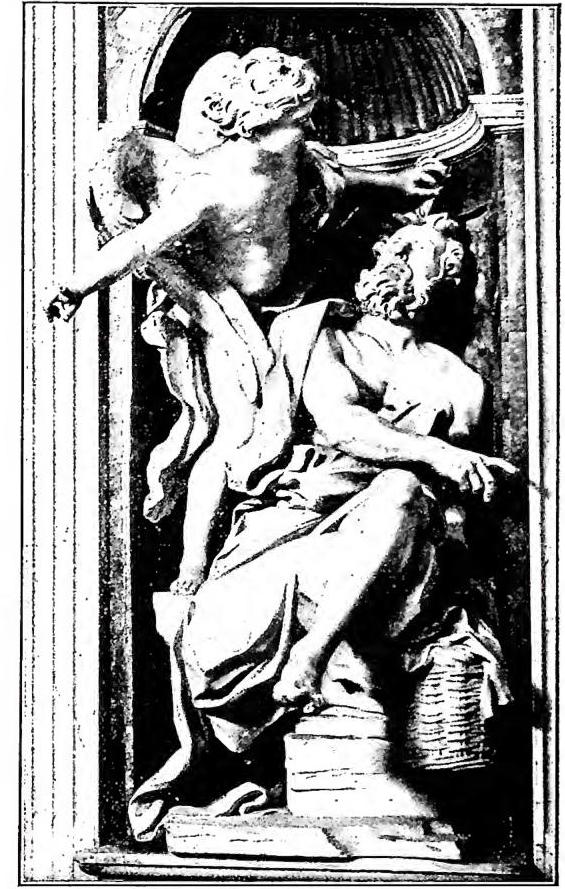
HABAKKUK (Hebrew: Hâbaqqûq; Septuagint: Αμβακούμ, confusing him with the figure in Dan. 14:32). — The eighth among the “minor” prophets of the Old Testament. The name is connected with the Assyrian *hambaququ* (the tora cassia plant), or with the Hebrew root *hâbaq*, meaning “embrace.”
I. LIFE
Of the person of Habakkuk we know only that he lived in Judea (Hab. 3:17) at the end of the 7th century B.C., and wrote a prophecy of three chapters in elegant style, rich in bold images drawn largely from nature. Unfounded is the deduction (from 3:19) that he was a Temple singer, since the choral indications in chap. 3 are probably later additions; legendary is his identification with the namesake in Dan. 14:32–38, who must be assigned to a different period.II. THE PROPHECY
a) Content. — To the prophet who laments the unjust oppression of the good by the wicked (1:2–4), the Lord responds by announcing their future punishment through the Chaldeans (1:5–10). The prophet, even more disturbed by these insatiable invaders, laments that God treats all men like “the fish of the sea and the reptiles that have no ruler to defend them” (1:11–17). But God assures that the just will be protected and saved by Him, while the invaders will in the end also be overthrown (2:1–5). Five woes follow, intended to console the oppressed good (2:6–20): the enemies have sucked human blood, but the victims will rise up to torment them (2:6–8); the edifice of their power, built on crimes, will cry out for vengeance (9–11); upon the splendor of their bloodstained cities the glory of God will rise (12–14), who will offer the cup of infamy to the invaders (15–17) and cause their foolish idolatry to vanish (18–20). A poetic description of the coming of God as judge (the Song of Habakkuk) closes the book (3:1–19).b) Date. — Following O. Happel, B. Duhm favors the period of Alexander the Great’s conquests (336–24 B.C.). To support this, in 1:6 the Chaldean invaders (*Kasdim*) are emended to *Kittim* (Macedonians), and *yayin* (wine: 2:5) is changed to *yevanim* (Ionians). But K. Budde, who wishes to see in the book the predicted destruction of the Assyrians rather than the Chaldeans, places it before 612 B.C., the year of the fall of Nineveh. From the “erratic block” of 1:5–11 (Chaldean invasion), which is out of place and seems only to indicate the Chaldeans as future punishers of the Assyrian people, he even adduces a proof by which he would date it back to 625 B.C., the year in which Chaldean power began. Junker prefers instead 612 B.C. More probably, Habakkuk delivered and wrote his oracles shortly after the battle of Carchemish (605 B.C.), when, after defeating Egypt near the Euphrates (Jer. 46), the Chaldeans, now all-powerful, were preparing in 602/1 B.C. to launch with Nebuchadnezzar their campaign against Judea. The prophecy, which according to P. Humbert would be a sacred service to be pronounced in the temple of Jerusalem, denouncing King Jehoiakim (the “tyrant” of 2:6), aims to console his countrymen by asserting the future ruin of the fierce Chaldean power. By subject and date, the book of Habakkuk stands alongside the book of Nahum (q.v.).
III. DOCTRINE
Habakkuk teaches the unity of God (2:18–20), His holiness and justice (1:12–13); he raises the problem of evil—why God allows the oppression of His people by the wicked, who devours one more just than himself (1:13)—and insists on the Providence of the Lord, universal ruler of nature and peoples, defender of Israel in whom He will establish His kingdom. The messianic restoration is not described as such (“your anointed” in 3:12 is not the Messiah); but it is hinted at in 2:14: “the earth shall be filled with the knowledge of the glory of the Lord,” and more especially in 2:4: “the just shall live by his faith,” the core of the entire book, cited three times by St. Paul (according to the Septuagint) as “Scripture” (Rom. 1:17; Gal. 3:11; Heb. 10:37–38). The Apostle also cites (Acts 13:41) the passage 1:5 among the group of “prophetic” books.Faustino Salvoni