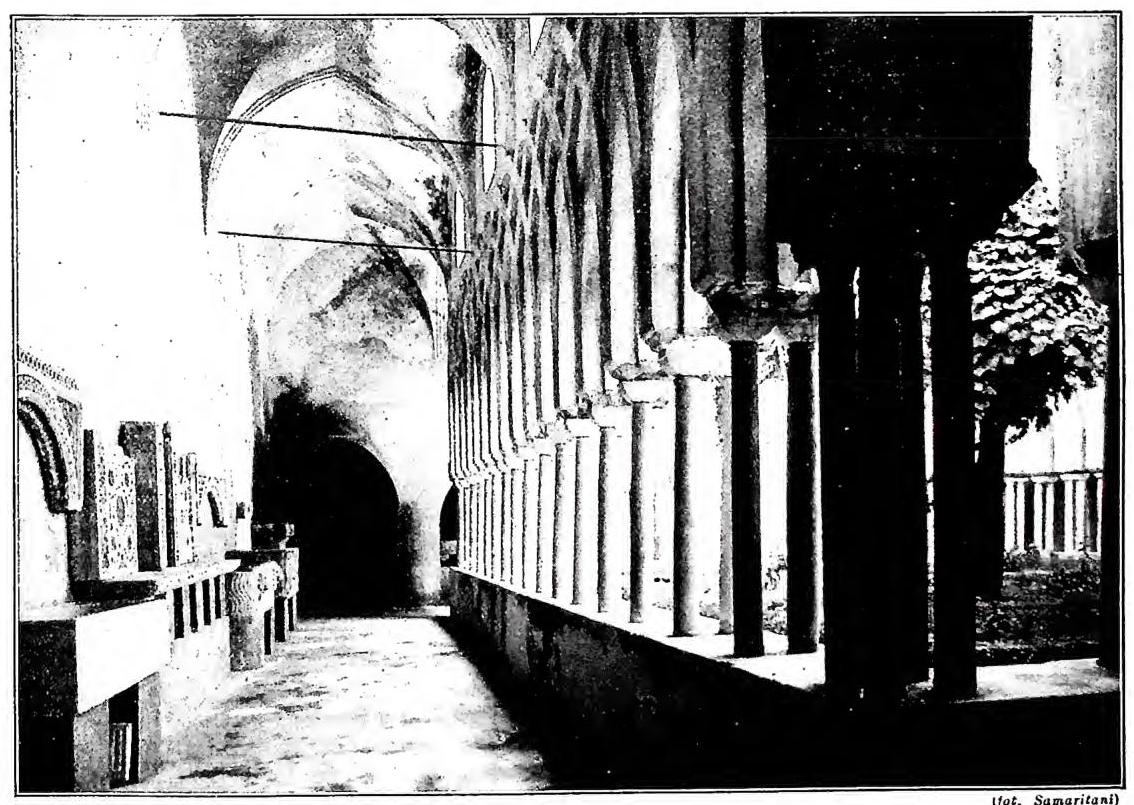
ABBEYS AND MONASTERIES. – The territory of the diocese of A. and that of the suppressed dioceses incorporated into it was extraordinarily rich in Benedictine monasteries. In A., there was S. Lorenzo (later called della Santissima Trinità), founded by Doge or Duke Mansone III, who was also responsible for the establishment of the archbishopric and the enlargement of the cathedral; S. Basilio, founded in the 11th century; S. Elena and S. Nicola in Campo, both for women; in Pogerola, that of S. Sebastiano; in Atrani, those of S. Maria de Fontanella, S. Michele Arcangelo, and S. Tommaso apostolo; in Scala, those dedicated to ss. Benedetto and Scolastica and to s. Cataldo; in Ravello, the Santissima Trinità; in Minori, S. Lucia. Almost all of these date back to the 9th–11th centuries and were suppressed, for the most part, between the 13th and 18th centuries due to the depletion of nuns, a consequence of the decline of the city and the area. The same fate befell the male Benedictine monasteries: in Atrani, SS. Ciriaco e Giuditta (970); in Scala, S. Maria de Aqua bona and SS. Giuliano e Marciano (both from the 9th century); in Positano, S. Maria e S. Vito (10th century); in Ravello, S. Trifone and S. Maria di Castiglione (10th century). But the greatest monastery, and one of the most noteworthy buildings in A., is the cloister of S. Pietro de Toscolo or in Canonica, originally Cistercian (1212), later passed to the Capuchins (1583), and which today has followed the common fate of becoming a hotel. Near Maiori, the Cistercians also had another of their monasteries: S. Maria de Vistela, and near Scala, S. Elena. The Conventuals had in A. S. Maria degli Angeli, founded by St. Francis in 1220. Finally, in Ravello, there was a convent of Clarisses, in addition to other smaller monasteries, especially Benedictine, in the region.
MONUMENTS. – The Arab-Sicilian architecture, important in Sicily during the Norman rule and developed in the subsequent Swabian period, gives A. a distinctive character through the bold use of interlaced arches; a style that reaches its masterpieces in two 13th-century monuments: the cloister of the Capuchins and the cloister of the Paradiso. The Cathedral, whose original nucleus has undergone, in the Middle Ages and even recently, reconstructions, enlargements, and modifications, still retains its beauty with the superb staircase and the bell tower, built from 1180 to 1276. Of the glorious age of the republic, only a part of the shipyard remains, along with the famous bronze doors (and their coeval doorposts) of the ancient cathedral, which a merchant, Pantaleone di Mauro, sent as a gift from Constantinople to his homeland. Rich in historical and artistic monuments, but above all in those singular natural beauties that have made the Amalfi Coast celebrated throughout the world, are the other places in the diocese: Capri, Ravello, Atrani, Positano, Peverola, Maiori, Minori, Scala. – V. Tavv. LXXV-LXXVI.
For the history of the duchy: F. G. Pansa, *Istoria dell'antica Repubblica d'A.*, 2 vols., Naples 1724; M. Camera, *Istoria della città e costiera d'A.*, Naples 1836; id., *Memorie storico-diplomatiche dell'antica città e ducato d'A.*, 2 vols., Salerno 1876–81; F. Schupfer, *Trani ed A.*, in *Riv. Ital. Sc. Giur.*, 17 (1893); A. Hofmeister, *Zur Gesch. Amalfis in d. byzantin. Zeit*, in *Byzantin.-neugriech. Jahrbuch*, 1 (1920); M. Berza, *A. predica*, in *Riv. Dacoromana*, 1 (1938).
For ecclesiastical history: Ughelli, VII, pp. 183–256; Cappelletti, XX, pp. 601–12; A. Gröner, *Die Diözesen Italiens*, Freiburg in Br. 1904, Italian trans., Melfi 1908, pp. 47–48 and passim; Lanzoni, pp. 248–50.
For artistic history: K. Schulz, *Denkmäler d. Kunst d. Mittelalters in Unteritalien*, II, Dresden 1860; D. Salazar, *Studi vianno, Facchini dell'Italia meridionale dal sec. IV al XIII*, Naples 1870; S. Volpicella, *Delle antichità d'A. e dintorni*, in *Studi di lett. st. ed arte*, Naples 1876; L. M. Mansi, *Illustrazione dei principali monumenti d'arte e storia del versante amalfitano*, Rome 1898; E. Bertaux, *L'art dans l'Italie meridionale*, Paris 1903; P. Pirri, *Il duomo di A. e il chiostro del Paradiso*, Rome 1941.