
ABELARDO (Abaelardus, Abaelardus), PIETRO. – French philosopher and theologian.
1. BIOGRAPHICAL NOTES
Born in 1079 at Pallet (Palatium), a village of Lesser Brittany, about 20 km east of Nantes; died on 21 April 1142 in the monastery of Saint-Marcel-sur-Saône. From his father Berengario, who, before embracing a military career, had spent several years studying, he inherited a lively love of letters and, while still very young, according to the custom of the time, began attending the schools of the most celebrated masters of dialectic.At that time the controversy over the status of universals was raging; it was a specifically philosophical problem of the 12th century, and A. had the good fortune to have as teachers the leaders of the two rival schools: Roscellino (nominalist) and Guglielmo di Champeaux (realist). The young Breton soon displayed a subtle mind and a prodigiously facile ability to learn the arts of the trivium and quadrivium, a proud and exuberant disposition, and a fervent passion for the battles of the intellect.
After travelling through various provinces of France, he settled in Paris, at the cathedral school, under the discipline of Guglielmo di Champeaux. But his restless and presumptuous spirit led him to criticize his teacher’s instruction and thus to incur his enmity and that of many fellow students. Not yet twenty-three, he then opened his own school at Melun, the residence of the court, and later moved it to Corbeil, to draw closer to the capital. But exhaustion, brought on by his excessive devotion to study, forced him to return to his native province and obliged him to take several years of relative rest.
Having recovered his health, he moved to Paris to study rhetoric under the direction of Guglielmo himself. There he resumed his struggle against his professor and, as A. himself asserts, forced him to retract and abandon his position in the question of universals (Historia calamitatum: PL 178, 119). This capitulation ruined the reputation of the old master, who nevertheless had a glorious past, and made the young professor famous, so that he soon founded a school outside the city walls, on the hill of S. Genoveffa, which quickly enjoyed great success.
Having defeated his teacher in dialectic and rhetoric, A. wished to reap laurels in sacred science as well, and went to Laon, to the school of the illustrious Anselmo. He found this teacher inferior to the reputation he enjoyed, capable indeed, but weak in reasoning: «He kindled the fire, and instead of illuminating the house, filled it with smoke. Alberto, who when viewed from afar appeared to be nothing but a splendid display of leaves, but when approached and carefully examined proved instead to be fruitless» (ibid., 123). He attempted to subject him to the same fate as Guglielmo and demanded to give several lectures on Ezechiele in his school. But Anselmo’s protests and hostility were so great that he had to leave Laon.
He returned once more to Paris, where he obtained the direction of the Notre-Dame school and taught philosophy and theology. Among the students who flocked to him from every part of France and Europe were 19 cardinals, more than 50 future bishops, and one (Celestino II) who went on to become pope. The tribune Arnaldo da Brescia also attended his lectures.
But it was precisely during the period of his teaching at Notre-Dame that the love affair with Eloisa took place, together with the atrocious revenge exacted by the canon Fulberto, the girl’s uncle. The uproar that arose around the affair forced him to withdraw to the abbey of S. Dionigi, while Eloisa took the veil in the monastery of Argenteuil. The two did not completely break off their relations, but the well-known correspondence they are said to have exchanged subsequently appears, according to the latest critical investigations, to be a literary fiction of the restless master. The monastic habit did not change his character, and, at the invitation of his pupils, he resumed his lectures and his battles for philosophy.
He engaged in a violent controversy with Roscellino (Epist., 19 and 15: PL 178, 356-72), and was condemned by the Council of Soissons on account of his treatise De unitate et trinitate divina (1121). Confined as punishment to the convent of S. Medardo, he was released after a few days by Cardinal legate Conone d'Urach, who had presided over the council, and sent back to S. Dionigi. Later we find him in the solitude of the Paracleto, near Troyes. But the desert in which he had sought refuge soon became a very well-attended school. In 1125 he was elected abbot of S. Gilda at Rhuys in Brittany and later (1129) returned to the Paracleto, which had already been given to Eloisa and her companions, driven from Argenteuil by the abbot Sigieri. There he devoted himself to their care. Giovanni di Salisbury shows him once again, in 1136, teaching from the chair on the hill of S. Genoveffa, intent on combating the sect of the cornificians. These, however, were the final triumphs of his teaching career: a grave storm was gathering over his head. Accused once again of heresy, he now had s. Bernardo as his opponent and was summoned before the Council of Sens (June 1141). A. would have liked to debate, but was invited to disavow the propositions of which he was accused and to retract. He preferred to appeal to the Pope and set out for Rome, where he counted on powerful friends. But when he learned that Innocenzo II had confirmed the sentence and condemnation, he stopped at Cluny. There Pietro il Venerabile received him kindly; he succeeded in reconciling him with s. Bernardo, in removing from him the effects of the papal condemnation, and in inspiring him with a sincerely Catholic retraction.
There A. died piously. His remains were transported to the Paracleto by the abbot of Cluny himself. Today the mortal remains of A. and Eloisa, transferred to Père-Lachaise in Paris in 1817, rest together in a single tomb.
2. THE WORKS: 1. Philosophical works: following Geyer, it has become customary to distinguish three groups among A.’s writings on logic: a) Literal glosses on individual treatises, which the author called Introductions parvulorum. Cousin collected and published them from various manuscripts, but not all have been printed. They date from before 1121.
b) Coordinated expositions of the whole of logic, composed between 1113 and 1120. This systematic logic has come down to us in two forms, according to the two Incipit: Ingredientibus and Nostorum petitioni sociorum. Geyer published the Glosses on Porphyry, as well as the Glosses on the Categories and the Glossulae super Porphirium.
c) The Dialectic, a complete treatise on logic, regular and methodical, personal and not a commentary on another thinker’s ideas. Guglielmo di Champeaux and Roscellino, who died in 1121, are mentioned in it; this reference suggests that the work was written after that year, since the author never names these masters in any other work, while they were still alive. The treatise was published for the most part by Cousin.
2. Theological works: De unitate et trinitate divina, a short work condemned by the Council of Soissons, which has come down to us in two versions. – Theologia christiana, a revised and expanded second edition of the preceding treatise. It is A.’s retaliation against the council. – Theologia, a reworking of the second treatise. We possess its first part under the false title Introductio ad theologiam. – Sic et non, a compilation of texts, as the author says, apparently contradictory, drawn from Scripture and the Fathers in order to resolve numerous theological problems. We have German editions of this work reproduced by Migne, as well as Cousin’s edition. L. Tosti, using a manuscript from Montecassino, added new and important fragments.
3. Exegetical and apologetic works: the Expositio in Hexaëmeron and the Commentariorum super s. Pauli epistolam ad Romanos libri quinque. — Scito te ipsum, a treatise on morality that is more philosophical than religious. — Dialogus inter philosophum et christianum, an original apology for Christianity. — Sermones, ascetical conferences, largely addressed to the nuns of the Paraclete.
We should also mention the Historia calamitatum and the Letters, of interest for the biography of A.; Problemata, the Apologia or Apologeticus, a justificatory memorial composed after the condemnation by the Council of Sens to be sent to Rome, and finally the Carmen ad Astrolabium, published in full by Barthélemy Hauréau in Notices et extraits des manuscrits de la Bibliothèque nationale, XXXIV, 2nd part, Paris 1893, p. 153 ff. Finally, the Hymni.
A.’s contribution to both philosophy and scholastic theology was important. In the strictly philosophical field, his name is linked to the solution of the problem of universals. No one better than he understood and assimilated, at the beginning of the 12th century, the Aristotelian doctrine of knowledge. He distinguishes between sensory and imaginative perception, common to human beings and animals, and abstractive perception, proper to the rational creature. The content of the latter is supplied by the senses, and constitutes the process necessary for the intellect to grasp the common likeness of individuals, that is, the very nature of beings and objects. The universal is the result of the effort of this abstraction. It is neither a thing (res) nor a word (sex), but a concept (sermo). A. was the first in the Middle Ages clearly to consider the ideal value of universals.
A. was also one of the principal moralists of his time. Know Thyself is a treatise on morality not lacking in originality. Two important principles are stated in it: that intention can make our actions good or bad, and that error in judgment diminishes guilt.
Nor were his merits in the theological sphere any less. He was one of the precursors of the doctrinal movement that brought dialectic into the very heart of the highest theological speculation. Even serious errors are not lacking in his works, but he certainly made a noteworthy contribution to the learning of the Middle Ages by proclaiming the distinction between philosophy and theology. He also perfected the method of teaching in sacred science. The treatise Sic et non, in which contradictory testimonies drawn from Scripture and the Fathers are assembled, is historically important in this regard. It is the didactic procedure of adducing arguments in favor, then those against, and finally the solution. This procedure developed and assumed a more clearly defined form in Alessandro di Hales and s. Tommaso d'Aquino.
Nor should one exaggerate the rationalism of this powerful thinker: he establishes a close bond between faith and reason. «I do not wish to be a philosopher», he wrote to Eloise, «if I must rebel against Paul, nor become Aristotle, if I must separate myself from Christ» (Ep., 17: PL 178, 375).
The more recent historians of medieval thought tend to rehabilitate him. He sometimes failed not so much in principles that today seem unassailable as in their use and application (cf. M. Grabmann, Storia della teologia cattolica, Italian version, Milan 1932, p. 41 ff.).
BIBLI: Editions: V. Cousin, Ouwraes inédits d'Abelard, Paris 1836; Petri Aboelardi opera, 2 vols., Paris 1849–59; R. Stölzle, Aboelards 1121 zu Soissons verurtheilter Tractatus de unitate et trinitate divina, Freiburg im Br. 1891; B. Geyer, Peter Aboelards philosophische Schriften, 1: Die Logica «Ingredientibus», Beiträge, XXI, 1–3, Münster (W.) 1919–21–27; P. Ruf and M. Grabmann, Ein uraufgefundenes Bruchstück der Apologia Aboelards, Munich 1930, Theologia «Summi Boni» = Theologia christiana, ed. H. Ostlender: Beiträge XXXV, 2–3, Münster in W. 1930.
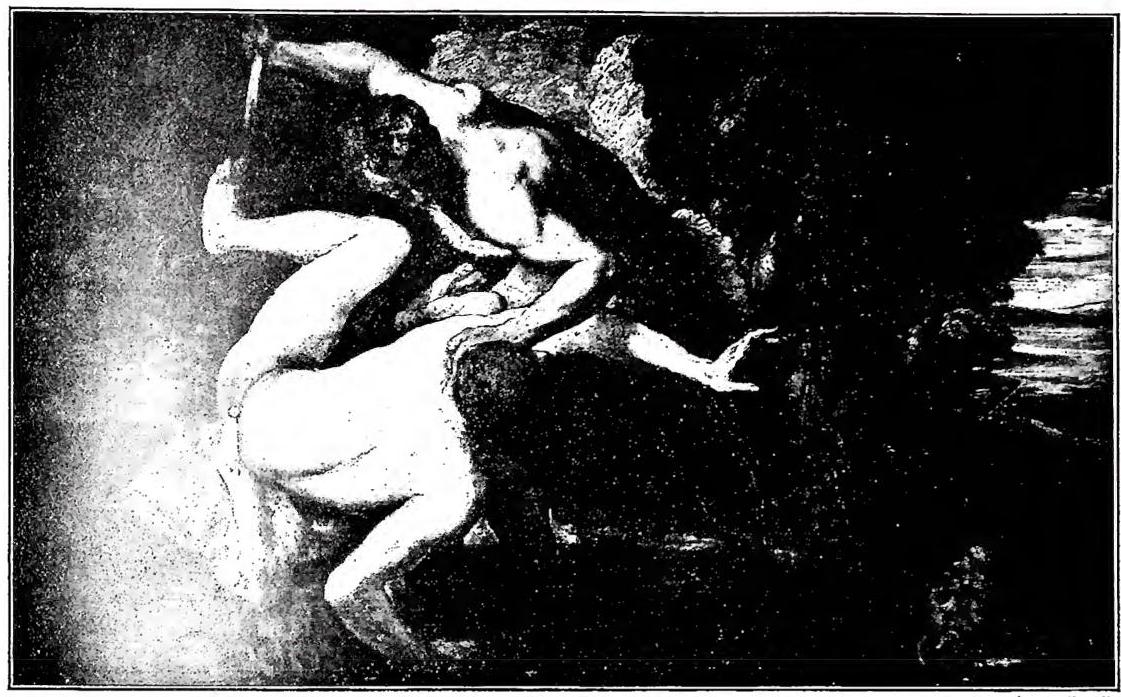
(photo Alinari)
ABELE – Cain killing A., by Tintoretto – Venice, Galleria dell’Accademia.
pp. 247–95, 533–51, 788–828; J. Rivière, Les « capitula » d'Abélard condamnés au concile de Sens, in Recherches de Théol. Ancienne et Médiévale, 5 (1933), pp. 5–22; M. De Wulf, Histoire de la philosophie médiévale, I, 6e ed., Paris 1934, pp. 200–11, Italian version, I, Florence 1944, pp. 193–204; H. Wandel, Peter A., London 1935.
ABELE (Heb. Hébel; Greek of the Septuagint Ἀβελ). –
2. IN SACRED SCRIPTURE
The second son of Adam, whose name is interpreted by the rabbis as “breath,” with an allusion to his fleeting life, while the word recalls the Sumerian ibila, reproduced in Assyrian as aphu, ablu (son, heir).While the firstborn Cain (v.) devoted himself to agriculture, A. tended his flock. After a certain period of time, perhaps at the end of the year, both offered their firstfruits to God; but the Lord rejected Cain’s offering and showed favour toward A.’s sacrifice (a holocaust or, rather, the offering of the fatty parts of the choicest animals: Gen. 4, 4; cf. Num. 18, 27; Lev. 3, 3), perhaps causing, according to Theodotion’s interpretation, fire to fall from heaven (ἐνετύριεν). The reason for the divine favour was the sacrificer’s inner religiosity, sustained (Hebr. 11, 4) by a living faith. Cain, becoming angry, killed his brother, who was later replaced by Seth (Gen. 4, 1–16). Sacred Scripture affirms that A. “after death still speaks” (Hebr. loc. cit.), since his death is a type of Christ’s sacrifice; it calls him “righteous” and places him at the head of the martyrs who suffered for the triumph of good (Mt. 23, 31–35; cf. Hebr., 12, 24). A. is also remembered in the canon of the Mass, in which God is asked to “accept the new sacrifice as that of his righteous servant Abel.” A.’s blood cries from the ground to Yahweh (Gen. 4, 10), from whom it demands vengeance (II Mach. 8, 3; Apoc. 6, 10).