
**ABLE (Hebr. Hèbel; Greek of the Septuagint "Αβελ"), I. IN SACRED SCRIPTURE.** — The second son of Adam, whose name is interpreted by the rabbis as "breath," with an allusion to his fleeting life, while the word recalls the Sumerian *ibila*, reproduced in Assyrian *aplu, ablu* (son, heir).
While the firstborn Cain (v.) devoted himself to agriculture, A. tended his flock. After a certain time, perhaps at the end of the year, both offered the first fruits to God; but the Lord rejected Cain’s offering and expressed approval for the sacrifice (a holocaust or, rather, an offering of the fat portions of the chosen animals: Gen. 4, 4; cf. Num. 18, 27; Lev. 3, 3) of A., perhaps causing, according to the interpretation of Theodotion, fire to descend from heaven (ἐνεπόρσεσεν). The reason for divine complacency was the internal piety of the sacrificer, sustained (Hebr. 11, 4) by a living faith. Cain, enraged, killed his brother, who was then replaced by Seth (Gen. 4, 1-16). Sacred Scripture states that A. "though dead still speaks" (Hebr. loc. cit.), his death being a type of Christ’s sacrifice, whom He calls "just," and placing him at the head of the martyrs who suffered for the triumph of good (Mt. 23, 31-35; cf. Hebr. 12, 24). A. is also remembered in the Canon of the Mass, in which we pray God to "accept the new sacrifice as that of His just servant Abel." The blood of A. cries out from the ground to Jahweh (Gen. 4, 10), demanding vengeance (II Mach. 8, 3; Apoc. 6, 10).
**
---
**II. IN ARCHAEOLOGY.** — Unknown in funerary painting, the offering of A. and Cain is represented in 14 funerary sculptures. Usually, the two brothers present themselves with their gifts before God, depicted with a beard, seated upon a rock in the act of speaking. The gift of A. is always a lamb or a kid; that of Cain, which in the earliest example is a cluster of grapes, soon becomes a sheaf of ears of grain (cf. Gen. 4, 2). Exceptionally, the deity is represented by Jesus, or by two or three persons. The scene was probably depicted among the mosaics of the dome of St. Costanza in Rome. If, originally, funerary art seemed to see in it the representation of the just man of the Old Testament, shortly after Constantine it was interpreted as the prototype of the sacrifice on the cross. It does not seem that the other allegorical interpretations of the patristic period, according to which Judaism depicted Christianity, and A. the shepherd as the *Bonus Pastor*, were reflected in ancient art. A. and Cain appear among the titles of the *Dittochaeum* of Prudentius. The fratricide depicted in the miniatures of the Cotton Bible inaugurates the further development of this historical cycle.
**
---
**III. IN RABBINIC LITERATURE.** — Rabbinic literature sees in A. and Cain the symbol of the rivalry between agriculture and pastoralism. The corpse of A. is guarded by a dog that drives away birds of prey (Pirqê R. Eliezer, 21). A raven covers the body of its dead mate with sand, and Adam decides to do the same with the corpse of A. Birds and pure animals buried A. Therefore, a blessing is pronounced at the time when they are slaughtered. According to a tradition (Midrâš Cant., ed. Schechter) collected by St. Jerome (In Es. 27, 18), the killing took place in the place where Damascus later arose (dam sangeu, šaqah u bere).
**
---
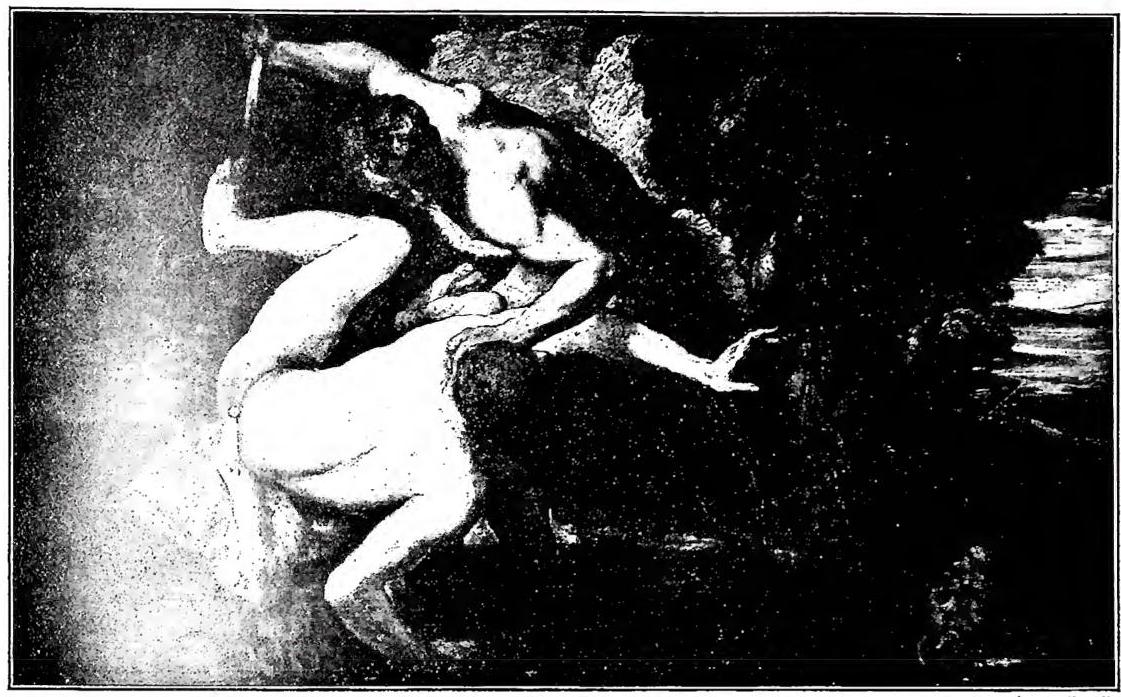
**IV. IN ART.** — The story of A., which in the Vatican codex appears as a Virgilian shepherd, offered artistic imagination, with the scenes of Cain and A. in the act of sacrificing and the subsequent fratricide, a subject that inspired countless works of art from the miniatures of the Ashburnham Pentateuch (7th century, Paris) to the paintings of Titian (Venice, S. Maria della Salute) and Tintoretto (ibid., Galleria dell'Accademia). Both scenes are depicted at Hildesheim (bronze doors, 1007-15), Modena (façade of the Duomo, 1106), and Schönghaben (13th century). A more explicit illustration of the biblical narrative is found in the mosaics of St. Mark’s in Venice, the Palatine Chapel in Palermo, and the cathedral of Monreale (13th century), the reliefs of Ghiberti on the eastern door of the Florentine Baptistery, and those of Bellano in the basilica of the Santo in Padua (1484-88). With symbolic meaning, i.e., as a prefiguration of the Eucharistic sacrifice, the sacrifice of A. is already found in three paleochristian sarcophagi. In a mosaic of St. Vitale in Ravenna, it is represented, with the same meaning, alongside the sacrifice of Melchizedek. But in St. Apollinaris in Classe (ibid., 7th century), in the Drogo Sacramentary (Paris, 9th century), and in the enamels of the portable altar of Eilbertus (Monaco-Gladbach, 12th century), it is accompanied also by that of Abraham. — See Plate IV.
**