
ABRAXAS (ἀβραξας). - A magical-mystical word (also written ἀβραξας) of Gnostic value, relating to the numerical value of the individual letters that compose it and therefore lacking a satisfactory etymology.
It designates: 1) according to Iranian-Babylonian heliocentric theology, the annual course of the sun; in fact, Hyginus (Fab. 183), a polygraph of the Augustan age, states that one of the four horses (symbolizing the four seasons) that draw the chariot of the sun is called ἀβραξας; 2) the Supreme Being in the Gnostic system of Basilides (q.v.); 3) the engraved gems on which it is written together with the names of various deities and with designs related to them.
The Alexandrian Gnostic Basilides, in accordance with the fundamental schema found throughout Hellenistic religious philosophy (and Oriental Hellenized, and therefore not exempt from Iranian influences), posits three descending worlds: the supercelestial, where the Supreme Being reigns; the intermediate, populated by aeons corresponding to as many heavens, in the number of 365, which is the Gnostic value of ἀβραξας (α = 1, β = 2, ρ = 100, α = 1, χ = 600, ζ = 7, α = 1, σ = 200)—and this corresponds to the number of days in the solar year according to the Alexandrian reckoning. Only through this intermediate world does the Supreme Being communicate with the third world, namely the sublunar and terrestrial, the domain of matter. According to St. Irenaeus (Adv. haer., 1, 24), the Supreme Being of Basilides is called ἀβραξας, inasmuch as it is the first source of the 365 heavens known through a hierarchy that extends from the Nous to the angelic hosts. The theological-solar meaning of ἀβραξας had already been noted by St. Jerome (In Am. 3) and by the author of the Acta Archelai, who had linked it to that of Mithra (Μεθραχ), whose Gnostic value also corresponds to 365; though it should be noted that while Mithra is merely a demiurge, A. in the Basilidian system is the Supreme Being.
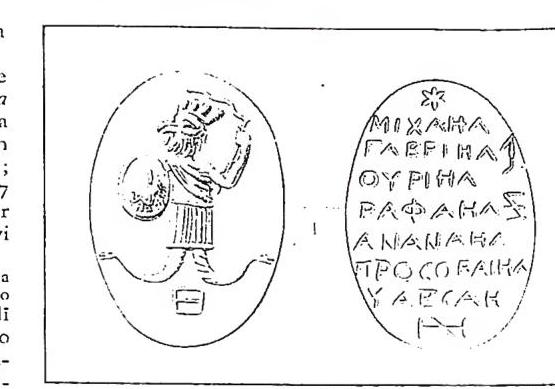
As for the engraved gems bearing ἀβraxas, which have the value of amulets, they display on one side the aforementioned word and on the other various designs: human figures with roosters' heads, with lions' heads or bodies, serpents; or images of Egyptian deities, especially Serapis, Anubis, or sphinxes. Sometimes there are names of Egyptian deities or from the Judeo-Hellenistic religious milieu, such as Osiris, Iao, Sabat, Gabrielsabat; or words of purely magical value connected with the mysticism of the alphabet and numbers, such as abracadabra. This word is repeated several times in descending series, always diminishing by one letter at the end, so that the whole forms a triangle with the base abracadabra at the top and the apex (a) at the bottom: an amulet considered most useful against tertian fever. Another frequent magical word is ablanathababla, the most recent specimen of which, on an ostracon, was discovered during the excavations of the Vogliano mission at Madinet Madi in 1936.