
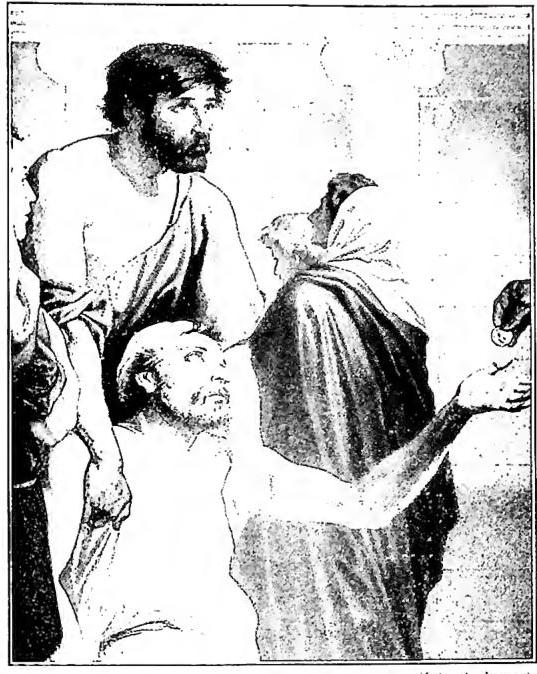
by Baciccio. The chalky chiaroscuro of the 18th century cannot do without the same completion, since it enriches the elementary simplicity of the palette. In Tiepolo, the opaque sketches and the crystal-clear, luminous glazes contrast strikingly, as in Veronese. In the 19th century, fresco enjoyed rather limited success in ecclesiastical decoration, whereas in recent decades it has seen a notable revival, also in relation to changed architectural forms; beyond true fresco, with or without tempera retouching, colors are often dissolved with casein, yielding an even more stable painting with vast potential for effects.
For the maladies of ancient frescoes, restoration methods, and transfers onto canvas or metal mesh,
V. RESTORATION
V. Plate XXVI.BIBL.: Theophilus, Diversarum artium schedula, in Eitelberger's Quellenschriften, VII, Vienna 1878; C. Cennini, Il libro dell’arte, ed. Milanesi, Florence 1859; G. Vasari, Introduzione alle arti del disegno, in G. Baldwin Brown, Vasari on technique etc., London 1907; G. B. Armenini, De vari precetti della pittura, Ravenna 1587; A. Pozzo, Introduzione per dipingere a fresco, in Prospettiva de’ pittori ed architetti, I, Rome 1693; L. Ward, Fresco painting, London 1900; Baudouin, La fresque: sa technique, ses applications, Paris 1914; H. Hildebrandt, Wandmalerei, Berlin 1920; P. Zancani Montuoro-N. Tarchiani-M. Bazzi, s.V. ENOCH. Ital. I, pp. 688-703; A. Eibner, Entwicklung der Wandmalerei, Munich 1926. Guglielmo Matthiae