
ALPHA AND OMEGA (A-Ω). - An allegorical formula from the Apocalypse (1:8; 21:6; 22:13), which juxtaposes the first and last letters (the beginning and the end) of the (Greek) alphabet as a divine title: "I am the Alpha and the Omega," says the Lord, who immediately interprets this as "He who is and who was and who is to come, the Almighty (ὁ παντοκράτωρ)" (1:8), "the beginning and the end" (21:6), "the first and the last, the beginning and the end" (22:13). This mysterious title, which signifies totality in being and duration, is explicitly applied to Jesus Christ in the last two passages (21:6 and 22:13), to whom it is consistently attributed in patristic literature and Christian usage; in the first passage (1:8), it designates God in His eternal infinity, though with an allusion to Jesus (cf. 1:13, 17-18; 2:8).
In the sense of first and last (cf. Sir. 24:38), later Jewish writers used *alef-tav*, the first and last letters of the (Hebrew) alphabet, to denote totality. In the *Palqut Rêubenî* (13th century): "Adam transgressed the entire Law from the alphabet (cf. 17:4); Abraham observed the Law from the alphabet (cf. 48:4); when God blesses Israel, He does so from the alphabet (cf. 48:4)" (in J. C. Schoettgen, *Horae hebraicae et talmudicae*, on Apoc. 1:8). Rabbi Ḥanina and Resh Laqish (3rd century) gave *alef-tav* the meaning of "truth" (alef-tav beyond mem = the midpoint) as "the seal of God." The Shekinah ("Presence"), that is, God, was designated by the cabbalists as *alef-tav* (J. Buxtorf, *Lexicon chaldaicum, talmudicum et rabbinicum*, p. 1). But R. H. Charles is mistaken in asserting that the "A and Ω" of the *Apocalypse* reproduces this Hebrew expression. B. Allo, on the other hand, assigns it a Hellenistic origin, deriving it from pagan formulas ("mysticism of letters") widespread in Asia Minor, which St. John would have given a Christian meaning.
The metaphorical use of the two extreme letters of the alphabet was known to secular writers: "A" signified preeminence, "the first" (cf. the contemporary Martial, *Epigrams*, II, 57; V, 26), "A-Ω" totality, "from first to last" (cf. Theodoret, *Ecclesiastical History*, IV, 7; PG 82, 1136). Thus in Italian, "dall'A alla Z" means "everything, from beginning to end" (N. Tommaseo, *Dizionario della Lingua Italiana*, I, p. 1); "dall'A all'O" is used in the same sense by Dante (Par. XXVI, 17; *Epistola a Cangrande*, 90) and 14th-century writers (F. Sacchetti, *Canzone 298*, in *Rime*, ed. A. Chiari, Bari 1916: "Da l'A a l'O disvaria Marte e Morte"), a clear echo of the reading of the *Apocalypse*. Thus, in form, A-Ω was a fundamentally intelligible expression for the learned.
In meaning, the *Apocalypse* seems to be directly connected with Isa. 41:4; 44:6; 48:12, where God promises redemption by defining Himself as "I am the first and the last" (words with which the *Apocalypse* explains the formula "A-Ω" in 21:6 and 22:13), as a guarantee of fulfillment (cf. Isa. 43:10-12). The *Apocalypse* thus intends to insinuate in the prologue (1:8) and conclusion (21:6 and 22:13) that God’s salvific plan will be brought to completion until the end, when the Almighty (1:8) will vanquish His adversaries in the "judgment" of Jesus the Savior and Sovereign, the beginning (Ps. 101 [102]:26 and Heb. 1:10; 12:2; John 1:1) and the end (Rom. 10:4). "A-Ω" expresses divine transcendence, in its attributes of infinity, eternity, and universal causality (efficient and final), including the economy of Redemption.
Thus explains Clement of Alexandria (*Stromata*, IV, 25: PG 8, 1365): "the circle of all perfections, which revolve and center upon unity." More fully, Tertullian (*De monogamia*, 5: PL 2, 935), quoted later by St. Jerome (*Adversus Iovinianum*, I, 18: PL 23, 247-48) and St. Isidore (*Etymologiae*, I, 3: PL 82, 76-77): "The Lord has taken to Himself the two letters of Greece, the first and the last, converging in figures of beginning and end, so that, just as A unfolds to Ω and Ω in turn is folded back to A, He might show that in Himself are both the course from beginning to end and the return from end to beginning, so that all creation, which ends in Him through whom it was made, namely the Word of God made flesh, might likewise end as it began." And Prudentius, *Cathemerinon*, IX, 11-12 (PL 59, 863): "Alpha and Omega named: He Himself the source and the close / Of all that is, that was, and that shall be."
Cf. St. Cyprian, *Testimonia adversus Iudaeos*, II, 1, 6, 22; III, 100: PL 4, 725, 730, 745, 806; St. Paulinus of Nola, who first attests the use of "A-Ω" in art, *Carmina*, 19, 645-52; 30, 89-96: PL 61, 546-47, 673; Arethas of Caesarea, on Apoc. 1:8 in J. A. Cramer, *Catenae Graecorum Patrum in N.T.*, VIII, Oxford 1844, pp. 189-90. - On the Gnostic interpretation (A-Ω forms the number 801, equivalent to *περιστερά* "dove") of Marcus, disciple of Valentinus, cf. St. Irenaeus, *Adversus Haereses*, I, 14, 6; 15, 1: PG 7, 608, 616-17, and Tertullian, *De praescriptione haereticorum*, 50: PL 2, 88.
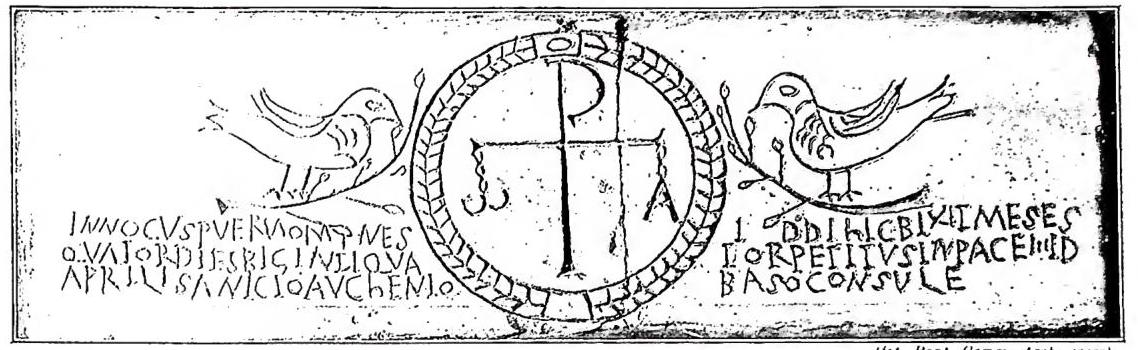
ARCHAEOLOGY. — Christians used the formula A-Ω on monuments, placing the two letters beside the chrismon or monogram of Christ; rarely did they use them alone, as in the famous inscription of Euelpis in Caesarea of Mauretania (De Rossi, in *Bullettino di archeologia cristiana*, 1st series, 2 [1864], p. 28). They probably intended thereby to protest against the Arians, who denied the divinity of the Word; indeed, this usage occurs only after the Council of Nicaea. Various anomalies in the practice of placing the two letters beside the monogram are due simply to the carelessness or whimsy of stonecutters; often they are even suspended from the horizontal bar of the monogrammatic cross (late), rather for decorative effect than in imitation of processional crosses.