
ALLOCUTION
A discourse, more or less solemn, delivered at a gathering; in particular, it is more commonly used to denote those solemn declarations which the Pope is wont to make in the presence of the Sacred College during the secret consistories (in our times, secret only in rite) or on other grand occasions of the Church or the Papal Court. In these addresses, matters of special topical interest are purposely treated, concerning the relations of the Holy See with civil governments, the most serious questions pending or resolved, the most urgent needs of the universal Church, the triumphs and persecutions of religion.
Many allocutions have had and still retain particular historical and diplomatic importance; such, to limit ourselves to the last 150 years, are those of Pius VII on the Concordat with Napoleon I and its violations by France, especially in 1802 and 1808; of Gregory XVI on the divergences with Prussia and Russia; of Pius IX and Leo XIII on the “Roman Question”; of Pius X on the separation of Church and State in France; of Pius XI on the imminent dangers of the last world war.
Other allocutions are frequently delivered on the occasion of the creation and imposition of the cardinal’s hat, for beatifications and canonizations.
Vittorio Bartoccetti
ALLORI, ALESSANDRO
Painter, b. in Florence on 3 May 1535, d. 22 Sept. 1607. Left fatherless, he was taken in by Agnolo Bronzino (v. BRONZO), whose name he adopted. Trained by him in art, he soon became his assistant and remained faithful to his example except in the case of Michelangelo. He was very active, decorating numerous churches in Florence and palaces and villas in the surrounding area. Among his works we recall: the decoration of the Gaddi Chapel in S. Maria Novella; the Miracle of the Manna in the refectory of S. Maria Novella; the paintings in the Salviati Chapel in S. Marco; Christ and the Adulteress in S. Spirito; the Resurrection in the Carmine in Pisa; S. Fiacre in the sacristy of S. Spirito; the
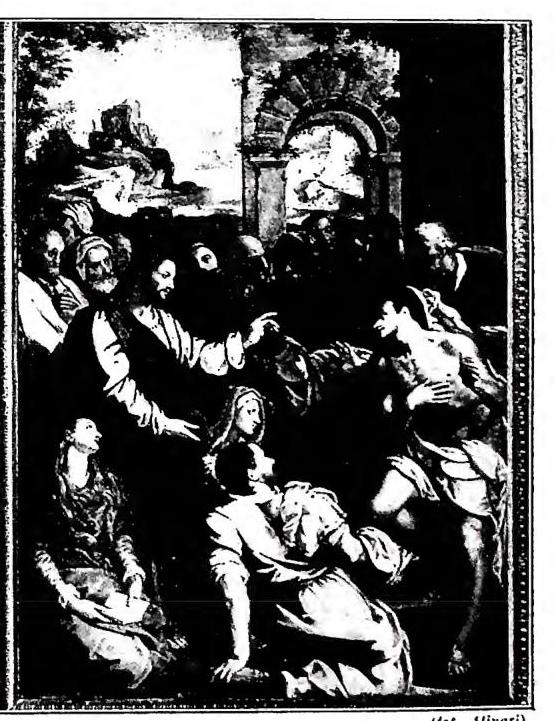
Allori, Alessandro – Resurrection of Lazarus. Montepulciano, church of S. Agostino.