
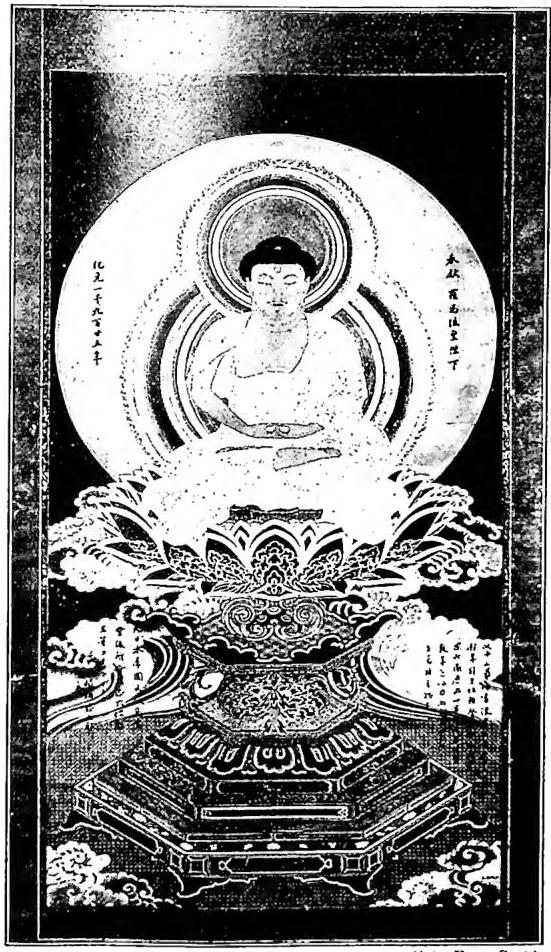
AMITĀBHA (AMITĀBHA). — One of the innumerable buddhas of *Mahāyāna* Buddhism, the "Great Vehicle," which, several centuries after its first appearance, was systematized by the Indian philosopher Nāgārjuna (2nd century A.D.), founder of the Buddhist school *Śūnyavāda* ("The System of Emptiness," nihilist).
The *Mahāyāna* differs from primitive Buddhism (6th–3rd centuries B.C.) by a particular evolution and extension of its historical and religious content. It represents, in fact, a universal means of salvation, rendering possible the attainment of final liberation (*nirvāṇa*) not only for monks but for all men living an active life. It moreover regards the Buddha Śākyamuni as a divine being, endowed with the greatest compassion and gentleness, superior to all others, and in the *bodhisattva* (lit. "one whose essence is enlightenment"), a creature destined for clairvoyance, to become a *buddha*, but possessed of such great altruism, through effective compassion for every sufferer, that it defers for an exceedingly long time the attainment of its own liberation. Such a being is therefore superior to the *arhat* of primitive Buddhism, the saint free from all possible passion, who in his final existence is a teacher of the truths proclaimed by the Buddha and a guide to the path of salvation, but no more. Because of these differing characteristics, primitive Buddhism was denominated by the followers of *Mahāyāna* as *Hīnayāna*, "Small Vehicle."
In addition to the above, *Mahāyāna* Buddhism has multiplied, as celestial reflections (*dhyāna-buddha*, "contemplative buddhas") of the great historical Buddha, numerous buddhas, beings of the highest order, great saviors, whose lives have attained a state of sanctification through countless centuries. One of these is precisely A., a *dhyāna-buddha* of the present age. Having been reborn in the West after millions of years spent in the practice of the most austere virtues as a *bodhisattva*, he is endowed with immense (*amita*) splendor (*ābha*), whence his name *Amitābha*, just as he is also called *Amitāyus* because of the exceedingly long (*amita*) duration of his life (*āyus*). His abode, the paradise *Sukhāvatī*, "the happy land," is, as described in the *Sukhāvatīvyūha*, "the particular description of the blessed land," the cause to men of every physical and moral well-being. All who, having lived in the fullness of goodness, direct their thoughts to A. are reborn in that happy land.
The cult of the great *dhyāna-buddha* A. has also passed into modern China, where Buddhism is the result of the fusion of various Mahāyānist sects. There he is called O-mi-t’o and has great power over the souls of the dead, freeing them from their sins and raising them to the rank of *bodhisattva*. In Japan A. is venerated under the name of *Amida*; he constitutes the ideal type of the buddha and occupies in worship a place far higher than that of the historical Gotama-Buddha. In Tibet A. is venerated under the name of *’Od-dpag-med*.