
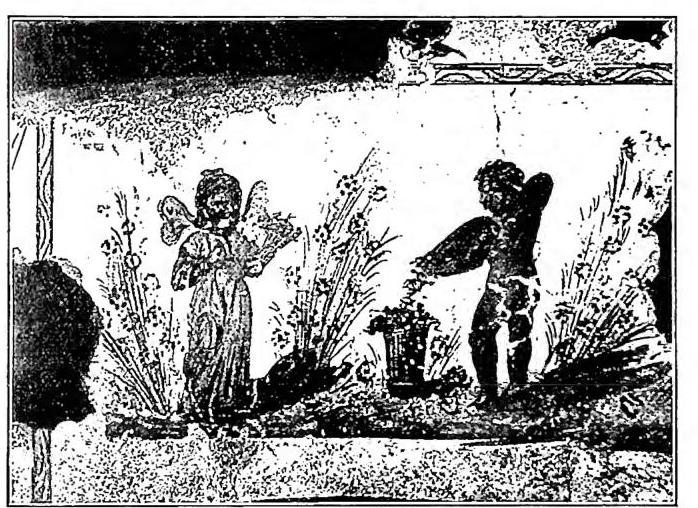
AMOR AND PSYCHE. – The myth of P. (the soul) found poetic expression in Books IV–VI of the *Metamorphoses* by Apuleius. Married to A., P., through her curiosity, sees her beloved vanish, but after long and painful trials, she finds him again and is reunited with him in eternal wedlock.
Through Neoplatonic interpretations, the fable acquired high moral value, adumbrating the concept that the love of divine things is a pledge of immortality. Thus elaborated, it offered itself to ancient Christian art as a poetic illustration of eternal happiness and could appear alongside the Good Shepherd, orants, or Jonah at rest. Equipped with butterfly wings, an emblem of the soul, P. gathers roses in the pure celestial glades together with A., or delights with him in the eternal dance, as seen in frescoes of the Catacomb of Domitilla or in the mosaics of Santa Costanza. The Alexandrian group of A. and P. embracing appears in a glass plaque with a Christian formula, and very rarely in sculpture, where a relief also unites them with the *dextrarum iunctio*, as an augury of reunion in the afterlife. In the paradisiacal vintage, P. offers A. a basket of grapes, an expression of celestial delights.
---
PURE LOVE, CONTROVERSY ON. – A famous theological-mystical debate concerning one of the most important topics of Catholic spirituality. For the historical aspect, see the entries: FÉNELON; GUYON, Mme de; MOLINOS; for the doctrinal aspect: CHARITY; QUIETISM; HOPE.
Since an object can be loved either because it is suitable to the one who loves or because it is lovable in itself, a distinction is made between love of concupiscence and love of friendship: the former makes its object a means; the latter, the end or goal to which it orders itself. And since supernatural charity is perfect love of friendship (q.v.), the question arose whether man can love God in such a way as to exclude himself, that is, whether self-love is compatible with charity. If self-love were contrary to perfect charity, the love that every being naturally owes to itself would be in conflict with charity, that is, nature would destroy grace, and vice versa. Moreover, since hope, as a theological virtue, is the love of God not insofar as He is good in Himself but insofar as He is our highest good, it too would be incompatible with perfect charity. Thus, true Christian perfection would imply not only the renunciation of our disordered appetites but the annihilation of our entire being, as if this were necessary to leave greater room for the glory of God.
Such pure or disinterested love, taught more or less by false mystics of all ages, found a vociferous supporter in the Quietist Michele Molinos, condemned by Innocent XI in 1687. Meanwhile, in France, the widow Guyon became its ardent apostle, succeeding in winning Fénelon to her doctrine in 1689. In 1693, Bossuet became acquainted with the correspondence between the latter and Mme Guyon, whose writings he read and condemned. To bring Fénelon to repentance, Bossuet arranged the Conferences of Issy (a villa of the seminary of Saint-Sulpice in Paris), where Bossuet, de Noailles (then Bishop of Châlons), and Tronson sought, from July 1694 to March 10, 1695, to define the limits of orthodoxy by re-examining the Quietist doctrines followed by Mme Guyon. The result was the 35 Articles of Issy, subscribed to by Fénelon, which set forth the correct doctrine regarding pure love, contemplation, and certain passive mystical trials. Having become Archbishop of Cambrai (1695), Fénelon continued to defend his ideas with the publication of *Explication des maximes des saints* (1697), which he opposed to Bossuet’s *Instruction sur les états d’oraison* (1697). The lively struggle between the two prelates (from February 1697 to February 1699) ended with the condemnation of the *Maximes* by Innocent XII in the brief *Cum alias* of March 12, 1699.
---
LOVE. – A name (Aramaic *amōra*, plural *amōrā’*, and in Hebrew form *’emōrā’îm*, “expositor”) originally given to the lower Jewish teachers who explained the teaching of the doctors of the Law to the people; after the closure of the Mishnah canon, it became the technical designation of the rabbinic doctors who, from 220 to 500 A.D., succeeded the *tannaim* and who explained the text of the Mishnah, resolving its contradictions or defining new cases, and developed it marginally by collecting other legal traditions which they fixed in writing. From their work resulted the dual *Gemara*, which, added to the text of the Mishnah, formed the Talmud; they inserted into it ancient sayings that had remained outside the Mishnah, calling them *baraythā’* (“external things”). The *amoraim* had schools: in Palestine, from 219 until its closure by order of Theodosius II in 425 at Caesarea, Sepphoris, and Tiberias; in Babylonia (from 219 to 500 A.D.) at Sura, Nehardea, Pumbedita, and Mahoza.
About two thousand *amoraim* are known, divided into seven generations, variously listed and dated by historians. The first five generations include Palestinian *amoraim* (with the title *rabbi*) and Babylonian *amoraim* (title *rabh*, sometimes *mar*; see ABBÂ II), in almost parallel series; the last two, only Babylonian *amoraim*. The last great *amoraim* were Rabh Asî (q.v.) and Abina (q.v.). Among the Babylonians, other notable figures include Abba Arka, three Samuels, Jehudah bar Jehezqel, Rabbâ bar Nahmani, Josef ben Hijâ, Nahman ben Jâhâq (and four others named Nahman); among the Palestinians: Usâ’jah, three Juchdâhs (2nd, 3rd, and 4th), Eleazar ben Pedath, Johanan bar Nappahâ, Abhâhû, Tanhum ben Abba.