
ANANIAS
I. OLD TESTAMENT
1) A name given to Azariah. In the Greek text, Tobias adds: “I knew A. and Jonatas, sons of the great Semaias, when they went together to worship in Jerusalem” (Tob. 5:18-19).2) False prophet (Vulgate: Hananias) of Gabaon, opponent of Jeremiah, who exposed his illusory prediction of the fall of Babylon; he died two months later, in the seventh month of the fourth year (594 BC) of Zedekiah (Jer. 28).
3) One of the three young men of the tribe of Judah and of royal lineage, deported with Daniel to Babylon. At the court of Nebuchadnezzar, his name was changed to Sidrach (Heb. Sadrach). Together with Azariah (q.v.) and Mishael, he refused to worship the king’s statue set up at Dura. For this, they were cast into a fiery furnace. After praying and singing hymns of praise to the Creator, the three emerged unharmed. Nebuchadnezzar, marveling at the miracle, confirmed them in their governance of the province of Babylon (Dan. 1:6-20; 3:1-97). Mattathias, on his deathbed, recalled their heroic observance of the divine law (1 Macc. 2:59).
4) A Levite, firstborn of the Korahite Shelemiah; he was a co-preparer of the sacred perfumes (1 Chron. 9:31). One of his descendants, also named A., returning from the Babylonian exile, helped restore part of the walls of Jerusalem (Neh. 3:8, 23).
5) Leader of the citadel (birah) of Jerusalem (Neh. 7:2; Vulgate: Hananias), a man of singular virtue, who, together with Hanani, Nehemiah’s brother, was appointed by Nehemiah to guard the city. A few decades later, an A., perhaps a high Persian court official, informed the priest Jedoniah that Darius II had decreed the Feast of Unleavened Bread at Elephantine (Elephantine papyrus 21, ed. Cowley), arriving in the same year, 419 BC.
II. NEW TESTAMENT
1) A Christian of the early Jerusalem community, husband of Sapphira, who, with her, was condemned and struck down by St. Peter as a terrible example for deceiving the Apostle and defrauding the “brothers.” Together with his wife, A. kept back part of the proceeds from the sale of a field, claiming to have given it all, but in reality lying to the Holy Spirit (Acts 5:1-11). For representations of A. and Sapphira in Christian art, see below.2) A Christian of Damascus, a Jew by birth, highly esteemed by all. After a vision, he went to find Saul in the house of Judas on the “Straight Street,” restored his sight by laying hands on him, baptized him, and announced the apostolic mission to which God had chosen him (Acts 9:10-18; 22:12-16).
According to E. P. Le Camus (*L’œuvre des Apôtres*, I, Paris 1891, p. 342), he would be identical to the Jewish (Christian, according to Orosius, VII, 6) propagandist who converted Izates, son of Monobazes, king of Adiabene (Flavius Josephus, *Antiquitates Judaicae*, XX, 2, 4). According to the *Constitutiones Apostolorum*, VIII, 46, 17 (ed. F. X. Funk, I, Tübingen 1905, p. 563), he was a layman; Ecumenius (*In Acta Apostolorum* 9:10; *PG* 118, 170) calls him a deacon; St. Augustine considers him a priest. A Byzantine tradition numbers him among the Seventy-Two Disciples and holds him to be the first bishop of Damascus and a martyr (Symeon Metaphrastes: *PG* 114, 1101-110).
A subterranean chapel (at the Roman level of Damascus), near the Eastern Gate (Bāb esh-Shaqī), held by the Franciscans since 1820 (destroyed in the massacre of 1860, rebuilt in 1867), has for centuries been venerated by Christians and Muslims as the dwelling of St. A.; it was part of a vanished Byzantine basilica, whose foundations are still visible. E. de Lorey explored the “House of A.” (from 1920 onward). The Greeks celebrated his feast on October 1, the Latins on January 25 (*Acta Sanctorum*, January III, Paris 1863, pp. 227ff.).
3) A Jewish high priest, son of Nebedaeus, successor of Joseph son of Camithus; appointed by Herod of Chalcis in 47, he remained in office until 59. He belonged to the family of Annas (q.v.) or Hanan and was known for his wealth and gluttony. In 52, he was sent to Rome by the legate of Syria, Quadratus, to give an account to Claudius of his conduct in the disputes between the Samaritans—supported by the procurator of Judea, Cumanus, and his tribune, Celere—and the Jews. Through the good offices of Agrippa II and Berenice, he returned acquitted, with the triumph of the Jews. He presided over the Sanhedrin convened after the arrest of St. Paul to accuse him and had him struck on the face as soon as the Apostle began his defense; Paul cursed him and called him a “whitewashed wall,” but, at the remonstrance of those present, added that he did not know that the man was the high priest. Soon after, he went with the priests and other Jews to accuse Paul before the procurator Felix (Acts 23:2-6; 24:1-9).
Even after his deposition, thanks to his wealth and the favor of the Roman procurators Albinus and Gessius Florus (62-66), he exercised great influence in Jerusalem, though notorious for his greed. He was assassinated in 66, as a friend of the Romans, by Sicarii led by his son Eleazar, at the beginning of the Jewish revolt (Flavius Josephus, *Antiquitates Judaicae*, XX, 5, 2; 6, 2; 9, 2; *Bellum Judaicum*, II, 12, 6; 17, 6, 9).
4) Another high priest named A., son of Masball,
5) A., son of Sadoc, was among the first instigators of the Jewish revolt of 66. He was sent by Eleazar, leader of the rebels, to the Roman commander Metilius, promising him safe conduct if he would withdraw his troops from Jerusalem; the soldiers were however slaughtered, and Metilius was circumcised. Eleazar also sent A. as his envoy to the Idumeans to seek their aid against Ananus II (q.v.), whom he accused of intending to deliver the city to the Romans (Flavius Josephus, *Bellum Judaicum*, II, 17, 10; IV, 4, 1).
III. ANANIAS AND SAPPHIRA IN CHRISTIAN ARCHAEOLOGY
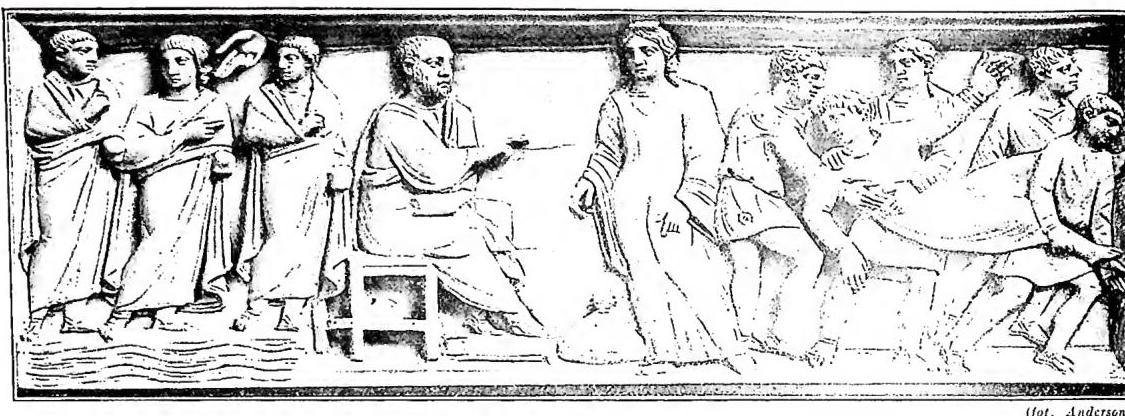
The account in Acts 5:1-10 is documented in Christian sculpture only in the last decades of the 4th century. It has been identified in a fragment of an Avignon sarcophagus and probably on another in the cemetery of St. Callistus, through the well-preserved scene on the rear panel of the Brescia Lipsanoteca. Here, the two phases of the event are combined into a single composition: on the left sits St. Peter interrogating Sapphira; between them, on the ground, the sack of money; on the right, young men are removing the body of A. It is likely that the motif has a doxological character.ANANIENSIS (ANAUNIENSIS), Giovinale Ruffini of Nonsberg: see GIOVENALE of VAL DI NON.
‘ANANIOSIO (ENANIOSIO). — A Nestorian monk, he studied with his brother Iesuyab at the school of Nisibis, where both had as a friend and fellow student the namesake Iesuyab, who was also from Adiabene and later became patriarch of the Nestorians. The two brothers embraced the monastic life and entered the monastery of Mount Izla, but then ‘A. visited the holy places and from there went into the desert of Nitria, where he studied the deeds of the anchorites. Returning home, he moved with his brother to the monastery of Beth ‘Abe. ‘A., says Thomas of Marga, surpassed in intelligence and learning all who came before and after him. For this reason, Iesuyab, first metropolitan of Arbela and then patriarch (647-58), made use of ‘A.’s work in compiling the canonical hours. Among his other works, we know of the *Liber canonum de aequilitteris*, published by Hoffmann (*Opuscula Nestoriana*, Kiel 1880, pp. 2-49).
A. is famous for having made a good edition of the Historia Lausiaca by Palladius in Syriac, at the request of Patriarch George (658-80). This book, which was circulated among the Nestorians, was edited by Bedjan (Acta mart. et sanct., VII, Leipzig 1897) in four parts, of which the one inserted between the second and third is attributed to St. Jerome, although it is now admitted to be the work of Timothy of Alexandria, translated into Latin by Rufinus. Another edition was made by W. Budde, with an English translation (The Book of Paradise, London 1904).