
APHEC (Hebrew 'Aphig or 'Aphig' «fortress» or «watercourse»). — Name of 5 localities in Palestine.
1. A Canaanite city in the mountains of Judah, whose king was defeated by Joshua (Jos. 12, 18 and 15, 52 [Aphieca]); it corresponds either to modern Fuqin, 9 km. west of Bethlehem, or to Hjirbet ed-Darrarne near the spring 'Ayn Dilbe.
2. A city on the southern border of the tribe of Asher (Jos. 13, 14; 19, 30; Jud. 1, 31) between Amma and Rohob; it remained inhabited by the Canaanites. Perhaps it corresponds to Apqu Asarhaddon (v.). It is modern Tell-Kurdane, near the spring 'Ayn el-Başş called Re-cordane by the Latins in the Middle Ages. It cannot be identified with the Greek Aphaka of Lebanon (modern Afqa, 28 km. west of Baalbek), famous for its temple of Venus (Astarte) which Constantine had destroyed (Eusebius, Vita Const., III, 55); for the borders of Israel never extended as far as Lebanon. It might instead be identified with the A. of I Sam. 29, 1 (cf. below under no. 4).
3. A city near Ebenezer in the plain of Sharon, where the Philistines defeated the Hebrews and took the Ark of the Covenant (I Sam. 4, 1 ff.). It appears in the list of Thutmose III (no. 66: I-pw-q-n = Efeqon), and in the Egyptian “execration texts” (19th cent. B.C.). Today it is often identified with Meğdel Jāba (Migdal Aphec of Flavius Josephus, Bell. Jud., II, 19, 1), 14 km. north of Lydda; but in reality it is Qal'at Rās el-'Ain, the Herodian Antipatris (v.), 3 km. further northwest, where traces of Bronze Age settlement (c. 2000 B.C.) have been found. Cf. F. M. Abel, Mirabel et la tour d'Aphie, in Revue Biblique, 36 (1927), pp. 390-400.
4. A city in Jezreel (v.), beside the mountains of Gilboa, near which the Philistines defeated Saul (I Sam. 29, 1 ff.); perhaps it corresponds to modern Fuqin'a. But F.-M. Abel identifies this with the previous one. Cf. above under no. 2.
5. The place where Ahab, king of Israel, defeated Benhadad II of Syria (I Reg. 20, 26-30), and later Joash, king of Israel, defeated Benhadad III (II Reg. 13, 17-25). It is to be placed east of the Sea of Tiberias; it corresponds to modern Fiq in the Golan, 21/2 km. east-northeast of el-Hoşn (Hippos).
A.P.I. — The bull A. (in Egyptian l'p'j meaning «the runner») was the most popular sacred animal of the Egyptians. It was especially honored at Memphis, where a living specimen was kept in the temple called Apieum. The choice of the animal was not simple. It had to be a black bull, but white on the belly, legs, and tail, with a roughly triangular white spot on its forehead, which the Egyptians compared to the wings of an eagle. The death of A. was a national mourning. The animal’s mummy was solemnly buried in the Serapeum of the Memphite necropolis; this burial site was discovered at Saqqara by Mariette in 1851.
A.P.I.
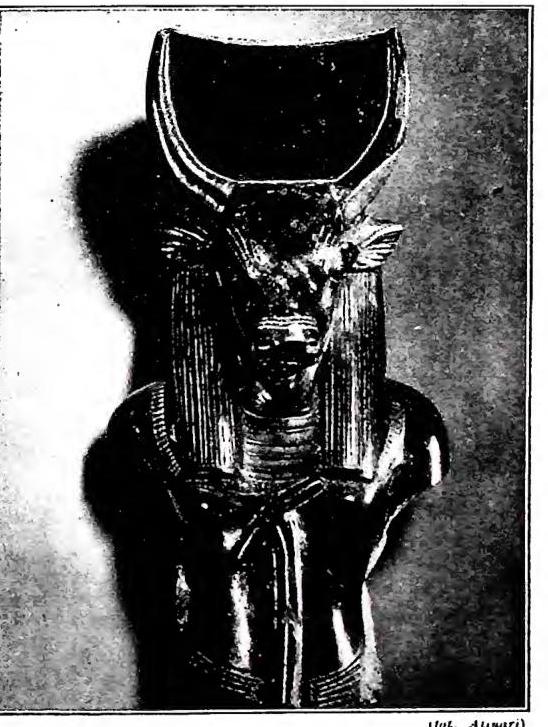
Roman-era granite sculpture — Vatican Egyptian Museum.
— The bull A. with the solar disk between its horns. Roman-era granite sculpture — Vatican Egyptian Museum.