
**ARADO** (Heb. 'Arvad; Assyr. 'Arvada; Sept. 'Azdio, 'Apazoc; Vulg. Aradii, Aradus). — A small island (800 m by 500 m) off the Phoenician coast with a city of the same name (today Ruwad, with 2,500 inhabitants), situated two and a half kilometers from the shore and about 60 km north of Tripoli in Syria, inhabited by the Aradii, descendants of Canaan (Gen. 10:18). According to Strabo (XVI, 2, 133), it was founded by refugees from Sidon. In antiquity it held an important place in commerce and navigation, alongside Sidon and Tyre. Aradus dominated the adjacent mainland territory, two cities of which are known from Egyptian lists of the 15th–12th centuries B.C.: Qamaqa (today Tell Gamqē) and Marathos (today Amrit), where after 1000 B.C. the rock-hewn mausolea of the kings of Aradus are located.
In the 15th century B.C. it was in contact with Egypt (it is mentioned in the documents of Thutmose III [1501–1447], and later in the el-Amarna letters), then with Assyria, and Tiglath-pileser I (1115–1102) boasts of having embarked on ships of Aradus. Esarhaddon (680–669) and his son Ashurbanipal (668–626) subjected the kings of Aradus, Mattan-ba‘al and Yakin-lu. By the mid-6th century B.C. it appears subject to Tyre, to which it contributed ships and soldiers (Ezek. 27:8, 11); yet under the Maccabees it reappears as independent (1 Macc. 15:23). The pseudo-Clementine writings place a visit of St. Peter there (Recogn., hom. VII, 26; XII, 12; PG 1, 1360; 2, 312; cf. Nicephorus, Historia eccl., II, 35; PG 145, 848).
Perhaps from the 3rd–4th century it was the seat of a bishopric. Known bishops, however, date only from the 4th century, at first with the additional title of Antaradus (v.): Mocimus at the Council of Constantinople (381), Musaeus or Moses at the Council of Ephesus (431), Paul at the Council of Chalcedon (451), Atticus (458), Stephen at the Council of Jerusalem (536), Asyncretius at the Second Ecumenical Council of Constantinople (553). From the Middle Ages it has been a titular see, V. ANTARADUS.
Like other Phoenician cities, it was destroyed in A.D. 648 by Mu‘awiyah, sent by ‘Umar. Its ruins were explored in 1860–61 and in 1915.
---
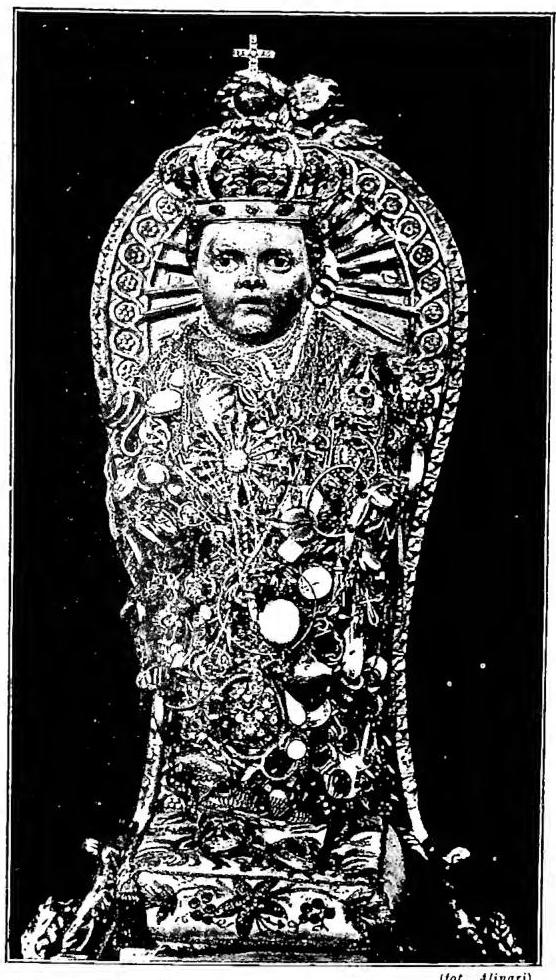
**ARACOELI** — The Holy Child. A wooden sculpture (perhaps of the 14th century) covered with ex-votos of various centuries — Rome, S. Maria in Aracoeli.
Even today, as in the Middle Ages, Aracoeli is the church of the commune of Rome. The historic Franciscan convent, until 1886 the seat of the Minister General of the Order, has almost entirely disappeared to make way for the monument to Victor Emmanuel II by Saccon