
ARK (OF THE COVENANT), ARK OF THE TESTIMONY. — Thus the Pentateuch designates the most important and ancient object of Israelite worship from Moses to the exile; the other sacred books also call it the “Ark of the Lord” or “of God.” It consisted (Ex. 25, 10–22; 37, 1–9) of a chest (the ordinary meaning of the Hebrew ’arôn) made of acacia wood, measuring 2½ cubits by 1½ (if, as seems likely, the smaller cubit is meant [m. 0.45]; ca. m. 1.12 by 0.67 by 0.67). Inside and out it was overlaid with pure gold; around the top, gold formed a raised border like a crown; at the four corners of the base were four gold rings, through which two acacia poles, also gilded, were permanently inserted for carrying II. On the upper face rested a solid gold slab, upon which were fixed two golden figures: the cherubim (v.), with wings outstretched so as to overshadow the slab, and their faces turned toward II. This slab is called in Hebrew kappōreth, which, by association with kipper “to atone,” is traditionally rendered “mercy seat” (v. LXX: ἱλαστήριον), a religious term preferable philologically to “lid” (in the LXX sometimes ἱλαστήριον ἐπίθημα). Inside was placed “the testimony,” namely the two tablets of the Law (1 Kings 8, 9; cf. Ex. 25, 16); according to Heb. 9, 4, also a golden jar containing a bit of manna and Aaron’s rod (but cf. Ex. 16, 33–34); beside it was placed the book of the Law of Moses (Deut. 31, 26).
The symbolism of the Ark is clarified by a historical-archaeological comparison. The custom of preserving important documents in temples was ancient and widespread, e.g., at Rome the Sibylline Books on the Capitol. But precisely in the Mosaic period, in Egypt—whence the Hebrews derived many forms of civilization—treaties were deposited at the feet of statues of deities, as if invoking the god as witness to the covenant and guarantor of its observance. Moses would have acted similarly with regard to God. Yahweh was “enthroned upon the cherubim” (1 Sam. 4, 4, etc.) of the mercy seat, or more precisely upon the space between their wings, where He appeared “in the cloud” (Lev. 16, 2) and spoke to Moses (Ex. 25, 22) and others. The Ark was therefore understood not as a representation of God but as His throne, the place of His presence, the “footstool of His feet” (Ps. 98, 5); this explains why, even though Yahweh was certainly distinct from the Ark (2 Kings 6, 12; 1 Kings 8, 10, etc.), in its presence one acclaimed Yahweh (Num. 10, 35 sqq.; 1 Sam. 4, 7; 6, 20, etc.). Before the Ark, that is, “before Yahweh” (Josh. 18, 8, etc.), one came to pray and offer sacrifices (1 Sam. 1, 2, 19; 6, 15); the Ark was the center of worship.
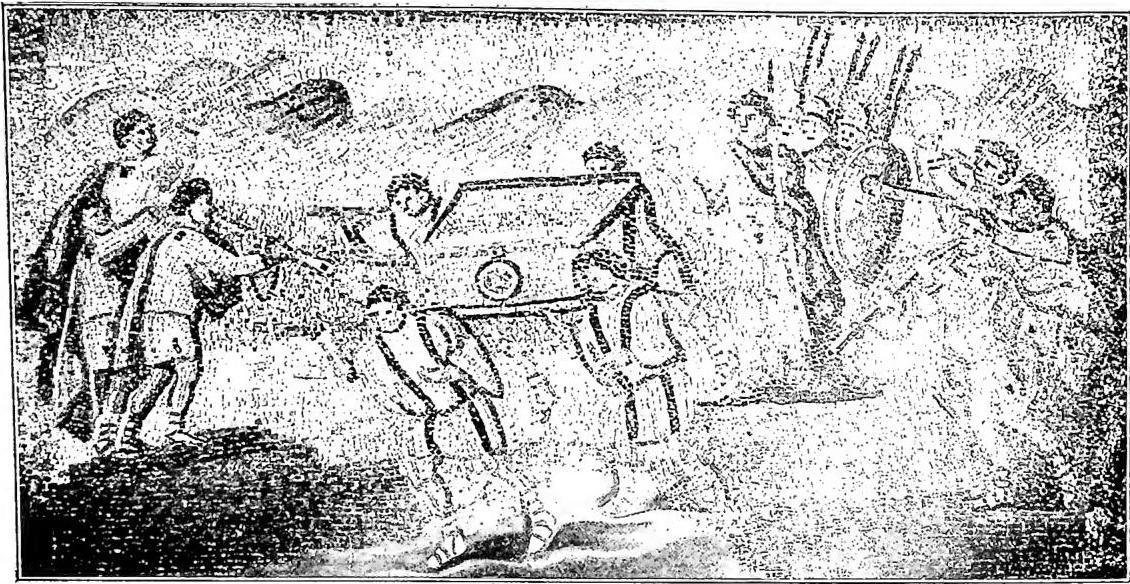
The Ark, constructed by Bezalel (v.) shortly after the Exodus (Ex. 37, 1–9), first stood in the Mosaic Tabernacle (v.), accompanied the Israelites in the desert, and then was at Shiloh until the time of Samuel (Josh. 18, 1–8, 10; Judg. 20, 18–27; 21, 2–19; 1 Sam. 1, 3–21; 24, 2; 14). From Shiloh it was carried into battle as a pledge of divine protection (Judg. 20, 18 [Heb.], 28; 2 Sam. 4, 3; 1 Sam. 11, 11). Captured by the Philistines, it was soon returned because of the disasters it provoked (1 Sam. 4–6). It remained at Beth-shemesh, then at Kiriath-jearim (ibid. 6, 12–7, 2), whence David solemnly transported it to a special tent on Zion (2 Sam. 6), and Solomon later placed it in the innermost chamber of his Temple (1 Kings 8, 3–11). After the destruction of Jerusalem (587 B.C.) it disappeared forever. According to one tradition (2 Macc. 2, 4–8), Jeremiah hid it in a cave on Mount Nebo (the Ark is not among the sacred vessels plundered by the Babylonians: Jer. 52, 17–23).