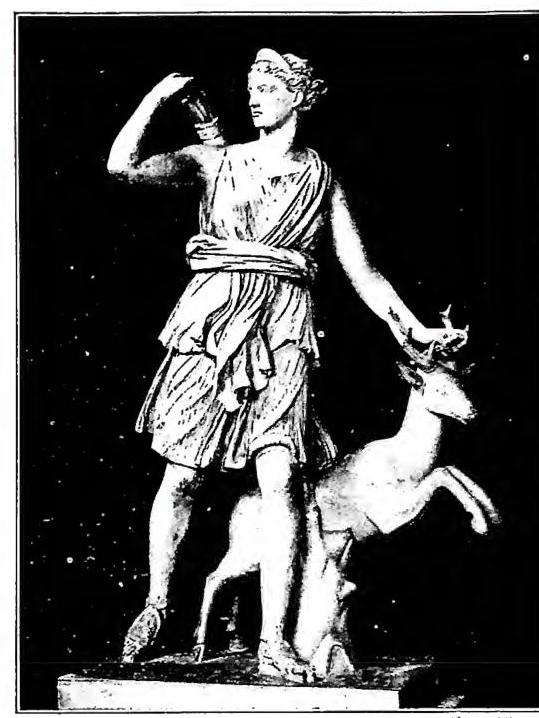
ARTEMIS ("Αρτεμίος"). — A goddess of Greece who enjoyed a very widespread cult, as is also shown by the frequent use of the month-name Artemisios, which was sacred to her in the various Greek calendars. The name has not been satisfactorily explained: derivations have been proposed from Hebrew, Persian, Egyptian, Greek, etc., and recently it has been suggested that it is of Minoan or Hittite origin, but all these hypotheses are uncertain. Even the original nature of Artemis is debated: whether she was a lunar deity, or the result of the gradual fusion of various nature goddesses and mother-goddesses, modified under the influence of the triad Apollo, Leto, and Artemis, becoming the virgin Artemis; or, finally, a goddess of wild nature and human fertility.
The traits under which Artemis appears in classical times are numerous and varied. She is a goddess of nature to which are sacred the mountains, the woods, the trees, and above all the waters of fertilizing moisture—springs, marshes, fountains—near which she often has her temples: because of her connection with springs she is sometimes worshipped alongside Asclepius. She protects agriculture, the harvests, and wards off harmful influences, for which reason she is offered the first fruits. She is the goddess of wild and domestic animals, πόνια ὄρνιθον, mistress of the animal world, which she protects, but also pursues and slays with her infallible bow. Some have thought that she herself was once worshipped in animal form, especially as a bear, and evidence for this has been sought in the nickname of “she-bears” given to the priestesses of Artemis at Brauron. As huntress and archer she is best known from poets and artists, less so from cult practice. She is also a warrior goddess, sometimes represented with helmet, sword, and spear, especially on coins. To her, under the epithet Artemis Ilithyia, women turn in childbirth. This aspect contrasts with that cult aspect which makes her the goddess of chastity, the “pure” par excellence, who shuns all love relationships.