
She was also celebrated as a goddess of safe passage: in this aspect she was honored at Athens in the Delphinia festival. She is a lunar goddess and her attributes are the torch and the crescent; according to some, this would in fact be her original aspect, which also appears in certain passages of the Iliad; according to others, it is a later development and would have received impetus from her identification with Hecate. As a lunar goddess she had no influence on cult practice, but from the Hellenistic age onward she exerted an influence on poetry and art.
Places of worship were numerous. Among the most interesting are that of A. Orthia at Sparta, built on a marshy site by the banks of the Eurotas; Orestes is said to have brought her image from Tauris. One of the rites that characterized this sanctuary was the flogging of boys, perhaps in substitution for ancient expiatory human sacrifices. Legend connects this sanctuary with those of A. Facelitis at Rhegium and of Diana Aricina at Nemi. A recent theory links A. Orthia with the goddess Rethia of Este (Veneto), suggesting that the A. of Sparta had the character of a healing goddess. Also characteristic at Sparta was the “festival of the wet-nurses,” in which infants were offered to A. In central Greece the cult of A. Laphria was widespread; during its festivals live animals—birds, boars, deer, wolves, bears, etc.—were cast into the fire and the priestess was carried in a chariot drawn by deer. In Arcadia A. was worshipped alongside Zeus Lykaios as the eponymous ancestor of the Arcadians. At Athens the Brauronia festival was celebrated, introduced from nearby Brauron, where lay the tomb of Iphigenia to whom the garments of women who had died in childbirth were offered. Only women took part in the Brauronia; the priestesses were girls between the ages of five and eight, nicknamed “ursos.” In Asia the sanctuary of Ephesus was famous, founded according to legend by the Amazons and enjoying the right of asylum; it attained great political and religious importance and employed a vast staff of priests and priestesses. These had to be unmarried, and married women were not permitted to enter the temple. According to Acts 19:24ff., reproductions of the temple and the goddess were used as amulets. The Artemisia festival was celebrated in March or April, and every four years the “Great Ephesia.” More important for its artistic influence than for cult was the A. Persica.
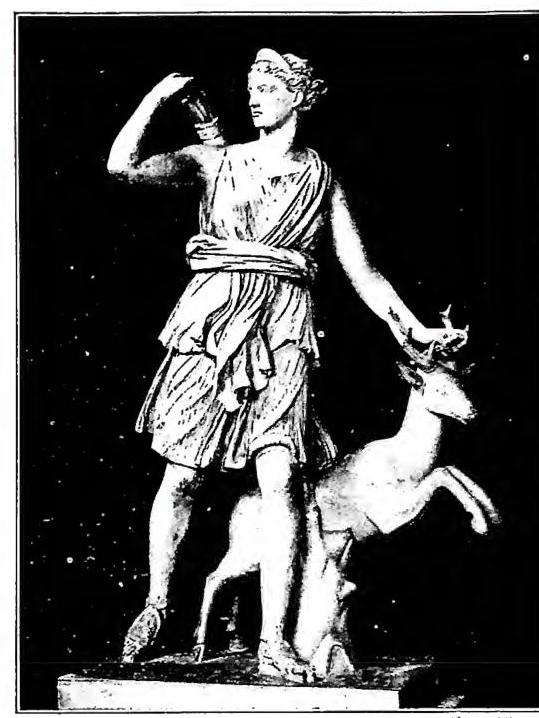
Ancient art depicted A. in many forms. The iconographic types are: the huntress in a short tunic, armed with bow and arrows, accompanied by a dog and a deer; the lunar goddess with a torch and a patera; the A. Persica or Taurica, often winged, seizing animals by their legs or necks as their mistress; and the A. Ephesia, with a cylindrical body to which numerous breasts were added in later times, a reproduction of oriental ornamentation.