
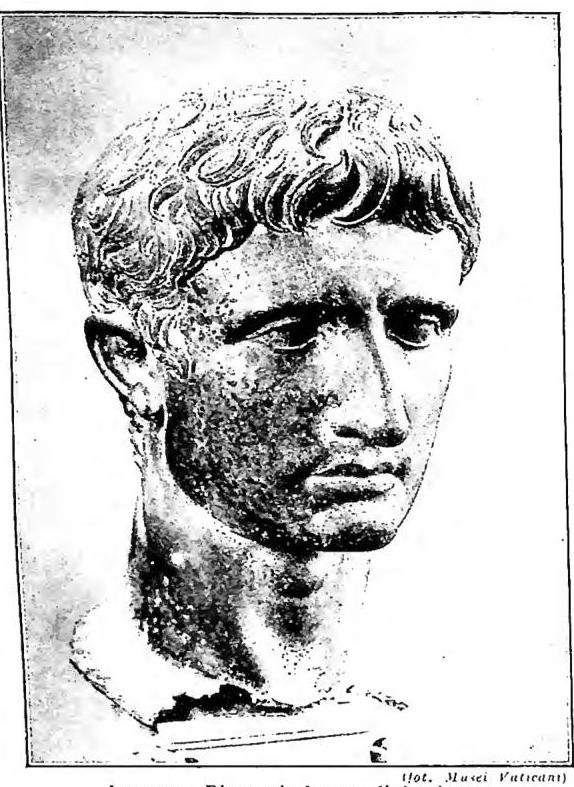
AUGUSTUS, Gaius Julius Caesar Octavianus (Gaius Iulius Caesar Octavianus Augustus). — Son of Gaius Octavius and Atia (daughter of Julia, younger sister of Julius Caesar), born on 23 September 63 BC (691 AUC), he was adopted and educated by his great-uncle, G. Caesar. While pursuing his studies in eloquence at Apollonia in Greece, he learned of the tragic death of his great-uncle (44 BC) and hastened to Rome to claim his inheritance and punish the assassins.
Having defeated Antony in 43 BC, he formed with him and Lepidus the Second Triumvirate, for the ratification of which the contracting parties mutually sacrificed their relatives and closest friends. The triumvirs defeated the republicans commanded by Brutus and Cassius at Philippi (42 BC). In 40 BC, by the Treaty of Brundisium, Octavian became master of the West; in 36 BC he defeated Sextus Pompey and left Lepidus only the office of pontifex maximus, an office which he assumed after Lepidus' death. With his victory at Actium over Antony (2 September 31 BC), he became virtually master of the entire State. To preserve appearances, he was successively granted the most important public offices, and in 27 BC he received the title of “Augustus” (in Greek Σεβαστός), together with that of praefectus morum and perpetual consul. He fostered the material and cultural prosperity of the empire, ensuring peace, promoting literature and the arts. He married successively Clodia, Scribonia, and Livia. He died at Nola in AD 14 (767 AUC), on the 19th day of the month of Sextilis, which in his honor was renamed Augustus (August).
Lk. 2:1-2, preparing to describe the birth of the Saviour, relates: “In those days a decree went out from Caesar Augustus to register all the inhabited world. This first census took place while Quirinius was governing Syria.” Since no explicit trace of a universal census decreed by Augustus has been found in secular sources, some critics (with E. Schürer) have questioned the veracity of Luke (v. QUIRINUS). However,
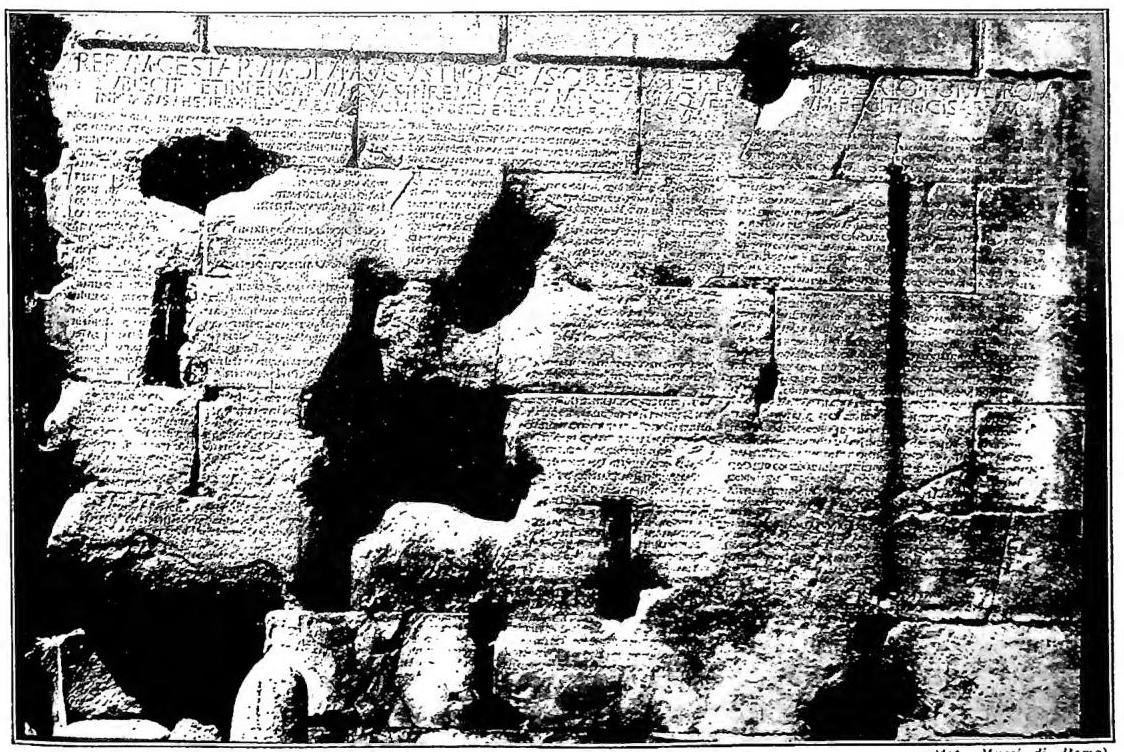
there are indications that confirm the Gospel. Tacitus (Ann., I, 2) informs us that after the death of Augustus a Breviarium imperii compiled by the emperor himself was read in the Senate “in which were indicated all public revenues, the number of citizens (Roman) and of allies under arms, the condition of the fleet, of subject or allied kingdoms, of provinces, of taxes, of tributes, of needs and of distributions.” To have this information Augustus must necessarily have ordered censuses and statistics throughout the empire. In the Monument of Ancyra (Ankara), which contains his Res gestae, Augustus states that he carried out the census of Roman citizens three times (in the years 28 and 8 BC and in AD 14).
Even before this time Augustus had intervened in the affairs of Palestine, especially in those concerning Herod. After the victory at Actium (31 BC), Augustus had granted pardon to Herod, who had sided with Antony and now strove, with idolatrous flattery, to make the powerful Roman forget his political fault: he multiplied his homage by naming cities after the deified Augustus and erecting temples to him (v. HEROD THE GREAT). Without being blinded by flattery, Augustus treated Herod with benevolence, granting him autonomy in the administration of justice and finance, exemption from imperial taxes and from the obligation to quarter Roman troops and garrisons; he granted him his own army composed mostly of mercenaries (Syrians, Thracians, Germans, Gauls), but demanded absolute dependence in political, military, and dynastic matters; practically, he regarded him as a fiduciary at will. When Herod in 8 BC, without Rome’s permission, used his army for a punitive expedition against the Nabataeans who favored the raiding Bedouins, Augustus indignantly wrote to him that from then on he would regard him not as a friend but as a subject (Flavius Josephus, Ant. Iud., XVI, 290). At Herod’s death (4 BC), Augustus partially confirmed his will, denying Archelaus the title of king of Judaea (with Idumaea and Samaria) and granting him only that of ethnarch. He accepted, however, the deceased’s designations for the other surviving sons, assigning to Antipas the tetrarchy of Galilee and Perea, and to Philip that of Batanea and Trachonitis (Lk. 3:1). Augustus intervened again in the affairs of Palestine by deposing Archelaus (AD 6) and entrusting Judaea to Roman procurators.
AUGUSTUS IN MEDIEVAL TRADITION. — For the pilgrim coming to Rome from the provinces of the collapsed empire or from the lands of the ancient barbarians, the imposing ruins of the monuments scattered across the seven hills recalled the name of Augustus, more or less legitimately associated with this or that place in the city. It will suffice to glance at the description that, between the 12th and 13th centuries, the English Master Gregory left of Rome for his countrymen (ed. R. Valentini and G. Zucchetti, Codice topografico della città di Roma, III, Roma 1945, pp. 137-67), which records the palace, the arch, and the pyramid of Augustus. More widely known, more authoritative, and older is the systematic description of the Mirabilia urbis Romae, dating from before the mid-12th century. Besides the arch and the palace, mention is made of the mausoleum of Augustus. In this description, the memory of the emperor is further evoked by the church of S. Maria in Aracoeli, where the emperor is said to have had a vision of the Sibyl; by the church of S. Maria in Trastevere, where a miraculous oil spring is said to have gushed forth; and by the church of S. Pietro in Vincoli, where the feast of 1 August is said to have replaced and continued that which had been celebrated there for four centuries in honor of Augustus and his victory over Antony (ed. R. Valentini and G. Zucchetti, op. cit., pp. 3-65).
The Mirabilia, from the 12th to the 15th century, enjoyed great diffusion throughout the West, but it is not to them that the chief credit is due for having kept alive the memory of the first emperor in the Middle Ages.
A. had been the founder of the empire which, after Charlemagne and Otto I, would once again become a living reality. Although it differed profoundly from the ancient one, it presented itself as its legitimate continuation, and the medieval emperors styled themselves as Caesars and Augusti, thus harking back to their distant predecessors from whom they claimed to derive their rights and powers, and they especially invoked the name of G. When historians traced the origins of the empire and of the world back from their own times—it will suffice to recall the universal chronicles—they accorded A. a preeminent place. And, noting the power, wealth, happiness, and prosperity no longer equaled in his reign, they fostered the belief that the age of A. had been a kind of golden age, which was willingly recalled in comparison and as solace for present miseries. Writers and poets, eager to inspire in contemporary rulers some feeling of emulation for the generosity of A., who had protected Virgil and Horace, favored this opinion. Thus Anselm of Besate promised Henry III to sing his deeds if he would grant him the protection that A. had granted to Virgil (cf. E. Dümmer, Anselm der Peripatetiker, Halle 1872, p. 16).
The strongest reason that in the Middle Ages kept alive among Christian peoples the memory of A. was the fact that under his reign Jesus Christ had been born. No one could believe that God, having taken human flesh, had chosen without profound reason that time in which, with the unity of the world attained and peace established, a prince had concentrated in himself all the powers of the dominant city and had founded the empire for centuries. On the contrary, all believed that God had given that prince a great and decisive mission, namely, to offer to the redemptive work of the Savior a unified and pacified world. The idea of this mission, even if unconsciously Christian, of A. is already clearly expressed at the beginning of the 5th century in the Historia adversus paganos (VI, 1) by Paul Orosius. Toward the end of the 6th century, in the Chronicle of a Byzantine writer of Syrian origin, John Malalas, we find the famous legend of the Capitoline vision, which attests to the awareness of A. of the birth of Christ (ed. L. Dindorf, Bonn 1831, pp. 231-32). Malalas had drawn this account from the now lost work of a somewhat earlier chronicler, Timothy. The legend long endured among the Christians of the East; in the 8th century it also had a Latin translation in Rome (cod. Vat. Pal. 277, fol. 63), and in the 12th century a new edition appeared in the Mirabilia urbis Romae. This legend is connected with the origins of the church of Santa Maria in Aracoeli, which are most likely dated to the 6th century.
While the Eastern version of the legend reaffirmed a concept common to 6th-century Christians—that with the birth of Jesus Christ the false oracles fell silent, i.e., it affirmed the victory of Christianity over paganism—the Western version returned to the thought of Orosius, that Christ was born under A., when the whole world was at peace, and added that A. had not wished to be called lord of men any longer, because the Lord of the world had been born among men. — See Pl. XXIX.