
BACICCIA (Gaulli, Giovanni Battista), known as il Baciccio. - Painter, born in Genoa on 1 May 1639, he went to Rome in 1657 and remained there until his death (2 April 1709), except for a brief stay in Modena (1669) and in Genoa; in 1674 he was elected prince of the Accademia di S. Luca.
In the Roman artistic milieu, where he benefited from the friendship and support of Bernini, Baciccia first gained fame as a portraitist, executing countless portraits of popes and cardinals from the pontificate of Alexander VII to that of Clement XI. In these works, the courtly Van Dyckian approach was infused with intense coloristic richness and expressive mobility, achieved through contact with Bernini’s art (portraits of Clement IX, in the Galleria di S. Luca and the Rospigliosi collection in Rome; portrait of Cardinal Leopoldo de’ Medici, in the Uffizi). The painter’s complex artistic formation, which took place in Genoa under Borzone and through contact with the prolific workshop of the De Wael brothers, is reflected in his early Roman works (altarpiece with the Madonna, Child, and saints, in S. Rocco, 1660–65; *Pietà*, Incisa collection, 1667; *Assumption*, formerly in the Chigi collection at Castelfusano, 1667). These works reveal, alongside Flemish influences from Rubens and Van Dyck and a Correggesque style often mediated through Lombard artists, a study of the monumental altarpieces of the Carracci and Reni. The inner pictorial conflict inherent in Baciccia’s emotive colorism in relation to a definitive drawing style was resolved through his Roman encounter with Bernini’s sculpture, whose exemplary significance of color he understood as enabling a new solution to the problem of mass and movement within conventional stylistic terms.
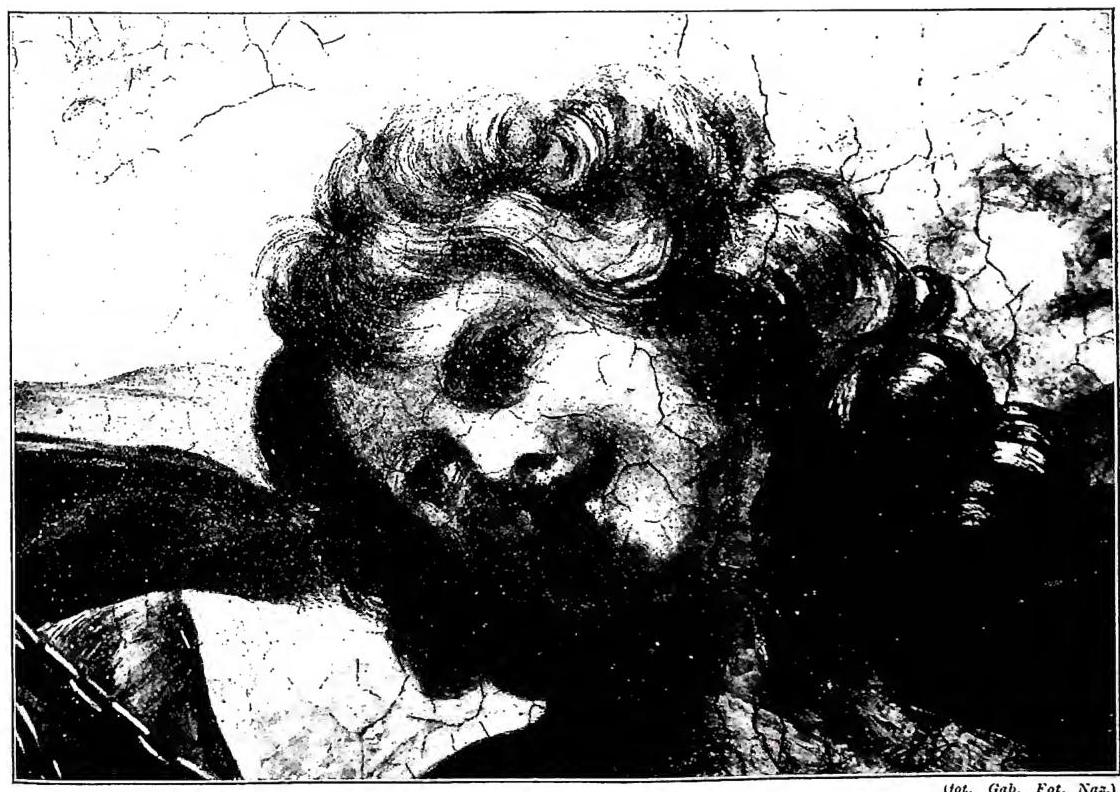
(Photo: Gab. Fot. Naz.)
BACICCIA - Angel’s Head. Detail of the fresco with the Adoration of the Name of Jesus - Rome, ceiling of the church of the Gesù.
In the decoration of the ceiling of the SS. Apostoli (1707) with *The Triumph of the Franciscan Order*, Baciccia reveals a latent adherence to the schemes and styles of the impending 18th century, which were contrary to his best style. - See Plate XLI.