
BANDELLO, MATTEO. — Novella writer, born in Castelnuovo sulla Scrivia around 1485. He entered the Dominican Order at a very young age, perhaps in Rome, of which his uncle Vincenzo Bandello was then (1501-1506) the Master General. He moved to the Milanese convent of Santa Maria delle Grazie, where he did not stay long, constantly traveling to Genoa, Florence, Naples, and Calabria. He then broadened his travels and acquaintances further after joining, in 1506, the Bentivoglio family, exiles from Bologna living in Milan; the young Dominican crossed the Alps several times on diplomatic missions. After the Battle of Marignano (1515), he settled in Mantua at the court of Isabella Gonzaga; when Francesco II Sforza was restored to the Duchy of Milan six years later, he returned there for a brief period, until the Morone conspiracy (1526) aroused suspicion against him, forcing him to leave and return to his Gonzaga patrons, this time as secretary to Luigi, captain of the Holy League. After leaving the Gonzaga, in 1528 we find Bandello with Cesare Fregoso, a captain first for Venice and then for France, and later with Fregoso’s widow, Costanza Rangoni, hosted by Francis I of France when Fregoso fell by the hand of Charles V’s assassins (1541). In the quiet retreat of Bazens, the adventurous friar devoted himself to learned conversations in the circle that gathered around Rangoni and to writing his novellas and verses. On 1 September 1550, he was appointed Bishop of Agen by the King of France, reserving half the income of the see for Ettore Fregoso, a Veronese cleric; but this was merely a provisional appointment, for Bandello resigned at the beginning of 1555 when Giano Fregoso was named to the see; he was then granted the castle of Bazens, located within the diocese. He died in France in 1561.
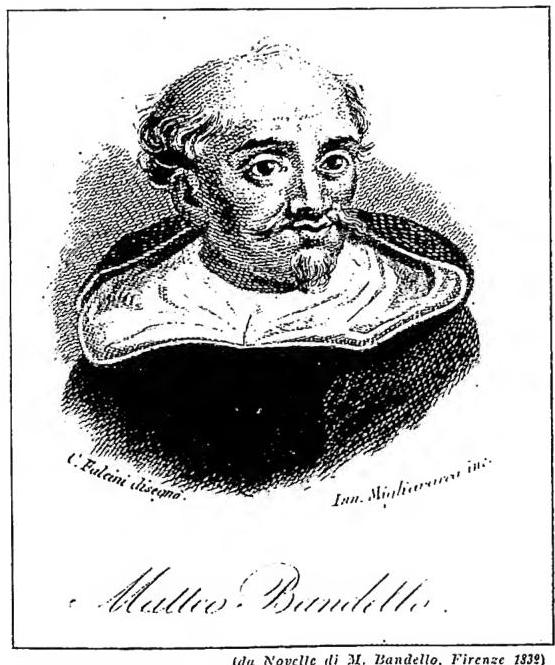
Bandello, Matteo - Portrait. Drawing by C. Falcini.
BANDELLO, MATTEO - Portrait. Drawing by C. Falcini.
A Petrarchan poet of some effectiveness in his Rime, in which a group inspired by the very young Lucrezia Gonzaga stands out, Bandello owes his importance in literary history to the Novelle. Published during the author’s lifetime in Lucca in 1554 and divided from the outset into four volumes or parts, they are one of the most characteristic works of the sixteenth century. Some of his novellas—like some of Boccaccio’s—have enjoyed extraordinary success: suffice it to recall the stories of Giulietta and Romeo or those of Ugo and Parisina, which Shakespeare and D’Annunzio took as their starting point.
In Bandello, the describer prevails over the artist, and as a result, historical documentation takes precedence over the narrative itself. Historical figures and distant events come alive in his dense pages; but even more so, men and events of real life, which the practiced eye of the contemporary scrutinizes and reveals without veils.
Departing from the Decameron schema, so widespread in the 1500s, Bandello leaves his two hundred fourteen novellas independent of one another, prefacing each with dedicatory letters in which, among other things, he explains how and where the novella was previously narrated, thus recreating the color of the times around the work. From a religious standpoint, his work seems to undermine the very foundations of morality: licentiousness, in this ecclesiastic, moves from words to a disregard for sacred things, from Boccaccian laughter to the most unbridled immorality.
Works: Tutte le opere di M. B., ed. F. Flora, Milan 1934-35.