
BARTOLOMEI, Enrico (Henricus de Segusio or Segusia; Hostienis). — Decretalist, born in Susa (Turin), died 25 Oct. 1271. He studied in Bologna, where he also initially attended civil law courses. He later taught law in Paris. First consecrated bishop of Sisteron, he became archbishop of Embrun and in 1261 was named cardinal bishop of Ostia, whence his epithet Hostienis, by which he is also known.
His Summa decretalium, based on the Decretals of Gregory IX, was called Aurea for the clarity and density of its scholarly information. Written around the mid-13th century and issued in several editions, it is notable for introducing a new method of textual exposition, abandoning the old system of simple exegesis, which consisted mainly in the addition of glosses or notulae to the text. The new method is described as follows:
“First, by setting out the case or stating the literal sense; second, by reading the text and explaining and even construing it if it appears difficult; third, by adducing similar passages; fourth, by adducing contrary ones and resolving and distinguishing them; fifth, by raising questions and determining them; sixth, by noting the points to which and the manner in which the decretal should lead.”
It should be noted that this method had already been anticipated by the decretists and later became the standard method of instruction in German law schools in the first half of the 14th century (cf. G. Kauffmann, Geschichte der deutschen Universitäten, Stuttgart 1888-96, II, pp. 347-48). Taken up in Italian civil-law schools, it formed the basis of the new approach of the commentators or Scholastics, whose principal representative was Bartolo, and was encapsulated in the distich:
“Praemitto, scindo, summo casumque figuro;
perlego, do causas, connoto et obicio.”
The Summa of the Ostian contains a notable appeal to civil-theoretical principles, and for this reason is a valuable source for reconstructing the general juridical doctrine of the time. It also reveals an early attempt to modify the school of civil law through the equitable spirit of the age. Bartolo has moreover been identified as the leader, within canonistic doctrine itself, of the equitable approach in opposition to the more rigid school led by Sinibaldo dei Fieschi (later Pope Innocent IV), who advocated strict interpretation of norms (cf. B. Kuhlmann, Der Gesetzesbegriff beim hl. Thomas von Aquin im Lichte des Rechtsstudiums seiner Zeit, Bonn 1912, p. 22). For his profound knowledge of both laws he was called monarcha utriusque iuris. In his polemic with the civil lawyers he particularly opposed the glossator Giovanni Bassiano and his pupil Niccolò Furioso.
He also wrote a Lectura on the same Gregorian decretals, composed with great erudition. This work is later than the Summa and appears to have been elaborated after 1268. He also left a Commentary on the Novellae constitutiones of Innocent IV, and finally a Tractatus super electione completed by Guglielmo de Mandagoto.
Bartolomeo, saint. — Benedictine abbot of Marmoutier (Tours) from 1063 until his death in February 1684, noted for his learning and reforming activity. His name appears in some ancient martyrologies, but there is no trace of any ancient cult paid to him.
Bartolomeo degli Amidei: V. SETTE FONDATORI DELL'ORD.
Bartolomeo Anglico or of Glanville. — English Franciscan of the 13th century, distinguished philosopher, theologian and naturalist. He studied in Oxford, as revealed by his scientific formation, and then went to Paris, where he expounded the entire Sacred Scripture “cursorily.” Bachelor of the Bible at the university in 1230, he was sent by his minister general, Brother Giovanni Parenti, as a lecturer in the Studium at Magdeburg in Germany. There he was received with great honour in 1231 and seems to have carried on his activity as teacher, preacher and writer until his death.
The fruit of his university life and teaching is the De proprietatibus rerum, an encyclopaedic work in 19 books, in which he gathered all the learning of his age. The enthusiastic reception it met with in the Middle Ages is attested by the many manuscripts preserved in various libraries and by the numerous editions and translations made in the following centuries. For this work Brother B. earned the title “Doctor proprietatum” and “first great encyclopedist of the Middle Ages.” The 14th-century Brother B. of Glanville seems to be a duplicate of our Brother B. Anglico, who may have been of Glanville or Glaunville descent.
Giovanni Odoardi
Bartolomeo (Βαρθολομαῖος, Bartholomaeus), APOSTLE, saint. —
I. Sacred Scripture
One of the twelve apostles in the New Testament, named only in the lists of the Synoptics (Mt. 10:3; Mk. 3:18; Lk. 6:14), where he is paired with Philip, and in Acts 1:13. The name is a patronymic whose double element is Aramaic: Bar-Talmai, “son of Talmai.” Talmai occurs in the Bible as a non-Jewish name (Josh. 15:14; 2 Sam. 3:3 and 13:37, a king of Geshur), the Septuagint renders it Θολμαῖ and Θολμαῖ (Vulgate: Tholmai and Tholmai) and Josephus Θολμαιστός (Ant. Jud., XIV, 8, 1; XX, 1, 1; Bell. Jud., I, 9, 3; these are Syrian personages), perhaps by assonance with Πτολεμαῖος. Syriac texts write Bar Talmai.Although patristic tradition is silent on the matter, B. is very probably to be identified with Nathanael (q.v.), of whom only the Fourth Gospel speaks, placing him among the apostles (Jn. 1:45-51: called after Andrew, Simon, Philip; 21:2: listed after Peter and Thomas, before the “sons of Zebedee”). The first to propose this identification, though in a tentative form, were among the Syrians Išo‘dad of Merw (9th cent.), and among the Latins Rupert of Deutz (d. 1129; PL 169, 273); later the hypothesis was supported by Cornelius Jansen of Ghent, A. Salmeron, Cornelius a Lapide, A. Calmet, and deliberately upheld by two Jesuits: J. Roberti (1620) and the Bollandist Joh. Stilting (Acta SS. Augusti, V, Antwerp 1741, pp. 1-34), and today it is commonly accepted (J. Knabenbauer, J. Belser, E. Le Camus, M.-J. Lagrange, F.-M. Braun, U. Holenstein, Th. Zahn, F. Prat, Th. Innitzer, etc.).
Nathanael ("He has given" [i.e., God], a meaning identical to Mattaj and Mattijah) was likely his personal name, while B. was his surname (as with Simon Barjona). He was a Galilean from Cana (John 21:2; cf. 2:1), where a church is now dedicated to St. B. From the Johannine account of his call to apostleship, he appears to have been of a reserved and thoughtful disposition. Brought to Jesus by Philip, he is praised by the Lord (2:47, "Behold, truly an Israelite in whom there is no deceit") who reveals His secrets to him, prompting him to make a profession of faith that foreshadows Peter’s (Matt. 16:16): "You are the Son of God, You are the King of Israel" (John 1:49). He is also present at the appearance of the Risen One on the lake (John 21:2). With the apostolic college, B. receives the Spirit at Pentecost (Acts 1:13).
His subsequent apostolate must have been very active, since later tradition attributes long missionary journeys to him, though nothing precise can be established.
Eusebius (Hist. Eccl., V, 10, 3: PG 20,456) relates that Pantenus (around the year 200) found the Gospel of Matthew in Hebrew (Aramaic) in India and was told it had been brought there by B.; this is repeated by St. Jerome (De vir. ill., 36: PL 23,651). However, it is unclear whether "India" refers to the regions near
his daughter, he was martyred: crucified, according to the widespread Eastern tradition; beheaded, according to the Martyrologies of Rabanus Maurus, Ado, and Usuard (PL 110, 1164; 123, 185; 124, 394). The flaying of St. B. is attested by St. Isidore of Seville and the Martyrology of Bede (PL 83, 1291; 94, 1016) and is commonly accepted among Latins from the late Middle Ages onward (though J. de Ribera [1588–1652] painted his flaying twelve times [K. Künstle, p. 117]). His relics were translated to Martyropolis or Majafàrqia by Bishop Marùta (c. 410), then to Dara in Mesopotamia (or Anastasiopolis in Phrygia?) by Emperor Anastasius I (c. 507; Theodorus Lector, 2, 57; PG 86, 211). Victor of Capua, in the Codex Fuldense, places them in Phrygia (c. 546), then they appear at Lipari (c. 580), Benevento (838), and today are venerated in Rome at St. Bartholomew-in-the-Island, allegedly brought there by Otto III (983). St. Gregory of Tours recounts the miraculous translation of St. B.’s body to Lipari (De gloria mart., 33; PL 71, 734); Theodorus Studita (PG 99, 800 sg.) and Nicetas of Paphlagonia (PG 105, 213–17) describe its journey from Armenia to Lipari and Benevento; Nicetas is reproduced in the *Eucomium* of St. B. by the monk Joseph (Vat. gr. 984; 9th–10th c. palimpsest, ff. 90–95, 265–71). The feast of St. B. is celebrated by the Byzantines on June 11, by Latins (at least since the 8th c.) on August 24, by Armenians on December 8 and February 25, and by Copts and Ethiopians on June 18 and November 20.
I. Lévy (contradicted by J. Halévy) and B. Heller derive from the Christian tradition about B. the Talmudic legend (Mé’liàh, 17b) of the demon Ben-Temalion, and both recall Indian sources.
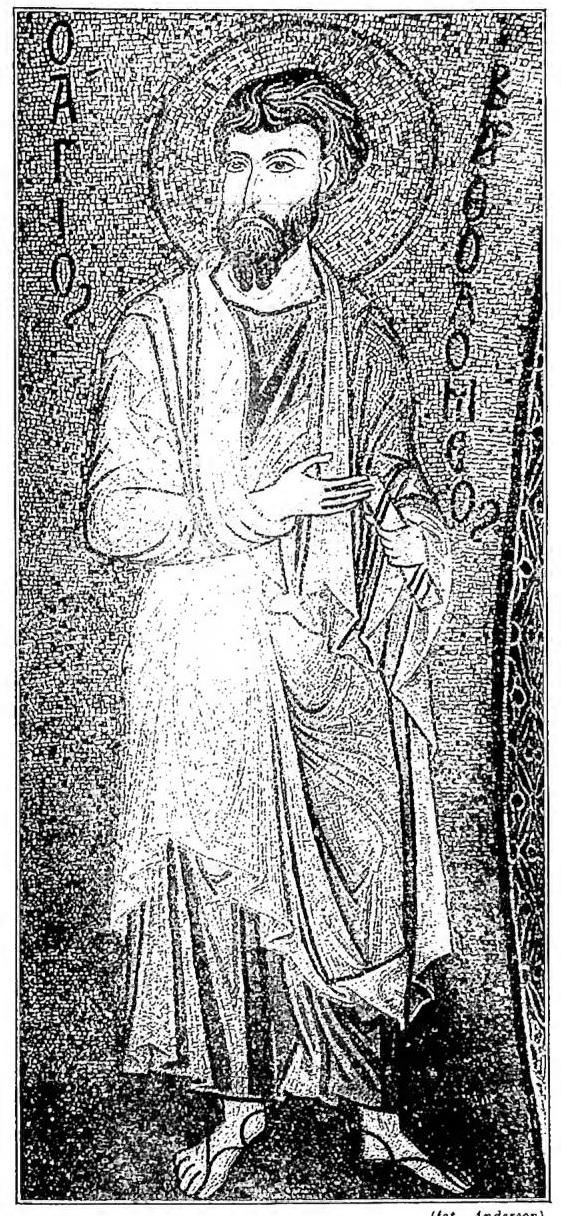
II. ICONOGRAPHY
Originally, he is depicted holding a book or scroll, symbols of his apostolate; from the 13th century onward, a knife—the instrument of his torture—and his own flayed skin. The earliest representations of the saint are found in some mosaic medallions in Ravenna (5th–6th c.) and in a fresco in Santa Maria Antiqua in Rome (c. 705). Later iconographic sources include a relief in the church of the same name in Rome (12th c.), a statue in Mainz (c. 1250), another by Michelozzo in Montepulciano, and the realistic sculpture by Marco d’Agrate (1562) in Milan Cathedral, as well as Michelangelo’s famous figure in the *Last Judgment* in the Sistine Chapel, where the painter’s self-portrait appears in the flayed skin hanging from the saint’s left hand. Apart from isolated episodes traceable to the 9th c., a 14th-century stained glass window in San Francesco in Assisi depicts "stories" from the legend of B. The horror of his martyrdom inspired most artists who illustrated the scene, particularly those of the late German Gothic period (e.g., Strigel, Holbein the Elder); the subject also appealed to Baroque artists (Mattia Preti, Salvator Rosa, and Ribera, who painted it twelve times), both for its dramatic expression and for the anatomical study it afforded.III. ST. B. IN FOLKLORE. — A popular poem was composed about the saint. Indeed, a *Historia et Oratione di S. B.* and a *Devotione* beginning *Donami gratia omnipotente Iddio* are recorded in the appendix to Clement XI’s Index of Prohibited Books. The life of St. B. inspired a "maggio," a popular folk play from the Tuscan Apennines, of which several editions from the mid-19th c. are known. A *Vita e morte di S. B.*, a "comedy in three acts for puppet theaters" (Novara 1859), may also be mentioned. In Isère, the saint is invoked by the people against fear, especially to dispel it from children. For this purpose, pilgrimages are made to his chapel in Favarges on his feast day, August 24. The blessing of salt for livestock is also performed there.
IV. PASSION (MARTYRDOM) OF B
A writing (5th or 6th c.) narrating the mission and martyrdom (beating, then beheading) of the apostle St. B. in India, sometimes called the *Acts of B.* Two distinct recensions survive: one Greek (*Martyrium Bartholomaei*) and one Latin (*Passio Bartholomaei*); the original may have been Syriac. R. A. Lipsius noted traces of Nestorianism in II. Against Lipsius, M. Bonnet demonstrated that the Latin text (preserved in many manuscripts from the 8th to the 20th c.) is original compared to the Greek (a single 13th-c. manuscript).
V. GOSPEL OF B
Apocryphal work, composed in the Egyptian Gnostic milieu (3rd century), belonging to the group of esoteric pseudepigrapha with an apostolic background, in which the risen Jesus reveals to an apostle a mysterious point of Gnostic doctrine. It is cited by St. Jerome (*Comm. in Matth., prol.* PL 26, 17), by the Gelasian Decree (E. V. Dobschütz *Texte u. Untersuch.*, 38, IV), Leipzig 1912, pp. 11 and 51; by St. Bede (*Comm. in Lucam*, I, 1: PL 92, 307); in the East, by Ps.-Dionysius the Areopagite (*Myst. Theol.*, I, 3: PG 3, 1000) and by the monk Epiphanius (12th century) who invokes the testimony of B. for the testament of Mary (*De vita SS. Deiparae*, 25: PG 120, 213). However, all trace of it had been lost, and the Gospel of B. was commonly identified with the Gospel of the Hebrews, taken to India by B. and found there by Pantaenus, according to Eusebius (*Hist. Eccl.*, V, 10). The Gospel of B. was substantially reconstructed between 1863 and 1913; a normal recension is known (important fragments in Greek, Slavonic, Latin), and a divergent Coptic recension. The apostle B. questions the risen Jesus on various mysteries, especially on the descent into hell (narrated at length), or asks Mary for details about the Incarnation. Finally, the final struggles between Christ and his adversary are foretold. According to J. Kroll, in the “Interrogations of B.” the first mentions of the descent-battle of Jesus into hell are found. The original work seems to have been composed in Greek in the 3rd century (according to J. Kroll in the 2nd), in a Christian sect detached from the Church of Alexandria.A. Wilmart and E. Tisserant published (1913) the Greek text (fragmentary) from no. 13 of St. Sabbas (now in Jerusalem), dating to the year 1000. The Slavonic text (“Interrogations of the holy apostle B.”) was edited by Tichonravov (1863), and Vassiliev published a parallel Greek text (1893); N. Bonwetsch used (1897) a similar text in Slavo-Serbian dialect. The primitive Greek text can largely be restored with the help of the two Slavonic texts.
Discovered by Card. A. Mai (1854), Latin fragments (in the *Cod. Vat. Reginensis*, 1050) were published by A. Wilmart and E. Tisserant. U. Moricea published a new Latin text (ms. 1880, 11th century, from the Casanatense Library): *Interrogatio beati B. apostoli, vel aliorum apostolorum cum Domino Jesu Christo*. Of different context are the Coptic fragments (Sahidic) which seem to constitute five or more derivations from a common text of the 5th or 6th century, composed from Greek sources. They are sometimes called the *Apocalypse of B.* They were published by E. Dulaurier (1835), by A. Harnack and Schmidt (1891), by P. Lacau (1904), by E. Révillout (PO 2, 2, 123-98, and *Revue Biblique*, new series, I [1904], pp. 167-87, 321-55), by R. de Rustafjaell (1909), and by E. A. Wallis Budge (1913).