
SEVEN FOUNDERS OF THE ORDER OF THE SERVANTS OF MARY, saints
I. THE SEVEN FOUNDERS OF THE SERVANTS OF MARY. Painting by G. M. Crespi, called lo Spagnolo (17th century). Bologna, church of S. Maria dei Servi.
The earliest literary testimony of this legend in the East is found in a 5th-century Syriac text cited by Dionysius of Tell Mahre and Jacob of Serugh (d. 521), who reworked the legend poetically. In the West, the cult of the Seven Sleepers had already spread to Gaul by the 6th century. Gregory of Tours (538–594) knew the legend in two versions (cf. MGH, Script. rer. Merov., I, pp. 550–52 [Glor. mart., 94], 848–52 [Passio]). Theodosius II (408–450) is said to have built a basilica over their cave in Ephesus.
No one, except for a few devoted hagiographers, defends the historicity of the account. The pious romance of the Seven Sleepers, moving from the realm of literature into that of liturgy, nevertheless, their cult did not originally continue a religious practice of Greek polytheism (cf. H. Delehaye, op. cit. in bibl., p. 177 ff.). The Seven Sleepers—Maximian, Malchus, Martinian, Dionysius, John, Serapion, and Constantine—are commemorated in the Roman Martyrology on July 27. The Menologion of Basil commemorates them on October 23, but instead of Malchus and Serapion, it lists Hyamblichus and Antoninus.
The Qur’an (Sura 18:8 ff.) and the hadith (tradition) refer to them as *ahl al-kahf* or *aṣḥāb al-kahf*, meaning “the People of the Cave.” Their legend is used to affirm the truth of the resurrection of the flesh, as in Christian doctrine. This sura is recited every Friday in the mosque. An ancient tradition teaches that this weekly recitation repairs the breaches made in the wall of Gog and Magog (cf. Qur’an 18:93; 21:96) by the barbaric hordes of the same name, whose irruption is to bring about the end of the world. An eschatological event whose precursors are described in the rest of the sura, and whose day the prayers of the faithful are meant to avert. An ancient hadith of Muhammad b. Khālid of Khuttal, a disciple of Kūfah,
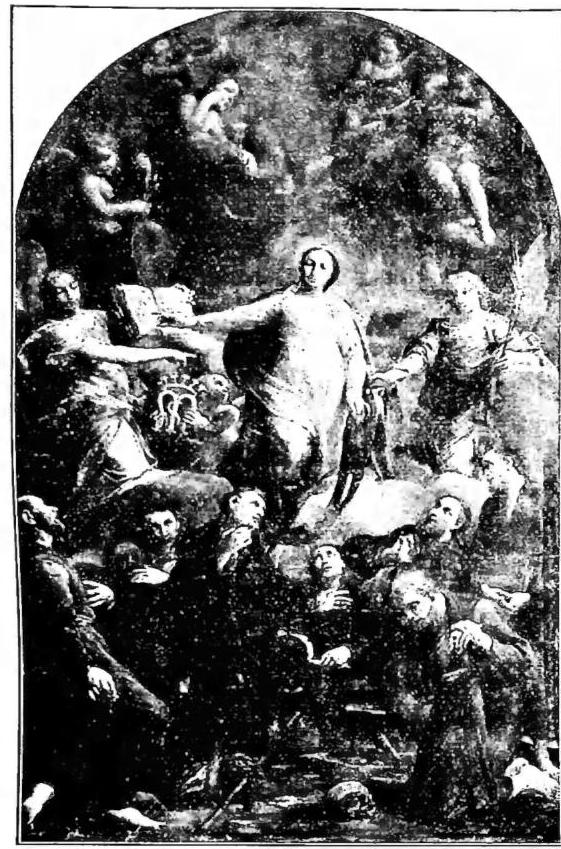
The Seven Founders of the Order of the Servants of Mary, saints. Painting by G. M. Crespi, called lo Spagnolo (17th century). Bologna, church of S. Maria dei Servi.
was widely believed that the Order had been suppressed by the Second Council of Lyon (1274), though it was shown that the institution had repeatedly been revived by the popes since 1256 and 1263. St. Alexis (d. 1310 at the age of 110) lived to see the complete triumph of the new religious family, with the definitive papal approval of the Order (February 11, 1304), which was later granted the privileges of the mendicant orders.
They were collectively venerated from the 14th century onward, but only the cult of St. Alexis was confirmed *ab immemorabili* on December 10, 1717, as blessed, and that of the other six on July 30, 1725 (cf. Benedict XIV, *De Servorum Dei beatificatione*, lib. II, xxiv, nn. 143–145, 161–66 and lib. IV, part 2, xviii, n. 15). Later, however, following new miracles obtained through their collective invocation in the last decades of the 19th century, Pope Leo XIII canonized them on January 15, 1888. Their feast is celebrated on February 12.