
BETHLEHEM (Hebr. Béth-léhem = “house of bread”; Gr. more commonly Βαθλοτέμ with Βαθλοτέμ; Vulg. Bethlehem; Arab. Bajt-lahm = “house of meat”). — A city of the tribe of Judah, where Jesus Christ was born. It is situated 8 km south of Jerusalem, on two hills 777 m above the level of the Mediterranean and 1267 m above the Dead Sea.
**CONTENTS:**
I. History
II. The Basilica of the Nativity
III. The Cave of the Nativity.I. HISTORY
In the letters of el-Amarna (290, 16, ed. J. A. Knudtzon) a city near Urusalim (Jerusalem) named Bit-ilu-NIN-IB is mentioned, and since in a list of Babylonian deities NIN-IB is a synonym of Labam(u), the hypothesis has been proposed (cf. O. Schroeder, Orientalistische Literaturzeitung, 18 [1915], col. 294 ff.), accepted by many, that the name of B. derives from Bit-ilu-lahm = house of the god Labam.Of B. we know only what the sacred texts tell us. It can however be affirmed that the ancient city stood on the summit of the north-western hill, and the shift toward the south-east is explained by the attraction exerted by the sanctuary of the Nativity. It is surnamed Ephrata, a name more properly applicable to the region inhabited by the clan of Ephrathah, composed of the families of the three sons of Hur the Calebite, Shobal, Salma and Hariph, respectively called the “fathers” of Beth-karib-jearim and Beth-gader (cf. 1 Chron. 2:51-54; 4:4; Eusebius, Onomasticon, 42:10; 82:10; cf. Klostermann), that is, inasmuch as the Ephrathite line of Caleb settled in those cities and gave the name Ephrathah to the region; and it is thus that the Ephrathah of Beth-karib-jearim is probably to be identified with the Ephrathah of Ps. 131:6.
In the Bible B. is first mentioned in connection with the death of Rachel (Gen. 35:19; 48:7), but even here it is a question of Ephrathah, whose identification with B. is considered by many to be a gloss. In Ruth 1:1-2; 4:11, as in Mic. 5:2, the identification of Ephrathah with B. is absolutely certain, because demanded by the context and the parallelism of the phrases; yet it must be noted that even in these passages Ephrathah does not entirely lose its character as a region. More frequent is the surname of B. “of Judah” (Judg. 17:7; 9:19; 1-18; Ruth 1:1; 2:1; 1 Kings 17:12; Matt. 2:1, 5, 6) to distinguish it from another B. in the tribe of Zebulun (Josh. 19:15). The name of B. is missing from the list of cities of Judah given by the Masoretic text in Josh. 15:21 ff., but it is found with ten other cities in the Septuagint addition (cf. Josh. 15:59 a).
In Judg. 17:7-13 the story is told of a young Levite from B. of the family of Micah; yet there is no reason to suppose that B. was a Levitical city: it is missing from the list in Judg. 21 and 1 Chron. 6:54-81. The wife of the Levite from Ephraim, who was cut to pieces by her husband after the outrage committed against her by the men of Gibeah, was also from B. (Judg. 19); but the renown of B. in ancient Israel derives from its being the home of the lineage of David (Ruth 4:17-22), who was anointed king by Samuel (1 Kings 16:13), and for which reason it is also called the city of David (1 Kings 20:6; Luke 2:4, 11). In the continual guerrilla warfare between David and the Philistines, the latter succeeded in taking B., which at that time appears to have been organized for defense (2 Kings 23:14 ff. = 1 Chron. 11:16 ff.), but the Philistine occupation must have been short-lived. Later it is mentioned among the fortified cities built by Rehoboam (2 Chron. 11:6), and among the places to which the remnants of its people returned after the exile (Esth. 2:21 = Neh. 7:26).
From that time the glories of B. seemed to have faded, reduced as it was to a small hamlet; but according to the prophecy of Isaiah, “there shall come forth a shoot from the stump of Jesse, and a branch shall grow out of his roots; and in that day the root of Jesse shall be raised up as a signal to the peoples” (Isa. 11:1, 10), and in B., according to the oracle of Mic. 5:2 ff., shall be born the Savior of the world (cf. Matt. 2:1, 5 ff.; Luke 2:4 ff., 15; John 7:42): the glory of having given birth to the Messiah shall be imperishable, and its name shall never be erased from history.
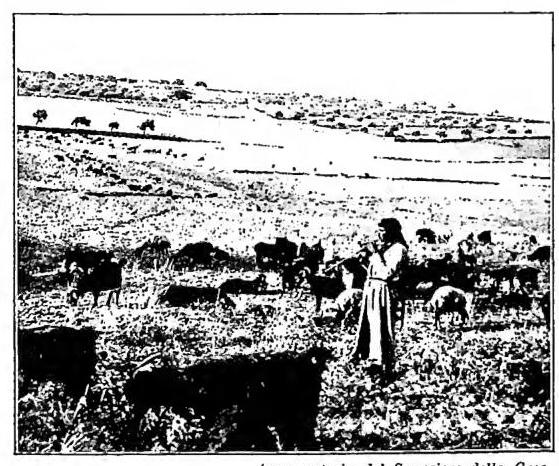
Indeed, the memory of the place of Jesus’ birth in B. remained ever alive in the early Christian tradition, and thus we see that by the middle of the 2nd century the Protoevangelium of James (17:3) along with other apocryphal works, and St. Justin Martyr (Dialogue with Trypho, 78:5) point to the place of Christ’s birth as a cave situated near the city, a detail not recorded in the Gospel. The same is attested by Origen (Contra Celsum, I, 51), who adds that the fact was well known and widely circulated even among pagans. Later, St. Jerome (Epist., 58:3) and St. Paulinus of Nola (Epist., 31:3) speak of the profanation carried out in the Holy Cave by the Emperor Hadrian (117-38), who introduced there the cult of Adonis-Tammuz, together with a sacred grove. The piety of Constantine and St. Helena recognized the cradle of the Redeemer, and fixed for future generations the never-extinguished memory of the Cave of the Nativity by the erection of a splendid basilica (cf. Eusebius, De laudibus Constantini, 9:17; Vita Constantini, III, 41-43), completed already in 333 (cf. Itinerarium Burdigalense, ed. Geyer, p. 25, 3-5). Around the Constantinian basilica monastic life soon flourished, particularly in the time of St. Jerome and his Roman disciples.
During the Samaritan revolt (521-30) B., like other cities, was sacked, and its beautiful basilica suffered, probably on that occasion, the severe fire that nearly destroyed it completely, traces of which were found in the excavations of 1934. When the revolt was quelled by the Emperor Justinian, he ordered the basilica to be rebuilt and the city to be surrounded by new walls. Providentially spared by the subsequent invasions of the Persians (614) and the Arabs (638), it was gravely damaged with the approach of the Crusaders, but the Basilica remained unharmed thanks to the timely intervention of Tancred, who, still at Emmaus, was urgently summoned by the inhabitants of B. and appeared suddenly before the city on 7 June 1099, took possession of it and planted the crusader banner on the church. Two years later, on Christmas night in B., Baldwin I was solemnly crowned King of Jerusalem, and the same rite was performed for Baldwin II in 1118. During the Crusader occupation religious life flourished again in B., and the Latin rite attained its greatest splendor. In 1110 Baldwin I obtained from Pope Paschal II that the priory of B. be elevated to a bishopric, which was done by transferring to B. the see of Ascalon with all its revenues. In 1187 B. was occupied by Saladin, and Christian worship was suppressed, then re-established in 1192 but for a short time, until the truce between Frederick II and the Sultan of Egypt al-Malik al-Kamil (1229) allowed the return of Christians. A new persecution occurred when in 1243 the hordes of the Khwarazmians swept through Syria and Palestine putting everything to fire and sword; but fortunately the storm lasted only a short time. Such painful vicissitudes, repeated in the centuries that followed, reduced B. to a wretched village, which survived, one might say, only thanks to the perennial vitality of its Sanctuary. When in 1834 Ibrahim Pasha punished the rebellion of the Muslims of B. by destroying their quarter, the city remained almost entirely Christian and soon began to flourish again, acquiring the cheerful and attractive aspect that distinguishes it today.
Today B. is a small town of about 7,500 inhabitants, of whom nearly half are Latin Catholics, and the rest are Greek Orthodox, Syrians, Armenians, Copts,
Some Protestants, and a few hundred Muslims. Besides the Franciscan Fathers who have the parish, schools for children, and the “Casa Nova” for pilgrims, there are several religious institutes of both sexes, which are particularly devoted to teaching and charity.
II. The Basilica of the Nativity
The old problem that set two theses in opposition—both defended by eminent archaeologists (integral Constantinian origin of the present Basilica, or remodelling carried out in Justinian’s time in the 6th century)—has received a decisive answer, favourable to the second thesis, after the explorations conducted both in the area of the original atrium (1932) and within the basilica itself, especially underground (1934), under the direction of E. T. Richmond and R. W. Hamilton in the first case, and of E. T. Richmond and W. Harvey in the second.1. The Constantinian Basilica
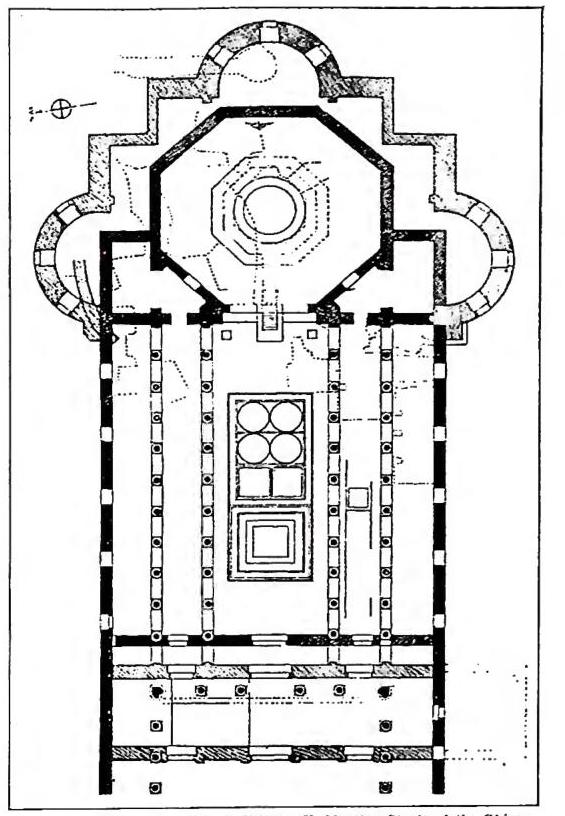
The result of these systematic explorations makes it possible to reconstruct with sufficient accuracy the Constantinian buildings, which consisted of three main parts: an octagonal structure above the Grotta della Natività, the basilica proper, and the atrium.The octagon, measuring 7.80 m on each side and 18 m on the major axes, rose like a crown around the sacred spot of the Nativity, and in its centre had a circular opening 4 m in diameter, reached by two steps that followed the octagonal outline of the building. This opening, surmounted by a precious baldachin and protected by a small parapet, allowed the faithful kneeling around it to see and venerate from above the Holy Grotto and the altar erected over the place of Christ’s Birth. On the western side of the octagon, which was open with a triumphal arch, stood the basilica hall, formed by a square of about 27 m on each side, divided into five naves (the central one 9.20 m wide, the other four 3.40 m) by four rows of monolithic columns, ten in each colonnade. The external longitudinal walls of the Basilica extended eastward for about 7 m beyond the basilica square, then turned at right angles to reach the northern and southern sides of the octagon respectively. In this way, two almost triangular spaces were created on either side between the octagonal structure and the side naves of the Basilica, serving liturgical purposes, while at the same time giving a more harmonious union between the octagon and the Basilica. Beneath the triumphal arch was a staircase leading down to the Holy Grotto, while two other staircases on the north and south sides of the upper altar facilitated the movement of the faithful.
In front of the façade of the Basilica, which was accessed by three doors corresponding to the three central naves, stretched the vast quadriporticus atrium, 73 m long and 26 m wide. The covered galleries were of proportions equal to those of the outer naves of the Basilica, whose lines extended as far as the western portico, but with wider intercolumniations. This extraordinary width of the Constantinian atrium, architecturally disproportionate, is well explained if one considers the need to provide sufficient shelter for the enormous crowds of pilgrims who flocked to Bethlehem for the Christmas solemnity. At the south-eastern outer corner of the atrium there was probably the Baptistery, but this has not been confirmed.
The considerable remains of the opus musivum pavement that have come to light, particularly in the central nave and on the north side of the octagon, show in their composition, design, and execution a technique later than the Constantinian period, which can be dated to the end of the 4th or the beginning of the 5th century. The same conclusion is supported by comparison with other Palestinian mosaics of similar date, as well as by careful study of the way in which the mosaic was adapted to the worn parts of the thresholds of the Basilica and the Grotto.
2. Justinian’s Reconstruction
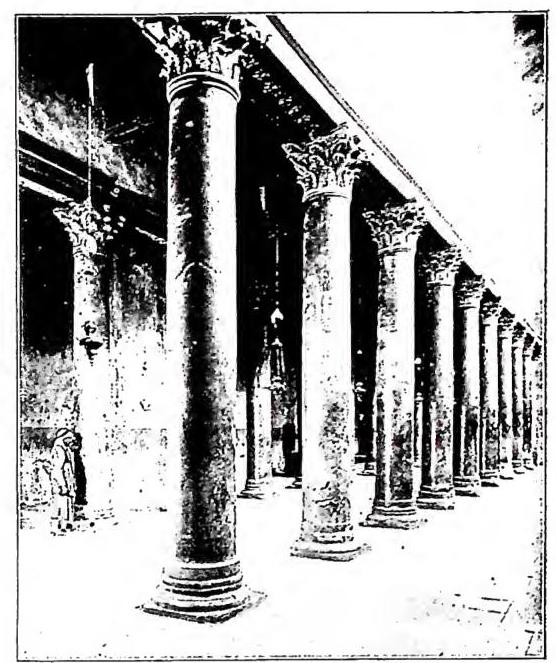
Following a very serious fire, probably during the Samaritan revolt, the basilica of Bethlehem was almost completely destroyed. The emperor Justinian ordered its reconstruction, conceived according to new architectural criteria, especially under liturgical influence. The basilica area gained greater breadth and complete unity by the elimination of the octagonal structure and the shifting of the inner façade a few metres further west, with the addition of the narthex.With the complete suppression of the octagon, a transverse nave was created to the east of the former basilica square, as wide as the central nave, closed at the ends by two semi-circular apses projecting beyond the vanished longitudinal walls. A third apse, symmetrical to those of the transept, arose at the end of the central nave, 8 m beyond the former octagon, to achieve the proper proportions. The free arms of the three apses were connected by walls with double right angles. Beyond the crossing, the naves reappeared, the outer side ones with a single bay, the central one with two of different widths. The ideal centre of the Sanctuary underwent no notable changes, the circular opening over the Holy Grotto remaining, as did the central staircase—raised by only three or four steps because of the difference in level—and the two side staircases.
At the western end of the basilica square, the ancient façade having completely disappeared, a new bay slightly wider than the others was added; then came the narthex or vestibule, 5.50 m wide, so that the new façade was situated about 10 m further west than the old one. The atrium was reduced to about half its former length (c. 10 m) due to the restrictions imposed by the aforementioned constructions, and by a connecting section of about 27 m on the western side. The need to provide a solid foundation for the basilica colonnades led to the construction of continuous walls in the manner of a stylobate about 1 m high, which also made it necessary to raise the floor to the level of the column bases, so that what remained of the ancient and precious mosaics was covered by a layer of about 80 cm of heterogeneous backfill.
3. Present Condition
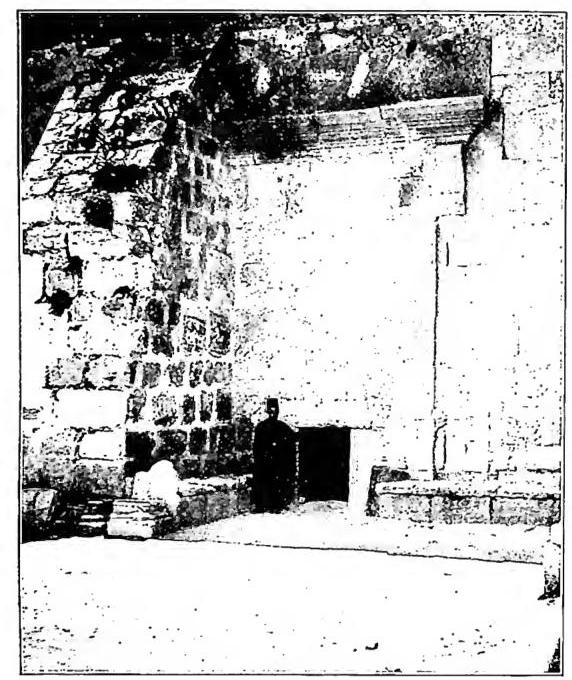
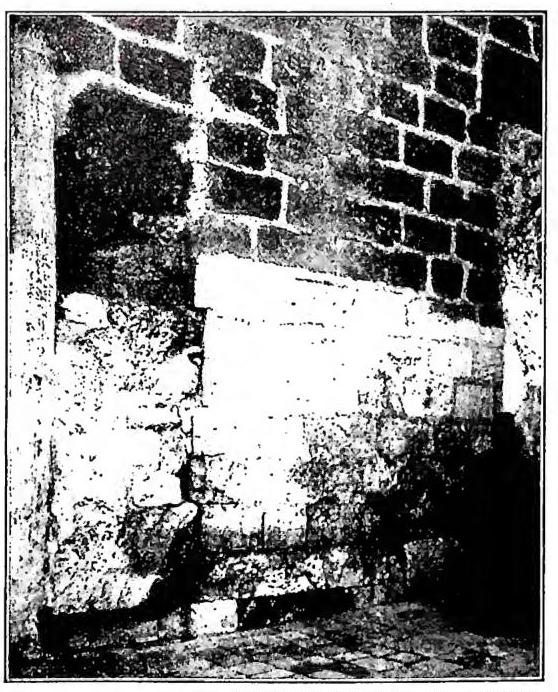
Such is still today the general architectural appearance of the interior of the Basilica, though bare and neglected. Indeed, no changes were made to the interior during the Crusader period. Worthy of special mention, however, is the splendid decoration in mosaic and painting of the internal walls and columns, executed in the time of Amalric I, King of Jerusalem (1163–73), and of Manuel I Komnenos, Byzantine emperor (1143–80), and completed in 1169. Of this outstanding work only a few wretched remains survive. At an unspecified date the staircase that led from the central nave, beneath the crossing, down into the Grotta della Natività disappeared. As for the exterior, already in the time of the Crusaders the façade underwent further remodelling, probably for reasons of greater security, which restored harmony to the whole: the side doors were closed, the central one considerably reduced, and the narthex divided into three compartments covered with groin vaults. Later, the same defensive criteria, together with the encroachment of nearby conventual buildings, further disfigured and almost completely concealed what remained of the façade. Finally, the atrium disappeared altogether, giving way to a simple open space.### III. THE GROTTO OF THE NATIVITY
Today access is gained by two irregular staircases located on the north and south sides of the present Greek Orthodox choir. The Holy Grotto presents the form of an irregular rectangle measuring 12 meters in length by an average of 4 meters in width, excavated in very soft limestone, with the walls reinforced by masonry as well as the entire vault. At the eastern end there is a semicircular niche with an altar beneath which, on the floor, is a silver star bearing the Latin inscription: *Hic de Virgine Maria Iesus Christus natus est* – 1717. A little further back and to the south there is another irregular excavation where the place of the Holy Manger is shown, before which is placed the altar of the Magi. The walls of the grotto, which were once decorated with mosaics, are now covered by an asbestos canvas on which are represented some scenes from the childhood of the Saviour. At the western end of the grotto there opens a small door which communicates with other underground chambers where various sacred relics are venerated. These chambers connect to the north by means of a staircase with the church of St. Catherine, served by the Franciscan Fathers, and where the parish is located.
Since the departure of the Augustinian Canons Regular in the 13th century, the sons of St. Francis have been the zealous guardians of the Catholic Church’s rights over the place of Christ’s birth; but in the relentless struggle which the Greek Orthodox waged repeatedly against Catholics, especially from the mid-16th century onward, every one of their rights—often sealed with generous blood shed upon the very cradle of the Prince of Peace—was overwhelmed by intrigues, abuses, forged signatures, fierce persecutions, and even armed attacks. Left often alone and defenseless when the intervention of Catholic European powers was most needed, the Franciscans saw, with helpless sorrow, one right after another of the Catholics they represented and steadfastly defended to the last wrested from them. Today nothing remains exclusively to them except the Holy Manger and the altar of the Magi with the adjacent grottos to that of the Nativity, where every day a devout commemorative procession is celebrated. Beside the church of St. Catherine and the precious medieval cloister, the basilica of the Nativity, though still majestic in its ensemble, reflects in its squalor, its bare coldness, and its abandonment a spiritual poverty unworthy of the place where the Light of the world appeared in mortal flesh.