
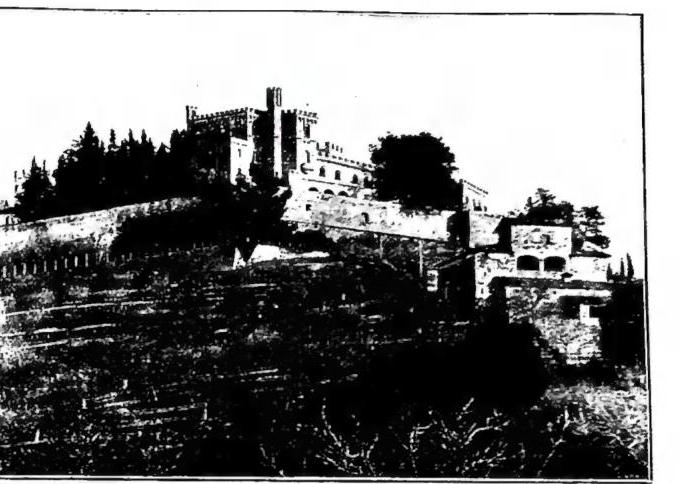
BETTINO R. — Tuscan statesman, b. in Florence on 9 March 1809, d. at the castle of Brolio (Siena) on 23 Oct. 1880.
A man of action rather than of thought, of authoritarian character, exceedingly strict with himself and others; in politics he was always a moderate liberal; sincerely religious, he nevertheless had some rather ill-defined tendencies toward a “reform” of Catholicism.
In his youth he devoted himself to the study of natural sciences; then, retiring to Brolio, he set about a complete transformation of farming methods, while at the same time aiming at the moral and social uplift of his own peasants. By 1847 he was already regarded as one of the leaders of the Tuscan moderate group, and with Lambruschini and Salvagnoli he founded La Patria with an Italian programme and without the usual aversion to Piedmont. In the same year he went on a mission to King Charles Albert to mediate in the diplomatic conflict between Tuscany and Modena. Gonfaloniere of Florence in 1848, he left office at the end of the year, while his attempts in August and October to form a ministry during the frequent governmental crises proved fruitless. In April–May 1849 he took part in the government commission that had assumed power after the fall of Guerrazzi, but Austrian occupation, the direction of the new government, and the attitude of the Grand Duke estranged him from the restored regime. Having gone to Switzerland, he devoted himself entirely to the education of his daughter; then, after the death of his wife Anna Bonaccorsi (1852), he returned to agricultural and industrial enterprises, especially in Malta. In 1853 he openly professed his faith in Italian unity under the House of Savoy. With national views he collaborated in the Committee of the Italian Civil Library (1857–59), but on the eve of 27 April 1859, fearing a demagogic revolution, he took part in the last-ditch efforts of the moderate group to save the Lorrain dynasty. With the fall of the regime, he became Minister of the Interior in May and set about, with imperious will, to overcome his colleagues’ hesitations over the union of Tuscany with Piedmont. Assuming the direction of the government after Villafranca, he did not change his policy and thus achieved the desired union by the plebiscite of March 1860.
After Cavour’s death, he was President of the Council and, besides attending to administrative reform in a centralizing sense, he attempted to solve the Roman Question. The King’s antipathy toward R.’s moral rigorism and the anticlerical spirit of the time helped to create an atmosphere of distrust around him. He resigned in 1862. Returning to power again in 1866, he anxiously followed the ill-starred military campaign, then resumed negotiations on the Roman Question, deluding himself that by solving it he might stir a regenerating movement within the Catholic Church. When this attempt also failed, he resigned definitively in 1867.