
BOCCACCINO, GIOVANNI. —
I. LIFE
Until recently, biographers, following the trail of many purported autobiographical pages, had fashioned for B.’s life, at least up to about his thirtieth year, a rather fanciful existence, blending real events with others that later proved imaginary. Thus, it was believed that he was born in Paris to a Giovanna of royal lineage (some claiming she was a De La Roche, giving credence to the subscription on a letter in Neapolitan dialect that B. wrote); it was also believed that, taken at an early age by his father to Florence, he knew not the affection of his mother—abandoned by his father in France—but the hostility of a stepmother, Margherita de’ Mardoli, and even of a half-brother, Francesco; and it seemed certain that he had been sent to Naples to engage in commerce while still very young (in 1323 according to Della Torre, in 1325 according to Torraca, or in 1328 according to Hauvette). It was said that in Naples, as he grew older, he fell in love with a young woman—himself illegitimate but of royal and French blood on his mother’s side—(in 1331 according to Della Torre, in 1333 according to Torraca, or in 1336 according to Hauvette), a woman likewise illegitimate but, like him, of royal and French blood on her father’s side: Maria de’ Conti d’Aquino, natural daughter of King Robert of Anjou, married to a nobleman of the court, the Fiammetta celebrated in verse and prose, in fanciful tales of love and sorrow, beautiful, seductive, and ultimately also unfaithful, despite the poet-lover’s protests and supplications. But it has now been convincingly demonstrated that such accounts are characteristic of an illustrious literary tradition, by which B., perhaps naturally inclined toward excellence and nobility, was finally seduced. Thus, the most reliable facts about his youth remain these few: his illegitimate birth, though not in Paris but in Tuscany, perhaps in Certaldo rather than Florence; the year of his birth, 1313; his name, given to him by his paternal uncle; his father, Boccaccio di Chelino, a merchant from Certaldo in the Val d’Elsa; the name of his stepmother and half-brothers, Michele, Iacopo, Minacoda, a Donato (?) and perhaps a Francesco who died young; his journey to Naples (though not at the age of ten) and his engagement in commerce (until around 1330?) and then his study of canon law (until around 1336?); his frequenting the Neapolitan court and his friendships with people of high society or with scholars such as Andalone del Negro, an expert in astronomy, and Paolo Perugino, the king’s librarian and lover of classical and mythological texts; his farewell around 1340 to the unforgettable city, which in the springtime of his life had offered him an unparalleled flourishing of joys, perhaps troubled or not by much sorrow, but certainly in art, for it was in Naples that he tested his talents and earned full praise as a poet. After leaving Naples and settling in Tuscany, between Florence and Certaldo, he continued his studies and works, still loving, alternating art and love with journeys he sought himself and with tasks entrusted to him by others. In 1346 he was in Ravenna with Ostasio da Polenta, and in 1347–48 in Forlì with Francesco degli Ordelaffi; in 1350 he went as Florence’s ambassador to Romagna, and from there returned to Ravenna to deliver, on behalf of the Compagnia di Or San Michele, ten gold florins to Sister Beatrice, Dante Alighieri’s daughter. In the same year, he had the good fortune to meet Petrarch in person. In 1351 he served as chamberlain of the Commune of Florence; and from Florence he was sent first to Naples to negotiate the acquisition of Prato, then to the Tyrol to meet Lodovico di Baviera to secure his alliance against Milan, and finally to Padua to Petrarch to announce the restoration of his property and to offer him a chair at the Florentine Studium. In 1353 he was again in Ravenna; in 1354 he served twice as Florence’s ambassador to Innocent VI in Avignon; in 1355 he was appointed to the Ufficio di Condotta, and in 1359 he met Petrarch again in Milan. In 1362 he was lured by an invitation from Francesco Nelli, “spenditore,” and Niccolò Acciaioli, “grand seneschal” of that court, to Naples; but both in Naples and at Tripergoli near Baiae, he was disappointed and left again. He found solace, however, in Petrarch’s company in Venice in 1363, and from Venice he retired to his native Certaldo. But in 1365 and 1367, Florence sent him once more as ambassador to Urban V, first to Avignon and then to Rome; in 1367 he was also in Venice to meet Petrarch, though he did not find him and instead received the most affectionate welcome from the poet’s daughter, Francesca, and her husband, Francescuolo da Brossano, and his granddaughter Eletta, who reminded him of his own daughter Violante—also illegitimate and tenderly loved by him, though mourned in sorrow after her premature death. In the autumn of 1370, he was once more drawn to Naples; from there he was to travel to Calabria as a guest of an old friend, Niccolò da Montefalcone, at that time appointed abbot of S. Stefano in Calabria. But the latter, after extending the invitation, had a change of heart and slipped away, even taking with him a notebook of Tacitus that B. had lent him. Once again disappointed, B. refused all further offers, including those of Ugo, Count of S. Severino, made in the name of Queen Giovanna, and of Giacomo of Majorca, the queen’s husband, and of Niccolò Orsini, Count Palatine. In the spring of 1371, he returned to Tuscany and perhaps even to Certaldo, from which he did not move again except for about a year when, in October 1373, he was called to Florence to read Dante’s *Divine Comedy* in S. Stefano di Badia. He died in Certaldo on December 21, 1375.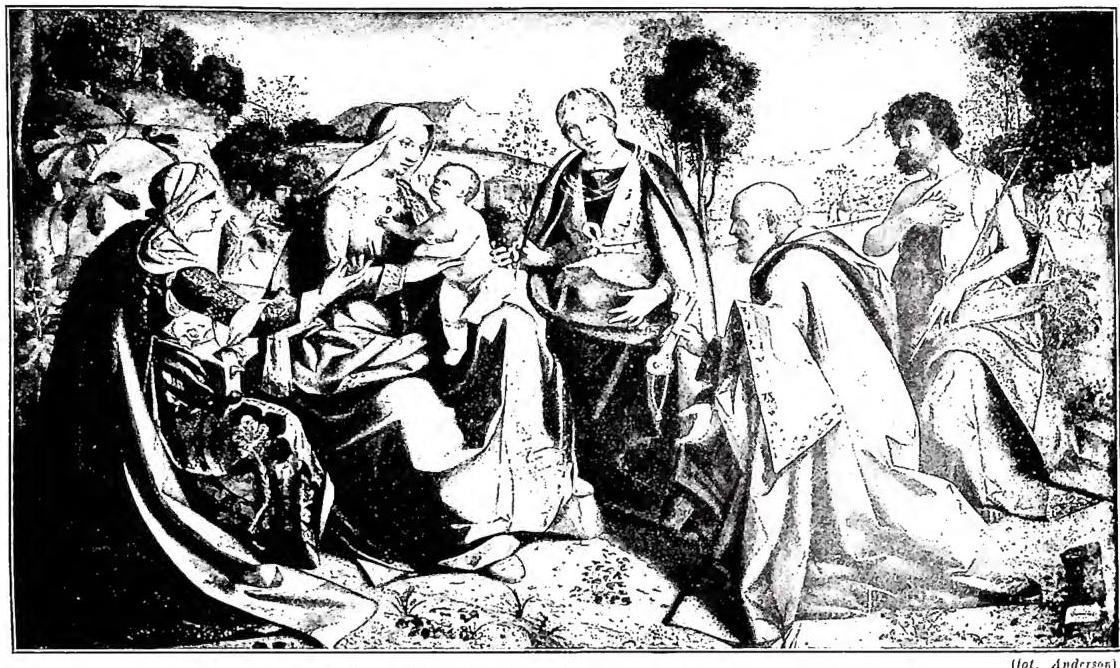
He died alone and poor, as he had been for most of his life, preserving his freedom from compromise in his dealings with men and the intrigues of courts. And he died a good Christian, gradually detached from the world and from the licentious tastes of the world already extolled in the *Decameron*; and for fifteen years (since 1360) he had been deemed worthy—perhaps already as a cleric—of an ecclesiastical benefice that granted him the faculty to receive prebends and care of souls even in a cathedral church, a privilege that would not have been accorded him had his sentiments and conduct not been upright. And for thirteen years (since 1362) he had grown increasingly mindful of this and the next life, following the severe and fearful admonitions delivered by the monk Ciani at the behest of the recently deceased Carthusian Pietro Petroni, in the wake of which he would even have consigned his masterpiece to the flames had Petrarch not dissuaded him.
11. His works
Even with regard to his works, critics, following the footsteps of De Sanctis and Carducci, had made of B. the singer of the human comedy, in contrast to Dante’s divine comedy, and the representative of a new age remotely preparing the way for the modern and contemporary age, which for some would represent the triumph of secularism and idealism together. Thus his figure and his work have been, and still are, either condemned outright by some Catholics or exalted by non-Catholics, whether in the name of this alleged secularist stance or in the name of art, which, if it is true art, is always moral for idealists. But now more than one scholar has proved that things are not quite so. It is quite true that in his works of fiction B. always extols ingenuity with a constant sympathy for those who possess it most, and consequently justifies shrewd and prudent actions even when they are unscrupulous; and it is equally true that he often proclaims the legitimacy of free love, exempt from all law, with a constant sympathy for those who love freely and consequently a polemic against all who would condemn excesses and licentiousness, particularly against religious figures portrayed, to taste, as hypocritical, utilitarian, and lustful. Yet, just as the praise of free love and the satire against religious figures are not isolated voices in the Middle Ages nor peculiar to B. alone, so B. cannot be taken as the standard-bearer of an anti-medieval stance, let alone as a Voltaire ante litteram, both because he lacked speculative qualities and ambitions and because he had instead only moments of unbridled and unprincipled morality; and just as the immoral and irreligious pages do not fill his entire indicted works from beginning to end, but alternate with pages rich in noble and exquisite sentiments, so too the condemnatory stance of B. finds a halt and a redemption even in the vigour of his bodily and mental powers.If one wishes to define the characteristics of B. as a writer, one must say that, in style, he aspires to give to the vernacular the elegance, clarity, and architectural harmony of the Latin and Ciceronian period; and that, in genre, he is, in both works of fiction and works of erudition, the consummate storyteller. Essentially novellas, if not in form, are his works before his return to Florence, i.e., up to about 1340: the first, in 18 cantos in terza rima, the *Caccia di Diana* (c. 1336), describes a hunt led by Diana with some legendary women among whom is the woman loved by the poet, who, as soon as the enterprise is over, no longer wishes to know Diana and consorts with her companions in Venus’s service; the second, the *Filocolo* (1310), in 5 long prose books, recounts the loves, first thwarted and then happily concluded, of Florio, son of King Felice, and Biancofiore, daughter of Quintus Lelius Hadrianus, a descendant of the Scipios and of Julia Topazia, a descendant of Julius Caesar, interspersed with many other tales; the third, the *Filostrato* (1338?), in ottave divided into 9 parts, sings of the unfortunate love of Troilus, son of Priam, for Criseida, i.e., Briseis, daughter of Calchas and a Trojan captive, light and treacherous; and the fourth, the *Teseida* (1339–40?), in 12 books in ottave, presents the sad and undeserved love vicissitudes of Arcita and the happy and undeserved ones of Palemone, two young Theban prisoners in love with Emilia, sister-in-law of Theseus, Duke of Athens and conqueror of the Amazons and the Thebans; in each of these works, and more especially in the *Filocolo*, whether through direct narration or through the allusive vicissitudes of the protagonists, there are interwoven those so-called autobiographical pages in which episodes from B.’s life and his love affairs are presented with a skilful blend of truth and fiction.
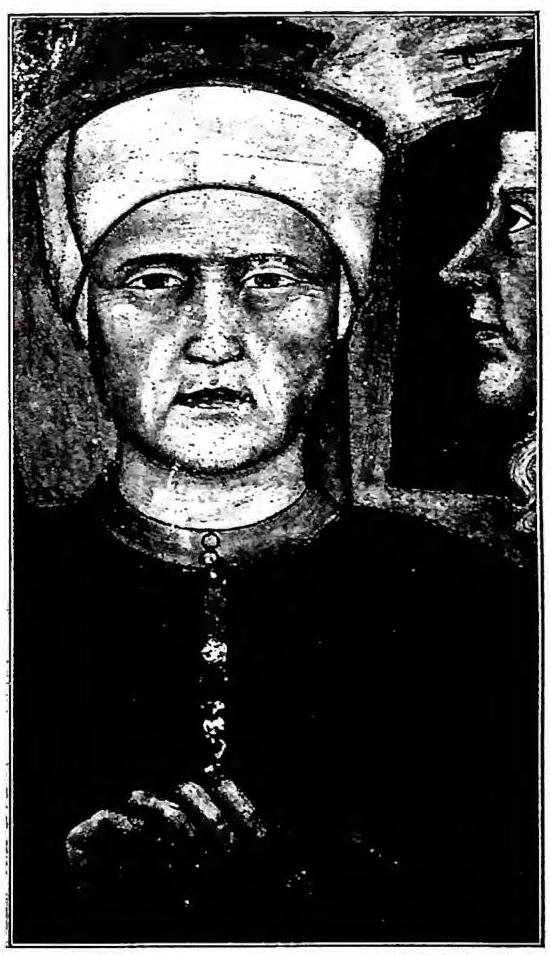
Novellas too are the works after his return from Naples: the first, a mixture of prose and terza rima, the *Ameto* or *Commedia delle Ninfe fiorentine* (1341–42), celebrates the loves of Ameto and the nymph Lia, interwoven with moralising allegories and autobiographical pages in which it will again be difficult to discern the true from the fantastic; the second, in 50 chapters in terza rima, the *Amorosa visione* (1342), through figurations and allegories and still recalling Fiammetta, aims in a Stilnovistic manner to indicate the redemptive virtue of love; the third, in 9 chapters of prose, the *Fiammetta* (1343?), again narrates in a fanciful way the love affair of Fiammetta and the author, but reversing the situation, making Fiammetta, who was once unfaithful, now the betrayed one, and putting into her mouth an invective against unfaithful men in love, whereas in the *Filocolo*, *Filostrato*, and *Teseida* there had been condemnation of the unfaithful woman or even invective against all women, which would later culminate in the *Corbaccio* after the *Decameron*; and the fourth, in 473 ottave, the *Ninfale fiesolano* (c. 1344–46), sings of the great and tragic love of Africo for the nymph Mensola in the environs of Fiesole, with another (according to some, autobiographical) allusion.
All novellas is the *Decameron* (c. 1348–53), the masterpiece; 100 tales told by 7 beautiful young women and 3 young men over 10 days on the hills north of Florence, whither the company had fled to escape the plague of 1348; tales now tragic, now burlesque, now noble, now improper, now long and adventurous, now brief and concentrated into an improvised and happy witticism; drawn sometimes from literary sources and sometimes from oral traditions and episodes of contemporary life, but always freely reworked; and presented within a frame of refined elegance, of persons, settings, and landscapes, according to a taste that first appears in the *Caccia* and then more extensively in the *Filocolo* and *Ameto*. And a novella, finally, is the *Corbaccio* (1354–55), in which, amid visions, figurations, and divine interventions, the previous misogynistic themes are carried to a rabid exacerbation, a bitter revenge against a beautiful widow with whom B. claimed to have fallen in love and by whom he claimed to have been betrayed. Completed, even if not all begun, after the works of fiction are those of erudition. But even the
9. *De casibus virorum illustrium* (1355–60 and revised up to about 1374) are themselves tales and instances of fortune, with a moralistic aim, of ancient and contemporary figures who poorly used prosperous fortune; and the treatise *De claris mulieribus*, written immediately after the *De casibus* and revised up to about 1374 and containing 104 biographies of women from ancient or recent times famous for virtues or vices, has a moralising intent along with pleasant narrative dissemination; and the
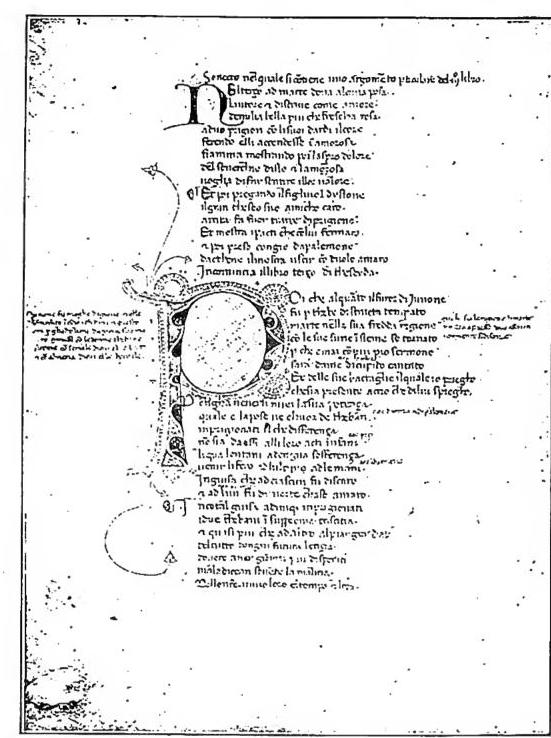
15. *De genealogia deorum gentilium* (begun before 1350, completed in 1360 and subsequently revised) still show the author’s combined narrative and moralistic interest in ancient myths; and to a similar interest must be traced also the *De montibus, silvis, fontibus, lacubus, fluminibus, stagnis seu paludibus, et de nominibus maris liber*, a collection of notices and tales written almost as an appendix to the *De genealogia*; and likewise the numerous marginal notes that B. made to some of his works can largely be attributed to the same taste and the same interest in knowing and making known the tales of others when his creative fervour no longer shone with its former brilliance. This fervour, moreover, never entirely died away, for even the works of erudition, and even in those parts where the author claims to be a direct witness, turn out to be a blend of truth and fiction, as in the *Vita di Dante* (written in a first, longer draft between 1357 and 1362 and then reworked into a shorter and more effective form), and even some parts of the *Comento alla Commedia* (which reaches only to the beginning of Canto XVII of the *Inferno*).
Aside from the terza rima Arguments and the prose Rubrics of the Divina Commedia, and the twenty-four surviving Epistles—some fragmentary and two vulgarized—of little stylistic interest and no more; and aside from his other minor Latin and vernacular writings, including 155 certain and 12 uncertain Rime, mention should be made of the Buccolicum carmen, fifteen eclogues written between 1351 and 1366. In some of these he treats subjects concerning the Kingdom of Naples (III–VI) or Florence (VII and IX); in others he touches more closely on his own life (I, II, VIII, XIV) or Christian faith (X–XI). Alongside the fourteenth, which laments the untimely death of Violante, attention is drawn especially to the twelfth, which contains the resolve, under Petrarch’s guidance, to abandon vernacular poetry for Latin; the fifteenth, which praises Petrarch as a master of virtuous and religious life; the thirteenth, which extols poetry as superior to all earthly goods; and the sixteenth, which, together with the dedication of the work to Albanzani, expresses the author’s weary disillusionment in contemplating his own humble life and reaffirms his faith in the ancient aspiration, the dulcis et ingens libertas. These pages, together with others scattered through his imaginative works that exalt doctrine, ingenuity, and poetry, and those in the De genealogiis or the Vita di Dante or the Comento written in defense of poetry and his love for it—as the soul of the world, a gift of God, and a means of redemption and elevation—must be given particular consideration to understand the man, the poet, and indeed the Christian, who is well presented in the epitaph composed for him and inscribed on his tomb in the church of San Iacopo in Certaldo:
Hac sub mole iacent cineres ac ossa Yohannis.
Mens sedet ante Deum, meritis ornata laborum
mortalis vitae. Genitor Boccaccius illi,
patria Certaldum, studium fuit alma poesis.
— V. Tav. CII.
For the fortuna of Boccaccio and his works v.: F. Zambrini and A. Bacchi della Lega, Bibliografia boccaccesca. Serie delle edizioni delle opere di G. B., latine, volgari, tradotte e trasformate, in Propugnatore, 8 (1875); G. Traversari, Bibliografia boccaccesca. I. Scritti intorno al B. e alla fortuna delle sue opere, Città di Castello 1907; V. BANCA, Linee di una storia della critica al Decameron, Milano 1939; and, as an excellent example of the fortuna of the Decameron—albeit limited to the first novella—V. L. Fassò, Saggi e ricerche di storia letteraria, 1914, pp. 31–90.
For biography v.: H. Hauvette, B. Étude biographique et littéraire, Paris 1914; C. Grabher, B. Torino 1941; and for many new corrections, G. Billanovich, Restauri boccacceschi, Roma 1945 and 1950; and V. BANCA, Schemi letterari e schemi autobiografici nell’opera del B., in La bibliografia, 49 (1947).
For understanding the man and his work, in addition to the books already cited, see: B. Croce, La novella di Andreuccio da Perugia, Bari 1911; id., Il B. e il Sacchetti, in Poesia popolare e poesia d’arte, 1913, pp. 81–105; U. Bosco, B., Rieti 1920; A. Schiaffini, Il B., in Tradizione e poesia, Genova 1934, pp. 243–87 and also pp. 218–42 (2nd ed., Roma 1943, pp. 167–97 and also pp. 151–166); N. Sapegno, Il B., in Il Trecento, 2nd ed., Milano 1942, pp. 276–400; A. Chiari, Polemica sul B., in Indagini e letture, Città di Castello 1946, pp. 35–87; G. Billanovich, La leggenda di Dante del B., in Prime ricerche dantesche, Roma 1947, pp. 20–86. — Among commentaries: A. Momigliano, Quarantanove novelle commentate, Milano 1924; and L. Russo, Venticinque novelle del Decameron, Firenze 1939.